Blackmagic Gen 6 Color Science: URSA Cine 12K Guide
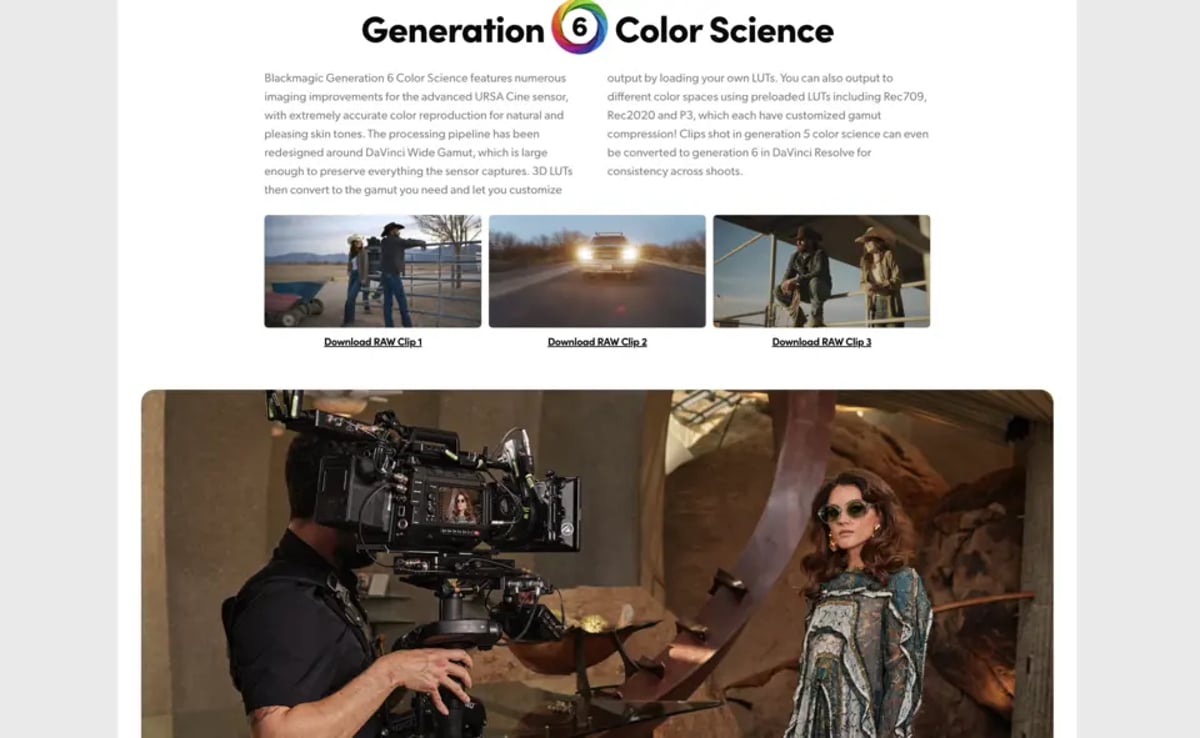
Blackmagic Design announced the Blackmagic Camera 10.3 update on September 14, 2026, and with it the first new color science the company has shipped since Generation 5 arrived in July 2020. Generation 6 lands first on the Blackmagic URSA Cine 12K LF, and it is not a cosmetic tweak. It changes the color space the camera works in, replaces the standard video transforms, reworks how LUTs are handled on set, and becomes a selectable decode option for existing Blackmagic RAW files in DaVinci Resolve 21.1 and the Blackmagic RAW 6.0 SDK.
For anyone running a color pipeline, that last part matters as much as the capture side. A new decode option applied to an existing archive is a versioning question before it is an aesthetic one.
What Actually Changed at the Foundation
Under Generation 5, images started life in Blackmagic Film Wide Gamut and were converted again once they reached Resolve. Generation 6 redesigns the pipeline around DaVinci Wide Gamut as the starting point, which Blackmagic describes as large enough to hold everything the sensor captures, and skips that second conversion step.
DaVinci Wide Gamut is a considerably larger container than Blackmagic Film Wide Gamut. Working in it from the outset means fewer transforms between sensor and timeline, and fewer transforms means fewer opportunities for hue shifts to accumulate in saturated areas and smooth gradients.
Blackmagic points to two specific outcomes:
- Skin tones. The company's stated priority for Gen 6 is accurate reproduction of natural skin tones. Skin sits in the narrowest tolerance band of any subject a camera handles, and it is where color science differences become visible first.
Neither claim is measurable from a press release. Both are testable on a chart and a face in an afternoon, which is exactly what you should do before committing a show to it.
Standard Video Transforms: Blackmagic Rec 709 BT1886
Generation 6 replaces the Gen 5 standard video color spaces with a Blackmagic Rec 709 BT1886 technical transform built for Rec 709 displays.
BT.1886 is the ITU-R reference electro-optical transfer function for flat-panel displays in a dim grading environment. It is not the same as the loose sRGB-style approximation that "Rec 709" often gets in practice, and the difference shows mainly in shadow and low mid-tone rendering. Standardizing on it means the camera's monitoring path and a properly calibrated reference display are describing the same thing, which is a real reduction in the guesswork that produces "it looked different on set" conversations.
If you are still mapping your monitoring chain, the reasoning behind these choices is covered in more depth in our guide to color pipeline planning from set monitoring to final master.
Dual LUTs and On-Set Monitoring
The URSA Cine 12K LF now carries two 3D LUT processors that can drive different outputs at the same time, plus an additional 3D LUT dedicated to the SMPTE-2110 output. In practice that means the camera LCD can run SDR while an SDI feed to video village runs HDR, or a creative show LUT can go to the director's monitor while a technical transform feeds the DIT cart.
That removes a box from the cart for a lot of setups. It also removes an excuse: if the client monitor and the operator monitor disagree now, it is a configuration decision someone made, not a hardware limitation. Governance of which LUT goes where, and who is allowed to change it, becomes the thing that keeps a show consistent. Our guide on building a LUT pipeline with show LUTs, CDLs, and governance covers how to structure that without it turning into a folder of files named final_v3.
Generation 6 also replaces the older in-camera gamut compression toggle with a LUT-based approach Blackmagic describes as more sophisticated and less processor intensive. Gamut compression is what stops out-of-gamut colors from simply clipping when a wide capture space is squeezed into Rec 709. Done well, it rolls saturated colors inward while holding hue and relative luminance instead of flattening them. Done badly, you get neon signs that turn into shapeless blocks. A LUT-based implementation is predictable and repeatable, which is what a show needs more than it needs elegance.
Retroactive Decode and the Version Control Problem
Generation 6 is available as a decode option for Blackmagic RAW in DaVinci Resolve 21.1 and the Blackmagic RAW 6.0 SDK, including for footage shot before the update, and it extends beyond the URSA Cine line to cameras such as the PYXIS and the Pocket Cinema Camera range.
The upside is obvious. A colorist can open older material, switch the decode, and see whether Gen 6 offers a better starting point without anyone re-shooting anything. For a mixed-body package, a shared decode across generations makes matching less painful.
The risk is equally obvious and less discussed. Decode version is a project-level decision that changes the image, and it is stored in a place nobody checks during a conform six months later. Treat it the way you treat a codec or a working color space:
- Record the decode generation in your project documentation and, where your workflow supports it, in clip metadata.
If you are thinking about how this sits alongside long-term recoverability, our guide to archiving, LTO strategy, and project re-openability covers the documentation habits that make a re-open survivable.
The Rest of Camera 10.3
Color is the headline, but the 10.3 release is broader. SMPTE-2110 support turns the URSA Cine 12K LF into a live studio camera when selected in the menu, delivering real-time 2110 video over the 10G Ethernet connector up to 2160p60, with tally, talkback, and live shading through an ATEM switcher. For live and hybrid work that is a genuine change in what the camera is, because it removes the adaptor chain that previously stood between a cinema body and an IP routing infrastructure. The release also adds a pre-record buffer and support for the URSA Cine Studio Viewfinder. A separate 10.2.3 release shortly beforehand covered startup performance and a Quiet Record function parameter on the URSA Cine 17K 65.
What to Do Before You Commit
- Shoot a comparison, not an opinion. Same setup, same exposure, Gen 5 and Gen 6 decode side by side. Include a skin tone you know well, a practical light in frame, and at least one saturated source. Look specifically at the top two stops and at how quickly saturated reds and blues lose separation.
The Short Version
Generation 6 does three things that matter: it moves the pipeline's native working space to DaVinci Wide Gamut and drops a conversion step, it standardizes Rec 709 output on BT.1886, and it gives the URSA Cine 12K LF real dual-LUT monitoring. The retroactive decode option is the most useful and the most dangerous feature in the set, useful because it rescues older material, dangerous because it changes images without announcing itself.
Test it against your own faces and your own lighting, write down which generation each project uses, and the upgrade is a straightforward win. Skip that and you inherit a matching problem at the worst possible point in the schedule.
Working through a pipeline decision like this with your team? The BlockReel forum has working colorists and DITs comparing notes, and our mentorship program connects you with post supervisors who have run these transitions on shows.
Sources
- Blackmagic Camera 10.3 update announcement, Blackmagic Design
---
© 2026 BlockReel DAO. All rights reserved. Licensed under CC BY-NC-ND 4.0 • No AI Training.