Natasha Braier Launches Deep Light for Cinematographers
The landscape of filmmaking, for all its collaborative rhetoric, often leaves department heads in a curious isolation. We gather on set, execute complex visions, and then disperse, occasionally crossing paths at industry events or the awards circuit. Real, unfiltered dialogue about the daily trials, the unforeseen practicalities, or the philosophical underpinnings of our craft? That often remains elusive. Speaking to IndieWire, Natasha Braier, ASC, ADF, a cinematographer whose work spans the audacious visuals of "The Bad Batch" to the stark beauty of "The Neon Demon," articulated this very gap, and more significantly, she decided to fill it.
Braier, an Argentinian-born DP who has lent her distinctive eye to projects as varied as "Honey Boy," "XXY," and a range of high-profile music videos, observed that while joining the American Society of Cinematographers offered a sense of peer community, it didn't always provide the in-the-moment, granular support or educational exchange she felt was missing. The question then becomes: how do you foster a community that learns from each other, not just what gear to use, but why to use it, and what stories it should serve?
The answer, it seems, emerged from the enforced stillness of the COVID lockdown. Braier used that downtime to begin organizing what would coalesce into Deep Light. This initiative is designed as a multifaceted platform for cinematographers at all stages of their careers to connect, learn, and share knowledge. It is an online and in-person ecosystem that includes:
- Workshops and masterclasses
This comprehensive approach reflects Braier's commitment to providing both the conceptual and practical tools necessary for young cinematographers. What often gets lost in the relentless march of technological innovation? The purpose behind the pixel.
Braier's observation about the current discourse surrounding cinematography is particularly salient. "You have thousands of YouTube accounts and Instagram accounts and online things and publications, and everyone talks about the tools," she told IndieWire. "And there's new tools every day, new cameras, new light. I felt like [the conversation] was really becoming about the tools and not about the meaning." This isn't a dismissal of technical advancements. It is a necessary recalibration. The latest RED or ARRI cameras, the newest LED panel, or the most advanced remote head are merely instruments. The profound impact lies in how these instruments are wielded to tell a story, to evoke emotion, to craft a specific visual language. The means should serve the end, not dictate it. That principle sits at the core of any real director and DP alignment.
What stories are we genuinely trying to tell as filmmakers? Why are we drawn to this profession, intent on producing images that move and resonate? These are the fundamental questions Deep Light aims to address, pushing beyond the specification sheets and marketing collateral that often dominate industry conversations. It is about grounding the craft back in its artistic intentions.
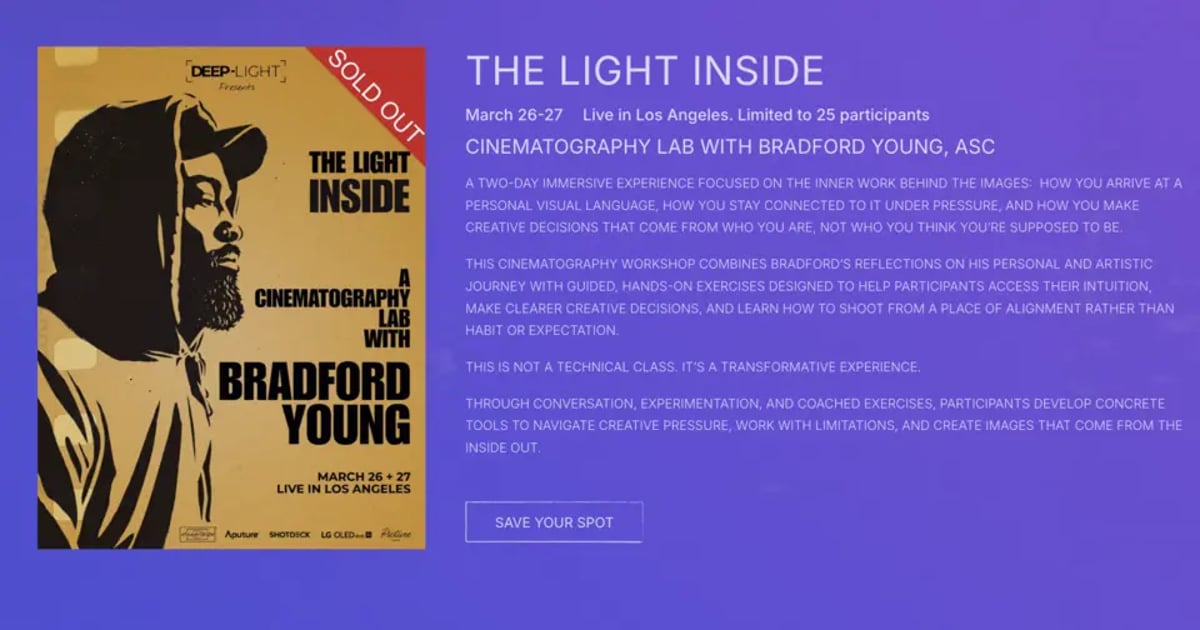
The initial endeavors of Deep Light exemplify this commitment. The initiative has hosted workshops led by cinematographers known for their distinctive visual philosophies, ensuring that participants engage with artistic intent rather than just operational mechanics. A recent example is "The Light Inside," a two-day lab in Los Angeles with Bradford Young, ASC, limited to a small group of participating cinematographers. The choice of Young, a cinematographer celebrated for his nuanced lighting and evocative imagery in films like Arrival and Selma, underscores Deep Light's dedication to exploring the art of image creation from a deeply considered perspective.
That some parts of the workshops are explicitly "off the record" is a telling detail for any industry veteran. It speaks to the desire for an unvarnished exchange, a space where professionals can speak freely, without the self-consciousness that often accompanies public-facing masterclasses. This distinction highlights the effort to cultivate an environment of genuine trust, where insights are shared not for public consumption or promotional gain, but for the collective advancement of the craft itself.
This focus on philosophical and conceptual mastery is a refreshing departure from so much contemporary content that fixates on the gear-centric. The pendulum has swung toward an obsession with resolution, dynamic range specs, and lens characteristics. Those technical elements are indeed crucial (no DP worth their salt would dismiss them), but they are, as Braier rightly points out, merely variables in a much larger equation. John Alcott didn't define Kubrick's aesthetic for Barry Lyndon purely by the f/0.7 Zeiss lenses; he defined it by the intentionality of available light, the dramatic chiaroscuro that deepened every frame. Roger Deakins doesn't achieve his signature look solely through specific camera bodies; it comes from a profound understanding of light, composition, and the emotional resonance of every shot. Even something as seemingly technical as lens selection is ultimately a narrative decision. The tools are a means. The vision is the end.
Deep Light's emphasis on "a mirror where they can see themselves in this career and keep going" also speaks to the inherent challenges of sustaining a career in cinematography. It is a field demanding not only immense technical skill but also profound resilience, artistic sensitivity, and often a thick skin against the vagaries of production. The path is often opaque for those starting out. When Braier recalled knowing only "three [cinematographer] names" as a student, without even knowing their faces, it illustrates the historical lack of accessible role models and transparent career paths. Such a void can be daunting, leading to imposter syndrome or, worse, a sense of aimless wandering in a highly competitive profession.
The mentorship aspect of Deep Light directly counteracts this. It is one thing to watch a behind-the-scenes documentary or read an interview; it is quite another to engage in a direct, sustained dialogue with a seasoned professional. This isn't about imparting dogma, but about sharing lived experience, offering guidance on navigating the complex interpersonal dynamics of a film set, understanding the business acumen required, and honing one's artistic voice. The craft of cinematography is as much about understanding light and optics as it is about leadership, collaboration, and diplomatic communication with directors, gaffers, and producers. These non-technical skills are often the most difficult to acquire and are rarely taught in formal settings; they are learned through experience, often through trial by fire, or, ideally, through mentorship.
The notion of a global crew pool and a Discord community for earlier-career cinematographers is particularly astute. The industry, despite its global reach, often remains insular and reliant on personal connections. Breaking into established networks, or even identifying them, can be a significant hurdle. A curated crew pool, vetted by working professionals within Deep Light, offers a practical mechanism for connection and opportunity, potentially democratizing access to talented crew members who might otherwise be overlooked. Similarly, a Discord community provides an immediate, low-barrier entry point for peer support and knowledge exchange, fostering a sense of camaraderie that can be crucial in a demanding profession. This digital town square model helps dismantle traditional gatekeepers of networking, allowing for more organic connections and problem-solving among peers.
Braier's commitment to teaching around her shooting schedule further reinforces the dedication behind Deep Light, indicating this is not merely a side project but a genuine extension of her professional ethos. Many cinematographers, once they achieve a certain level of success, focus almost exclusively on their demanding production schedules. Dedicating valuable time to developing and overseeing a community initiative, even with the support of mentees as moderators, speaks to a deeply held belief in the importance of collective growth and skill transfer.
This effort to build a stronger, more interconnected cinematography community isn't just altruistic. It is a structural improvement for the industry as a whole. When cinematographers are better equipped, not just with the newest gear but with a deeper understanding of artistic purpose, business realities, and strong peer support, the quality of their output can only benefit. This iterative process of shared learning, particularly when guided by experienced DPs like Braier and those she brings into the fold (like Bradford Young), creates a feedback loop that elevates the craft from the ground up.
As filmmakers, we are always asked to innovate, to push boundaries, to tell stories in new and compelling ways. But innovation isn't solely about technology. It is fundamentally about perspective, about asking the right questions. Braier's Deep Light seems poised to focus on those deeper questions, ensuring that the dialogue around cinematography remains vibrant, relevant, and, above all, meaningful. It highlights that while we chase the next piece of equipment, the most invaluable asset remains the human element: the shared wisdom, the collegial support, and the ceaseless pursuit of artistic intention that lies beneath every illuminated frame.
---
© 2026 BlockReel DAO. All rights reserved. Licensed under CC BY-NC-ND 4.0 • No AI Training.