Godox PaletteLab: 9-Band LED Engine Debuts at NAB 2026
We've all been there: chasing that perfect skin tone or trying to match disparate light sources on set, only to find our LEDs falling just short. The promise of LED is spectral purity and control, but the reality has often been a compromise, especially when it comes to the trickier parts of the visible spectrum. That’s why the announcement of Godox’s PaletteLab color engine at NAB 2026 is worth a close look for any professional working with digital motion picture capture.
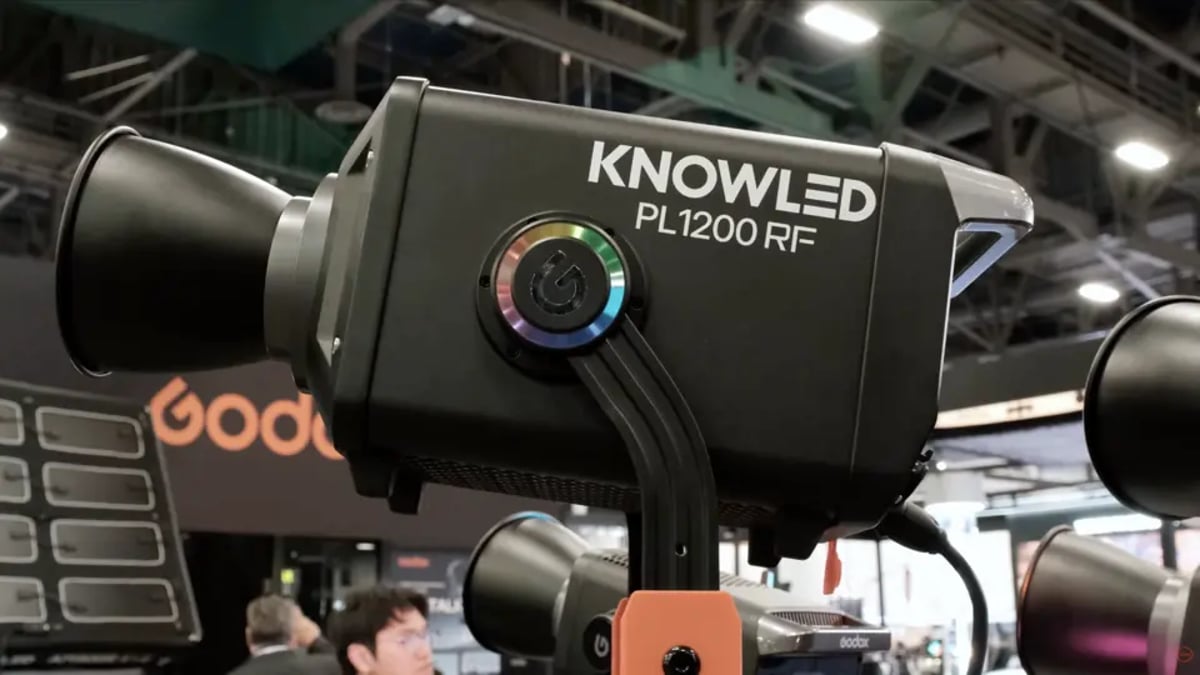
Godox debuted PaletteLab, a new nine-band full-spectrum color engine, integrated into five new fixtures ranging from 150W to 1200W. This isn't just about brighter lights; it’s about a more nuanced approach to color reproduction, aiming to tackle some of the inherent spectral challenges of LED technology head-on. The lineup includes the KNOWLED PL600RF and PL1200RF, both featuring built-in CRMX wireless control and IP65 weather sealing. Additionally, Godox released the all-in-one SL300RF and SL200RF, along with the more compact ML150RF, all boasting the widely adopted Bowens mount.
According to Davide Valente CSC, cinematographer, color scientist, and Godox’s Global Brand Ambassador, who assisted in the engine's calibration, PaletteLab represents Godox’s most spectrally accurate color system to date. It’s positioned to complement, rather than replace, their existing bi-color and RGBW offerings, suggesting a strategic expansion of their lighting portfolio for different production needs. The “Palette” concept was first teased at IBC 2025 during the launch of the KNOWLED MG4K, and it has now fully materialized in this new product line.
Nine Diodes to Conquer the Spectral Gap
The core of PaletteLab is its multi-channel architecture, specifically utilizing nine separate color diodes. This design directly addresses the persistent issue of spectral drop-offs that have plagued LED lighting since its inception. Anyone who's wrestled with a spectroradiometer on set knows that even "full spectrum" LEDs often exhibit gaps, particularly in crucial areas for human perception and sensor response.
Godox states that PaletteLab employs “Multispectral Optical Coupling Technology” to refine spectral transitions, focusing on historically difficult zones. Specifically, they've targeted the range from blue to cyan and from orange-red into deep red. These are critical areas. A deficiency in cyan can lead to muddy blues and greens, while a weak rendering of deep reds can flatten complexions and dull rich fabric tones. The stated goal is to achieve a more continuous spectrum, one that more closely mimics natural sunlight, moving away from the "spiky" spectral output often seen in RGB and RGBWW fixtures that can challenge camera sensors and post-production color pipelines.
The published color metrics for the PaletteLab engine are ambitious:
Furthermore, the system is claimed to cover approximately 92% of the Rec.2020 gamut (a coverage figure quoted under specific CCT and test conditions). All of these figures are manufacturer-claimed by Godox and have not yet been independently verified by third-party labs, but if the production units perform to spec, they would place PaletteLab in direct competition with some of the most advanced cinema-grade LED engines currently on the market. For practitioners weighing real-world color performance, the long-running pitfalls of CRI/TLCI scoring are worth revisiting in our guide on practical lighting, dimming, and CRI/TLCI pitfalls. Achieving a high R9 value (rendered red, crucial for skin tones) of 99 is particularly notable, as this is often where lesser LED fixtures struggle. A TM-30 Rg (gamut index) exceeding 100 suggests a potential for richer, more saturated colors than a reference illuminant, while maintaining spectral fidelity. The high SSI (Spectral Similarity Index) values against both tungsten and daylight indicate a consistent performance across different color temperatures, which is vital for matching existing sources or working in mixed lighting environments.
The Nuance of Three Engines, Not One
When pressed on why filmmakers should opt for PaletteLab over Godox's established offerings, Davide Valente’s response was refreshingly candid: it’s not for everyone. This acknowledgment of trade-offs, rather than pushing a singular "ultimate" solution, reflects a maturing understanding of diverse production needs within the lighting industry.
Godox now effectively offers three distinct color technologies, each with its own advantages:
This stratified approach from Godox is a pragmatic one. In a professional setting, the "best" light isn't a universal constant. It's dictated by the creative brief, the shot requirements, power constraints, and budget. Having specialized tools for specific jobs often provides a more efficient workflow than trying to force one tool to do everything. This mirrors the choices DPs make with camera formats (anamorphic vs. spherical, large format vs. S35) or lens characteristics (vintage vs. modern, primes vs. zooms). Each choice brings its own set of advantages and compromises.
For projects where the integrity of color is paramount (perhaps for commercial work involving highly color-sensitive products, high-end drama where subtle skin tones convey emotion, or VFX plates requiring pristine color information) the potential of PaletteLab's spectral accuracy could be a significant advantage. It suggests a tool designed for discerning DPs and gaffers who understand the subtle yet profound impact of light quality on the final image.
The move towards more spectrally complete LED engines is a welcome one. As someone who's spent years ensuring color consistency across various setups, I can attest to the headaches caused by fixtures with "spiky" or incomplete spectra. They might look good on a light meter, but the chromatic aberrations or odd color shifts become apparent only when viewed through a high-resolution camera and graded on a precise monitor. A more accurate spectrum means less time chasing elusive color shifts in post-production, and more confidence in the integrity of the captured image directly on set. For more on managing color in complex environments, consider articles on Matching Cameras: Practical Multi-Cam Color Matching on Set.
The Five New Fixtures
The initial rollout integrates the PaletteLab engine into five distinct fixtures, covering a power range suitable for a variety of production demands:
- KNOWLED PL600RF and PL1200RF: These are the flagship models, clearly aimed at higher-end productions. The inclusion of built-in CRMX wireless control is a professional standard specification, simplifying DMX routing on set and allowing for seamless integration with existing lighting control systems. Their IP65 weather sealing is also a significant advantage for exterior shoots or challenging environments, allowing DPs and gaffers to deploy them with confidence in rain, dust, or other adverse conditions without needing to scramble for weather protection. This kind of robust build quality is crucial for rental houses and demanding productions.
Connectivity and Control
While the article explicitly mentions CRMX wireless control for the PL600RF and PL1200RF, the broader connectivity and control options for all five fixtures would be of keen interest to gaffers and DMX programmers. Standard industry practice involves robust DMX/RDM implementations, alongside intuitive on-board controls and often, app-based functionality. Given the "all-in-one" descriptor for some units, it's reasonable to infer a streamlined user interface. The move towards more robust, weather-sealed options also suggests a recognition of the demanding environments these fixtures will operate in.
Pricing and Availability
Godox has not yet published official global pricing, but early NAB 2026 trade coverage from outlets including CineD and Newsshooter cites approximate street prices of around $719 for the SL300RF, $1,990 for the KNOWLED PL600RF, and $3,490 for the KNOWLED PL1200RF, with availability expected within roughly a month of the announcement. Final pricing will be a significant factor in how widely these fixtures are adopted, particularly in a competitive market that already features established players in high CRI/TLCI LED lighting.
Concluding Thoughts
Godox’s PaletteLab engine, with its nine-band architecture, signifies an important step in the ongoing evolution of LED lighting for cinema. By specifically targeting the spectral gaps that have historically limited LED performance, Godox aims to provide cinematographers with a tool that delivers enhanced color accuracy, particularly in critical areas like skin tones and saturated colors. The strategic decision to position PaletteLab as a premium, specialized option alongside their existing lines rather than a universal replacement shows a mature understanding of their market and the diverse needs of professional filmmakers. This development reinforces the industry's continuous push for lighting instruments that offer not just brightness, but also uncompromising spectral fidelity and control, bringing us closer to the ideal of truly emulate natural light with artificial sources. For more deep dives into the technical aspects discussed at industry events, you might be interested in our coverage of Newsshooter's NAB 2026 Best of Show Winners: A Technical Review.
---
© 2026 BlockReel DAO. All rights reserved. Licensed under CC BY-NC-ND 4.0 • No AI Training.