Fujifilm instax mini Evo Cinema: Instant Prints Meet Video - First Look
Fujifilm instax mini Evo Cinema: Instant Prints Meet Video - First Look
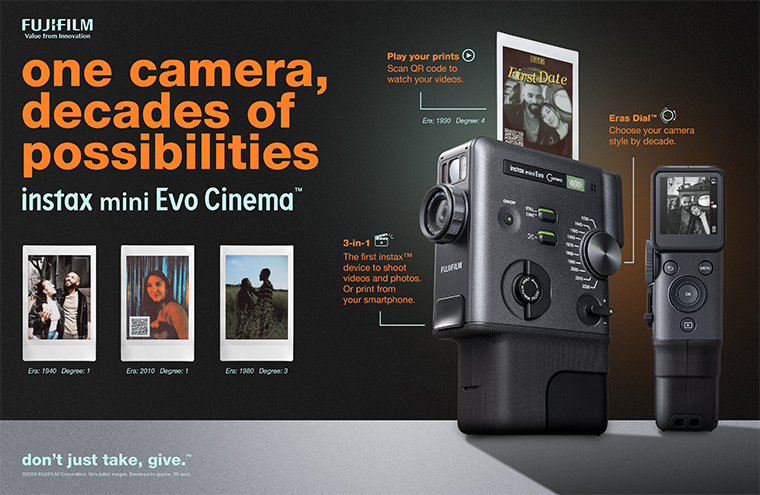
Fujifilm today unveiled the instax mini Evo Cinema, a new hybrid instant camera that introduces video capture capabilities to the instax lineup, alongside an innovative "Eras Dial" feature for vintage aesthetic effects. Announced on January 7, 2026, the mini Evo Cinema aims to blend the tactile experience of instant prints with digital video, offering a unique tool for creative expression.
Key Specifications
The instax mini Evo Cinema is designed to capture both still images and short video clips. Still images are recorded at 1920 × 2560 pixels, while video is captured up to 15 seconds long at either 600 × 800 or 1080 × 1440 pixels at 24 frames per second. All content is stored on internal memory or a microSDXC card.
A standout feature is the ability to print still images that include a QR code. When scanned via a smartphone app, this QR code links to the captured video footage, allowing users to share a physical print that serves as a gateway to digital motion. Fujifilm states that video data uploaded via the instax mini Evo app will be downloadable for two years from the upload date. Printing from the device boasts 1600×600 dots (compared to 800×600 from a smartphone via the app) and takes approximately 16 seconds per print, utilizing instax mini film.
For creative control, the camera features an "Eras Dial" with 10 distinct effects, each offering 10 adjustable levels. These effects aim to replicate looks from different decades, such as 8mm film or CRT television textures, complete with simulated noise and tape wobble. These aesthetics can be applied to both video visuals and audio, adding elements like film spin sounds.
Ergonomically, the mini Evo Cinema sports a vertical grip design, reportedly inspired by Fujifilm's FUJICA Single-8 8mm camera from 1965. It includes a "Z-Dial," a print lever, a rear LCD monitor, and a viewfinder attachment. The device also offers a dedicated app that facilitates video editing, allowing users to combine clips into longer sequences (up to 30 seconds total) and add cinematic templates. The app also supports "Direct Print" from a smartphone, effectively allowing the camera to function as a 3-in-1 device: a camera, a video recorder, and a smartphone printer.
Under the hood, the camera is equipped with a 5-megapixel 1/5-inch CMOS sensor and a fixed 28mm equivalent F2 lens. It features Single AF and Face Detection AF with a focus range from 10cm to infinity, an ISO range of 100-1600, Program AE, and ±2EV exposure compensation.
Price & Availability
Fujifilm has listed the instax mini Evo Cinema with an "Open Price," indicating that official pricing information is not yet available. The camera is scheduled for release in Japan on January 30, 2026. Global availability has not yet been confirmed.
Competitive Context
The instax mini Evo Cinema carves out a new niche for Fujifilm by integrating video capture into its instant camera line, a significant departure from earlier still-only hybrid models like the instax mini Evo. The inclusion of QR-linked prints and retro audio effects is a novel approach, distinguishing it from traditional instant cameras and even entry-level digital cameras or smartphones.
While it's the first instax camera to offer video, the 15-second clip limit and resolutions of 1080x1440 at 24fps place it far outside the realm of professional video production tools like Blackmagic's Pocket Cinema Cameras or even recent mirrorless offerings from Sony or Canon, which provide 4K and 8K resolution with advanced codecs. The two-year data retention limit for QR-linked videos is also a notable consideration for long-term archival.
Instead, its direct competition lies more with creative tools designed for social media content or highly stylized short-form video. Devices like the DJI Osmo Pocket series offer compact video capture, albeit with a focus on stabilization and higher fidelity digital output. The mini Evo Cinema's strength lies in its unique blend of physical and digital, merging instant print aesthetics with lo-fi video capture. It's less about technical video prowess and more about curated, nostalgic output.
Who It's For
This camera is not intended for high-end film production or serious documentary work. Its limitations, particularly in video resolution, frame rates, and clip duration, preclude it from traditional cinematography applications.
Rather, the instax mini Evo Cinema appears to be geared toward creative professionals, artists, and enthusiasts looking for a distinctive tool for conceptual projects, behind-the-scenes content, or stylized, lo-fi artistic expression. Filmmakers or DPs might find it useful for capturing unique "mood footage" or "in-camera effects" for mood boards or pre-visualization. For productions interested in integrating a retro, analog feel into their social media campaigns or as a unique prop, the physical print with embedded video could be a compelling element.
It could also serve as a fun, creative accessory on set for capturing candid moments during production, offering cast and crew instant, stylized mementos with a digital video component. Its design, reminiscent of an 8mm camera, leans into a nostalgic aesthetic that is increasingly popular in various forms of media.
Expert Take
The instax mini Evo Cinema is less a game-changer for mainstream cinematography and more an intriguing addition to the growing toolkit of niche, creatively-focused imaging devices. The hybrid nature of instant prints bridging to digital video is genuinely innovative for the instant camera market. The "Eras Dial" with its detailed vintage effects, including audio manipulation, shows a thoughtful approach to delivering a specific aesthetic.
From a production standpoint, it's critical to understand its limitations upfront. This isn't a robust video camera; it's a specialized creative instrument. The 15-second video limit and the two-year expiration on QR code links means productions shouldn't rely on this for primary archival or critical content. However, for specific, targeted applications requiring a distinct lo-fi, vintage, and instantly shareable aesthetic, the mini Evo Cinema offers a unique proposition. It’s the kind of camera that could generate buzz for independent short films, music videos, or branded content looking for a differentiated visual signature.
Ultimately, the instax mini Evo Cinema isn't about technical perfection; it's about curated imperfection and a tangible, shareable experience. Professionals considering it will weigh its creative potential against its practical constraints, but for those seeking a distinct vintage vibe and a novel way to combine physical prints with digital video, it's certainly worth a look upon its release.
---
© 2026 BlockReel DAO. All rights reserved. Licensed under CC BY-NC-ND 4.0 • No AI Training. Originally published on BlockReel DAO.