AI in VFX 2026: How Studios Use Kling, Runway & Sora Now
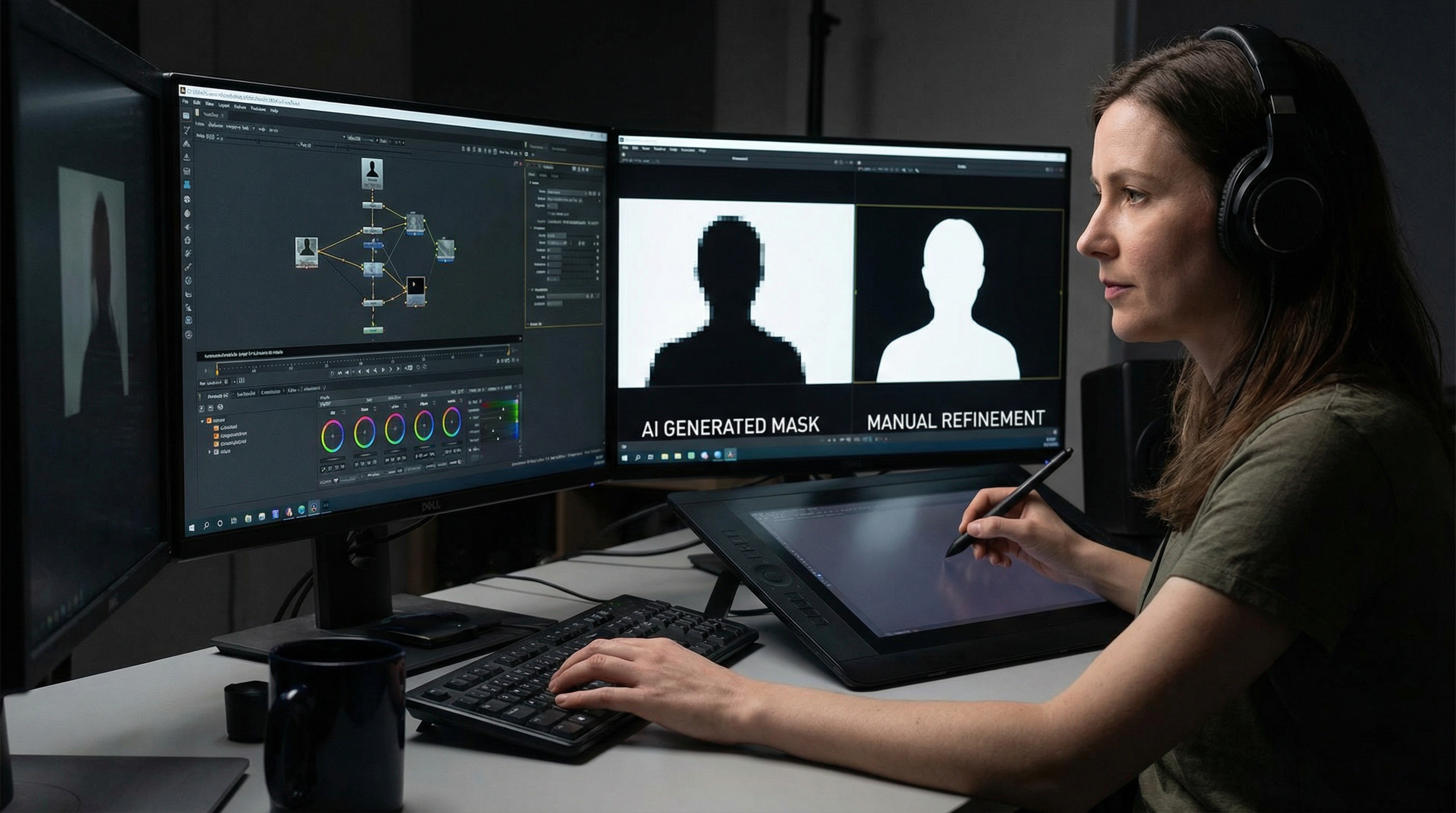
AI and VFX: Augmenting Creative Agency in Post-Production
The notion of AI generating entire visual effects sequences with a click, without human intervention, remains a persistent, if misguided, fear in certain corners of our industry. However, the practical application of artificial intelligence within visual effects studios in 2026 tells a far more nuanced story. It is one of augmentation, not automation. AI is not usurping the artist. It is arming them with more potent tools, streamlining repetitive tasks, and opening new avenues for creative exploration and control. The current trajectory suggests a deepening codependency, where the artist directs the machine to achieve previously unattainable creative fidelity and efficiency.
The Algorithmic Hand in the Artist's Workflow
Decades of iterative improvements in software and hardware have steadily redefined the VFX pipeline. From the earliest motion control rigs to the sophisticated photogrammetry tools of today, technology has always been a force multiplier. AI represents the latest, and arguably most transformative, step in this evolution. Its integration is not a sudden revolution but a quiet infiltration, enhancing existing processes rather than outright replacing them.
One significant area where AI has already demonstrated its transformative power is in the realm of rotoscoping and keying. Traditionally, these tasks were labor-intensive, frame-by-frame operations demanding immense concentration and time. Human artists, no matter how skilled, are susceptible to fatigue and the inherent challenges of maintaining consistency across thousands of frames. AI-powered segmentation tools, leveraging machine learning models trained on vast datasets of imagery, can now perform initial passes with remarkable accuracy. Tools such as those found in Blackmagic Design's DaVinci Resolve Magic Mask, or even specialized plugins in Nuke and After Effects, can differentiate foreground elements from backgrounds in complex shots, providing a cleaner plate for the artist to refine. This isn't about eliminating the roto artist. It's about providing them with an 80% solution, freeing them to focus on the intricate details and problematic frames that still require human discernment. It reduces the grunt work and shifts the artist's energy toward more creatively impactful corrections and artistic decisions.
Similarly, in matchmove and tracking, AI is beginning to provide significant boosts. Traditional 2D and 3D tracking software, while powerful, often requires manual intervention for occlusions, motion blur, or ambiguous features. Machine learning algorithms can analyze sequential frames, predict motion paths, and identify feature points with greater resilience to these challenges. This means faster and more accurate camera solves, object tracks, and even facial performance tracking, which directly translates to less time spent troubleshooting and more time on integrating CG elements convincingly. The artist still sets the parameters, validates the results, and makes the final adjustments, but the initial heavy lifting is increasingly offloaded to intelligent algorithms.
The 2026 Landscape: Video Generation Models Enter Production
The past year has witnessed an explosion in video generation AI that is fundamentally reshaping previz, concepting, and even final pixel work. Runway's Gen-3 Alpha and its successors have matured from curiosity to production tool. Kling, the Chinese video model that stunned the industry with its temporal coherence, is now being licensed by major studios for background plate generation. Pika and Stable Video Diffusion have found niches in rapid iteration workflows. And OpenAI's Sora, while still access-restricted, demonstrated what is coming down the pipeline.
These tools are not replacing VFX artists. They are becoming the new sketchpad. A supervisor can now generate dozens of concept shots in minutes, communicating vision to clients and directors with moving images rather than storyboards. When a director asks "what if the explosion came from the left instead?" the answer takes seconds, not days. This rapid prototyping capability is compressing creative development timelines in ways we've never seen.
For productions with constrained budgets, AI-generated establishing shots and background plates are increasingly viable. The key is understanding where these tools excel and where they fail. They struggle with precise character performance, complex physical interactions, and maintaining exact continuity across shots. But for atmospheric elements, crowd replication, and environmental ambiance, they are becoming indispensable. For a comprehensive breakdown of integrating these tools into your workflow, see our guide on AI and virtual production.
Crafting Realism: Machine Learning for Asset Generation and Simulation
The creation of photorealistic assets and environments is a cornerstone of modern visual effects. This process, encompassing modeling, texturing, rigging, and shading, is inherently complex and time-consuming. AI is now contributing to several stages, enhancing both speed and quality.
Consider texturing. Physically based rendering (PBR) workflows demand intricate maps including albedo, normal, roughness, and metallic channels to accurately represent material properties. Tools leveraging machine learning can generate these maps from a single photograph or even synthesize entirely new textures based on stylistic prompts. This significantly accelerates the asset creation process, allowing artists to iterate on design choices more rapidly. Furthermore, AI can be used for up-rezzing low-resolution textures, intelligently adding detail and fidelity without resorting to simple pixel interpolation. This capability is particularly useful in virtual production pipelines where real-time performance and high-resolution assets are simultaneously critical.
Generative AI models are also beginning to make inroads in areas like procedural modeling and environment generation. While still in nascent stages for high-fidelity film production, the ability to generate variations of architecture, foliage, or organic forms based on learned patterns holds immense promise. This does not mean AI is designing sets. It means AI can rapidly populate a scene with contextually appropriate variations of elements, all under the artistic direction and supervision of the environment artist. The artist defines the aesthetic rules and parameters, and the AI acts as a sophisticated assistant capable of executing those rules at scale.
Beyond static assets, AI is impacting dynamic simulations. Traditional fluid, cloth, and hair simulations are computationally expensive and often require extensive parameter tweaking to achieve desired results. Research is actively exploring how neural networks can learn to approximate these complex physics, potentially generating convincing simulations in a fraction of the time. Imagine an artist needing to simulate hundreds of interacting particles or a complex fluid flow. An AI model trained on a vast array of physical phenomena could provide a realistic baseline much faster than a traditional solver, leaving the artist to fine-tune the artistic direction rather than battling convergence issues. This provides a tangible increase in creative control, as artists can explore more iterations and push stylistic boundaries without being bottlenecked by render times.
The Human Element: Curation, Direction, and Artistic Intent
The constant refrain from those who fear AI's impact on creative fields is that it will diminish the need for human creativity. This perspective fundamentally misunderstands the role of the artist in the age of AI. The more powerful the tool, the more crucial the hand wielding it.
AI, in its current and foreseeable forms, excels at pattern recognition, data processing, and logical execution within defined parameters. It lacks genuine understanding, aesthetic judgment, or the ability to articulate novel artistic intent without human guidance. An AI can generate a thousand variations of a concept, but it cannot discern which variation best serves the story, evokes the desired emotion, or fits the director's vision. That remains the exclusive domain of the human artist, supervisor, and director.
The true impact of AI is not in replacing the artist, but in elevating their role to that of a highly skilled curator, director, and arbiter of taste. As AI handles more of the repetitive and technically arduous tasks, artists are liberated to focus on higher-level creative problems including storytelling, visual metaphor, emotional resonance, and pushing the boundaries of aesthetic expression. The compositor's role is evolving from pixel pusher to creative supervisor, managing AI outputs rather than manually executing every adjustment.
Consider deepfake technology, often viewed with trepidation. When used responsibly and ethically, it offers an unprecedented degree of control for performance capture and digital manipulation. Directors can now subtly alter an actor's performance to match a specific take or adjust facial expressions in post-production with a fidelity previously confined to expensive, bespoke digital doubles. This doesn't replace the actor or director. It gives them an additional layer of control, a digital chisel to refine performances with surgical precision. The ethical considerations are real and require industry-wide standards, but the creative potential is undeniable.
The Road Ahead: Harmonious Symbiosis
The future of visual effects is undeniably intertwined with the continued development of artificial intelligence. We are moving towards a symbiotic relationship where human creativity and machine efficiency complement each other. Studios are investing heavily in custom AI solutions, often employing dedicated AI research and development teams to address specific production challenges.
This iterative development means that the tools of tomorrow will be even more integrated, more intuitive, and more powerful than those we use today. We are already seeing AI-driven assistants that proactively suggest optimization strategies for scenes, and algorithms that detect inconsistencies in lighting across shots before they ever reach the final render. Automated quality control, automated render farm management, and predictive scheduling are becoming standard, freeing up producers and technical directors to focus on strategic oversight rather than minutiae.
The discussion around "man vs. machine" in VFX is largely a false dichotomy. The reality is "man with machine." The most successful artists and studios will be those who best understand how to harness these powerful new tools, integrate them into their workflows, and direct them to push the boundaries of visual storytelling. The creative control once limited by time, budget, and computing power is expanding rapidly, offering a new golden age for visual effects artists who embrace this evolving partnership. The discerning eye, the artistic judgment, and the profound human desire to tell compelling stories will always remain at the core of our craft. AI is merely providing a new, sharper set of chisels. The true impact remains firmly in the hands of the artist.
---
© 2026 BlockReel DAO. All rights reserved. Licensed under CC BY-NC-ND 4.0 • No AI Training. Originally published on BlockReel DAO.