ARRI Omnibar LED Tube: Specs, Rigging System, and What It Means for Gaffers

When you hear "ARRI," you usually think cameras or, more recently, their established LED panel lines like Skypanels. But lighting tubes have long been a category dominated by others, often leaving gaffers rigging with zip ties and hoping for the best. ARRI, under the new stewardship of the Riedel Group following the April 2026 acquisition, is now entering that fray with the Omnibar, focusing heavily on what they call a "hybrid solution" to common rigging headaches.
This isn't just another LED bar; it's ARRI's first lighting product developed post-acquisition by Thomas Riedel and it signals a nuanced strategic shift. They're manufacturing this new fixture in China with a third-party partner, which is a notable departure from their traditional production models. For those of us who've wrestled with mounting tubes in tight spots or trying to build complex linear arrays, the Omnibar's emphasis on user-friendly rigging and scalability immediately grabs attention.
Addressing the Rigging Conundrum
Tube lights, for all their aesthetic appeal and utility, can be a pain to mount. I've spent enough time on interiors trying to secure these fixtures in places never intended for them, often with makeshift solutions that felt more precarious than professional. ARRI directly tackles this with the Omnibar, making mounting a core design principle rather than an afterthought. For a deeper look at how grip hardware shapes on-set lighting decisions, our Grip Toolkit: Flags, Nets, Frames, and the Why Behind Each covers the foundational gear.
They've designed the Omnibar to combine the best aspects of traditional tube lights and bar-style fixtures, and the focus on rigging is front and center. One of the standout features is the integration of strong magnets directly into the bar. This isn't just for convenience; it opens up a host of practical applications on set. You can snap an Omnibar vertically, horizontally, or even overhead onto magnetic surfaces. Think about all the metal structures on a typical soundstage or location; this immediately expands placement options without additional clamps or grip hardware.
A clever detail I appreciate is the slightly shorter length of the 4-foot Omnibar. It's designed to fit into existing T8 tube lighting fixtures and their associated spaces, avoiding the common issue of hitting end connectors. That's a small but significant consideration that shows an understanding of real-world set conditions.
Beyond magnets, ARRI has also integrated what they call "cable slots." These aren't just decorative; they're designed for passing zip ties or safety cables through, securing the fixture without obscuring the light-emitting surface. Anyone who's had to tie off a tube only to find the ties casting shadows across the beam will appreciate this. The fact that these slots are positioned at the Omnibar's center of gravity is a smart move, ensuring a more balanced and secure hang for overhead applications. This kind of attention to practical rigging details often makes or breaks a fixture's utility on set.
Modular Accessories and Scalability
ARRI hasn't stopped at integrated magnets and cable slots; they've developed an entire ecosystem of accessories focused on enhancing modularity and ease of use.
First up is the Omnigrip. This accessory clasps onto a rail system on the back of the Omnibar, allowing it to be secured at any point along its length. What's particularly useful is its ability to connect multiple Omnibars. If you need a seamless, longer linear source, the Omnigrip can bridge two fixtures, creating a continuous light without a visible gap. This kind of modularity is crucial for gaffers building dynamic light arrays or intricate practical installations.
Then there's the Omnipin. This sounds like ARRI's answer to the often-annoying 3/8" screws that loosen during placement. The Omnipin is a click-in design with a positive lock, ensuring it fastens securely without spinning. For anyone who's had to constantly re-tighten a light on a C-stand head, this offers a welcome degree of confidence.
For more permanent or pre-rigged scenarios, the Omniclip offers another layer of flexibility. These clips attach to the rail system on the Omnibar and can also be screwed into surfaces like walls or wooden structures. A key advantage here is the ability to pre-install these clips into a set, then simply click in the Omnibars when the time comes. ARRI's even thought of an installation gauge to ensure the clips are perfectly parallel. This streamlines setup, something that becomes increasingly valuable on tight schedules.
Finally, a Mini Tripod serves as a floor stand. It's adjustable to three or four different heights and offers a clever flat design, complete with screw holes for securing it to a surface. An Eyebolt adapter rounds out the accessory line for additional rigging flexibility.
Technical Specifications and Practical Applications
Beyond the rigging, the Omnibar boasts serious technical capabilities that align with ARRI's reputation for quality light. The key features include:
- RGBMA engine (Red/Green/Blue/Mint/Amber): ARRI selected this five-channel emitter configuration to balance full-spectrum color reproduction with cost efficiency. The result is the color accuracy cinematographers expect from ARRI (CRI/TLCI 98) while keeping the fixture accessible.
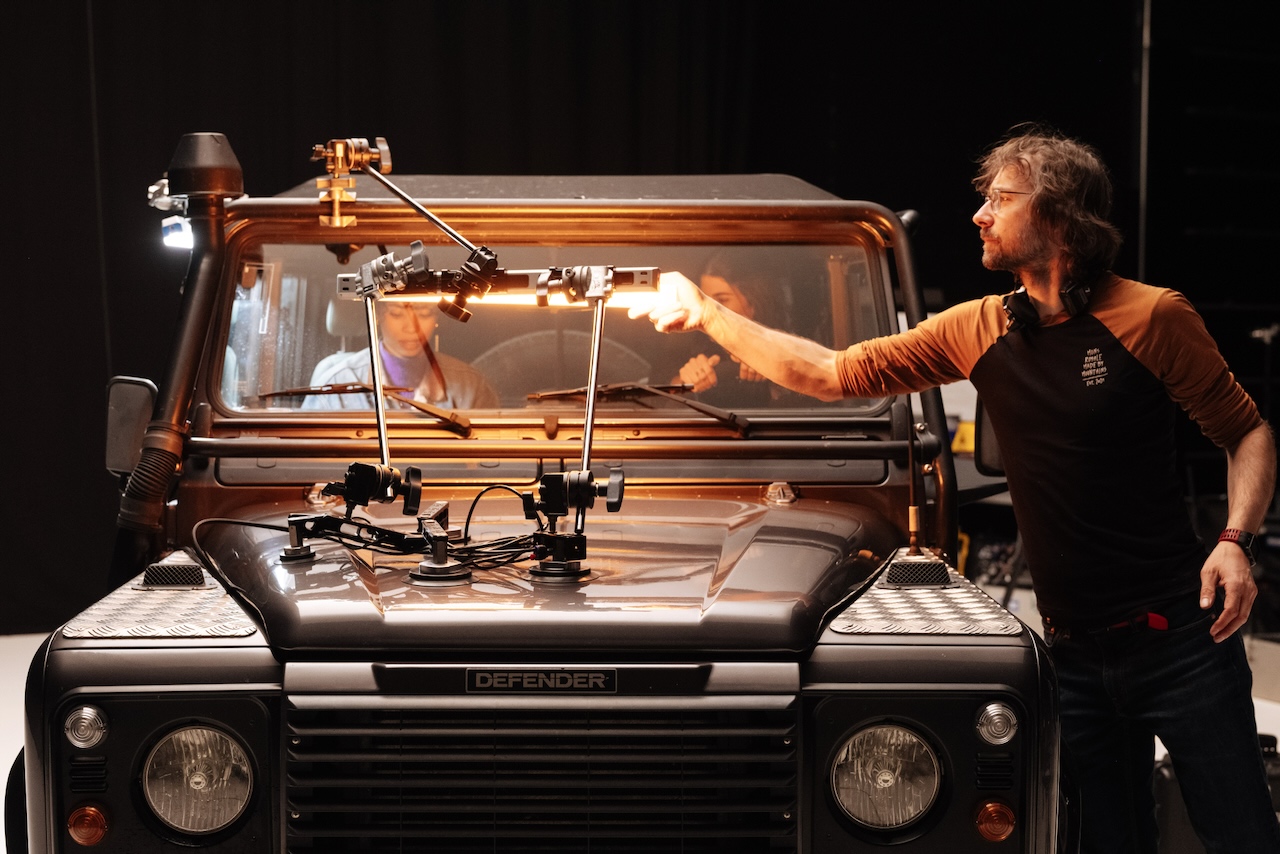
Working on sets, we often see these kinds of linear fixtures used for practicals, edge lighting, reflections in shiny surfaces, or building dynamic lighting cues. The Omnibar's pixel zones, combined with interchangeable optics, mean it could be a potent tool for simulating complex lighting environments within shot, or for precisely shaping light onto performers. I've seen some intricate setups for car interiors or background elements where a fixture like this, with easy magnetic attachment and pixel control, would save a considerable amount of time. Understanding how CRI and TLCI values translate to real skin tone accuracy is essential here; our Practical Lighting: Bulbs, Dimming, CRI/TLCI Pitfalls, and Color Control breaks that down.
Strategic Implications and Market Position
The move to manufacture the Omnibar in China with a third-party partner suggests ARRI is strategically adapting to market demands in the lighting sector. Historically, ARRI's production has been deeply rooted in Germany, embodying a specific quality and engineering ethos. This shift, particularly for a lighting product, hints at a recognition that certain segments require different manufacturing approaches to remain competitive and accessible. It's not necessarily a compromise on quality, but an acknowledgement of globalized supply chains and the need for efficiency.
For gaffers and cinematographers, this entry by ARRI into the linear LED space is noteworthy. While other brands have established themselves, ARRI's reputation for color science and thorough engineering carries significant weight. If the Omnibar lives up to ARRI's color standards, its enhanced rigging convenience could make it a very attractive option, especially when integrating with existing ARRI lighting packages. It's about building a cohesive lighting system where all elements speak the same color language.
In an industry where every minute on set counts, and rigging time is often underestimated, the Omnibar's focus on simplifying this process is a pragmatic design choice. We've seen an explosion of linear LED options over the past few years, but many still suffer from clunky mounting solutions. ARRI's approach here, with integrated magnets, dedicated cable slots, and a suite of smart accessories, seems to be a direct response to those real-world frustrations. It's not just about emitting light; it's about how effortlessly that light can be put into position and integrated into a broader lighting design. This is particularly relevant when you're sculpting light with precise subtraction, a technique where fixtures need to be placed quickly and accurately. See our piece on Negative Fill Mastery: Shaping Faces With Subtraction for more on that.
The IP65 weatherproofing is also a crucial detail that professionals will appreciate. Working outdoors, especially in unpredictable conditions, often limits fixture choices. An IP65-rated fixture expands the creative possibilities without requiring extensive weather protection measures, something I've learned the hard way on numerous occasions.
Ultimately, the Omnibar is ARRI's formal entry into a segment that has seen significant growth, aiming to solve long-standing practical issues with mounting and scalability. Its success will likely hinge on its ability to deliver ARRI's expected light quality while truly simplifying the workflow that has historically been the bane of linear lighting applications. For professionals looking to streamline their setups and expand their creative options, it looks like a compelling tool that could address some very tangible challenges on set.
---
© 2026 BlockReel DAO. All rights reserved. Licensed under CC BY-NC-ND 4.0 • No AI Training.