Negative Fill Mastery: Shape Faces by Subtracting Light
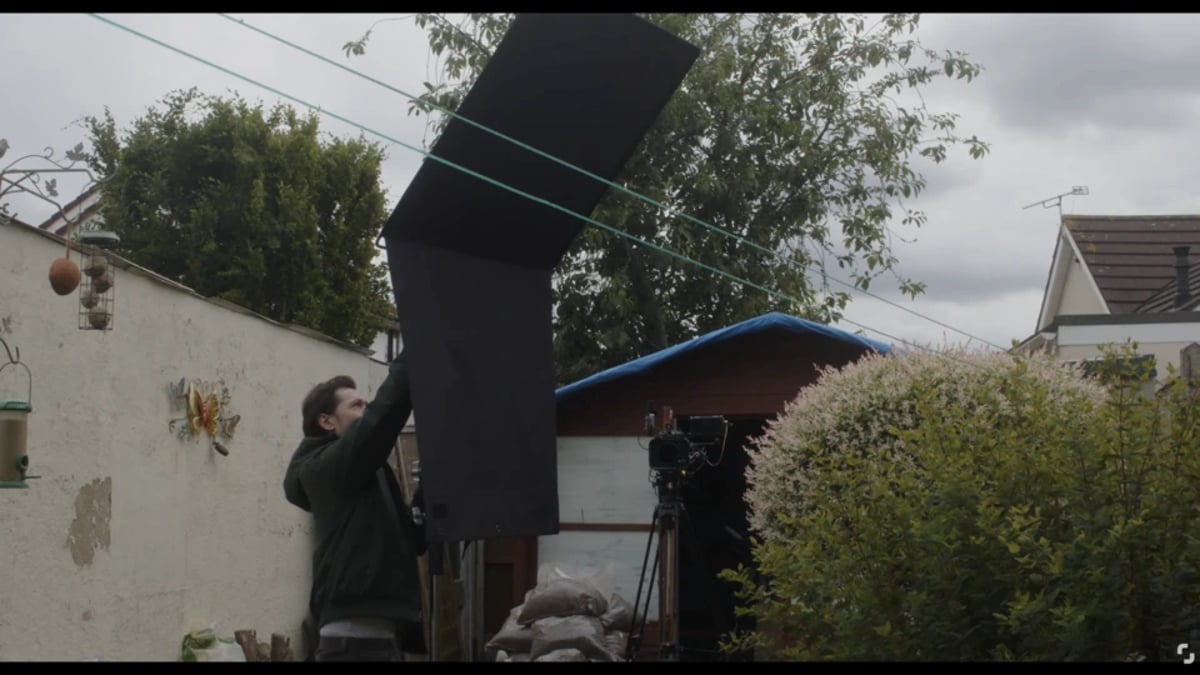
Negative fill is the effect produced by placing any light-absorbing surface (a black solid, flag, duvetyne, or the black side of a V-flat) where ambient bounce would otherwise reach your subject. It is not a piece of gear, it is a result. By removing fill rather than adding light, you restore contrast, deepen shadow planes, and let the key light do its job of describing form.
For the complete overview of lighting and grip strategy, see our Lighting & Grip Masterclass: Prelight Strategy to Set Execution.
Executive Summary
- Negative fill is subtraction, not addition. A black surface absorbs stray bounce so the shadow side reads darker and the planes of the face become visible.
Table of Contents
Fundamentals of Negative Fill in Facial Sculpting
Negative fill works on a simple principle: in any environment, light does not only travel from a source to your subject, it also bounces off walls, ceilings, floors, and clothing. That ambient bounce lifts the shadow side of the face and softens the planes that the key light is trying to describe. A light-absorbing surface placed on the shadow side prevents most of that stray bounce from reaching the face, so the shadow side reads darker and the cheekbones, jawline, and brow regain definition.
The standard placement is a black surface on the side opposite the key light. The result is not a new light, it is the absence of unwanted one. This is why negative fill is most powerful in studios with white cyc walls, in white-walled apartments, in tile bathrooms, and in any location where the room itself is acting as a giant fill bounce. It is also useful in bright exteriors where the ground (sand, concrete, snow) is throwing fill into your subject's chin from below.
Cinematographers known for disciplined contrast control, including Roger Deakins (work on No Country for Old Men, 2007 and Blade Runner 2049, 2017) and Emmanuel Lubezki (work on The Revenant, 2015), often demonstrate the importance of letting shadow do narrative work. Their images show what is possible when ambient fill is managed rather than left to chance. The exact tools and positions used on any given setup are specific to the scene, but the underlying behavior (deep, intentional shadow on the side opposite the key) is what we are aiming for.
A common mistake is underestimating how much white walls contribute to the image. Even a single soft key in a small white room can produce enough scattered light to flatten a face. The correction is environmental: black on the shadow side, often paired with overhead control to kill ceiling spill. Meter the shadow side before and after you place the panel so you can see what the negative fill is actually doing.
> 💡 Pro Tip: When you bring in a black panel, take a meter reading on the shadow side before placing it and after. The number tells you whether the panel is doing useful work or whether the room is still bouncing around it (often a sign you need a topper, a second panel, or to move the subject away from a reflective wall behind them).
Core Techniques and Positions
The two most common configurations are side blacking and corridor blacking (sometimes called the "bookend" setup). Side blacking is a single black surface placed on the shadow side of the subject, opposite the key. Corridor blacking uses two panels, one on each side of the subject, to channel the key and prevent stray bounce from reaching the face from either flank. Corridor blacking is the move when the room is small, bright, and reflective.
Distance is conditional. A panel placed close to the subject (roughly within arm's reach) produces a sharper transition between light and shadow, but it also risks cutting hard into the face if the actor moves. A panel placed further away produces a softer falloff but allows more ambient light to creep in around it. In a tight white interior you may need the panel close. In a large stage with controlled walls you may not need it at all. Test with the actor in their blocking, meter the shadow side, and adjust.
Angling matters as much as distance. A panel parallel to the subject is rarely correct. A small angle, often somewhere in a five to twenty degree range away from parallel, lets you feather the absorption across the cheek and jaw rather than cutting it off in a hard line. The exact angle is something you read with your eye on the monitor, not a number to memorize.
A common mistake is treating negative fill as a static set-and-forget tool. As actors move through blocking, the relationship between the key, the panel, and the face changes. Plan for the marks where contrast matters most (close-ups, key reaction beats) and either reposition the panel for those takes or flag the issue to the gaffer so it can be addressed in coverage.
> 💡 Pro Tip: When you build a corridor with two black panels, tilt the top edge of each panel slightly outward (away from the subject). This preserves the eye light by letting a small amount of overhead ambient reach the upper face, so you keep the shadow depth on the cheeks without losing life in the eyes.
Tools: V-Flats, Solids, Flags, and Duvetyne
The tool set is straightforward. V-flats are 4x8 foot reversible panels (white on one side, matte black on the other) and they are the workhorse of negative fill on most sets. The black side absorbs the majority of stray bounce, the white side gives you a controllable bounce when you need to add fill back in. Solids (black floppy or 4x4 / 8x8 frames covered in solid black fabric) handle larger areas and are easier to fly on a stand. Flags are smaller, cut more precisely, and are useful for dialing in absorption around a specific feature. Duvetyne (or commando cloth) is a heavy black light-absorbing fabric you can drape over a frame, a wall, or a ceiling section to kill bounce in a specific zone.
Material choice matters. Matte finishes absorb, glossy finishes reflect. A glossy black surface on the shadow side will produce specular highlights on the cheek (the opposite of the intended effect). Stick with matte fabric, painted matte foamcore, or a properly finished V-flat. Avoid using anything black-and-shiny (vinyl, plastic, gaffer tape sheen) as a substitute.
Stability is non-negotiable. V-flats and large solids catch wind even indoors (HVAC drafts, actors brushing past), and they will fall on people if they are not properly weighted. Sandbag every stand. In an exterior with any breeze, double-bag and consider a second crew member on the panel during takes.
A common mistake is using a panel that is too small. A 2x3 flag may absorb the light reaching the cheek but leave the shoulders and chest still receiving bounce, which lifts the lower face through skin reflection. For full upper-body and headshot framings, a 4x8 V-flat or larger solid is usually what you want.
> 💡 Pro Tip: A black V-flat positioned directly behind the subject (with no light spilling onto it) gives you an instant deep black background. Light the subject separately and you can produce a controlled portrait against a clean negative space without painting or rigging a backdrop.
Integration With the Key Light
Negative fill is not an afterthought, it is part of the lighting design. The shape and softness of your key light determines how much ambient your room is producing in the first place, and that determines how much subtraction you need.
A typical sculpting setup pairs a soft key (a softbox, book light, or large diffused source) at roughly a 45 degree angle to the subject with a black panel opposite. The soft key wraps gently across the lit side of the face, and the panel ensures the shadow side stays defined rather than getting filled back in by the room. This is the foundation for most beauty, portrait, and intimate dramatic close-up work.
Calibrate against the look you want, not against a fixed ratio. Meter the lit side and the shadow side. For a natural narrative look, the shadow side is often around one stop below the key. For more dramatic, sculpted work it may sit two stops below or deeper. Negative fill does not produce a ratio on its own, it removes the ambient that was preventing the ratio you want from existing. Adjust the panel distance and angle, and adjust the key intensity, until the meter reads the depth you are going for.
A common mistake is to use negative fill without watching what it does to the eye. If the panel is too aggressive (too close, too tall, no top tilt), you can lose the catchlight on the shadow-side eye and the face will look lifeless. Allow a small amount of ambient to reach the eyes, or add a small dedicated eye light if the scene calls for it. For more on shaping with single sources, see Lighting Prelight Strategy: When It's Worth It and How to Plan It and Soft Sources Explained: Book Lights, Bounce, Diffusion, and Control.
> 💡 Pro Tip: When you want sculpted shadow but still want a hint of fill on the shadow side, replace your single black panel with a smaller black flag plus a white card placed further back. You subtract the close, intense bounce while permitting a softer, more distant fill to lift the deepest shadow just enough to retain detail.
Common Mistakes and Professional Corrections
The most common failure is forgetting the ceiling. Side blacking handles wall bounce, but in any room with a low, light-colored ceiling the overhead reflection is often the dominant ambient source. The fix is a topper (an overhead solid, a floppy on a high stand, or a piece of duvetyne rigged across the area above the subject) so the side panels can actually do their job.
The second common failure is panel-to-subject distance. Too far and ambient creeps around the panel. Too close and the panel cuts hard into the face when the actor moves an inch. The correction is to test with the actor on their mark, meter the shadow side, and adjust until the falloff is what the scene calls for. Treat any specific number as a starting point, not a rule.
A third failure is glossy material. Anything shiny on the shadow side is the opposite of negative fill. Even unintended sources count: a black leather jacket, a plastic monitor case, or a freshly painted gloss-black wall can all produce specular highlights that show up on the cheek.
A fourth failure is static positioning. Lighting that works for a static portrait often does not survive the first dolly move or actor cross. Either move the panel between setups, plan coverage so the negative fill stays valid for the angles that matter, or accept softer contrast for wide coverage and sculpt more aggressively in the close-ups.
A fifth failure is skipping the meter. Negative fill is invisible by nature (it is the absence of something), so it is easy to assume it is doing more or less than it actually is. A reading on each side of the face, before and after the panel, removes the guesswork.
> 💡 Pro Tip: If the shadow side is not as deep as you want, do not start by adjusting the angle of the panel. First check the ceiling and the wall behind the subject. The ambient is almost always coming from one of those two places, and a topper or a black on the back wall will do more for your shadow than another five degrees of panel rotation.
Expert Notes for Precision Shadow Control
At the precision end, negative fill becomes an exercise in feathering and stacking. Feathering is the practice of angling a panel so that only the portion of its surface that is doing useful work is presented to the face, with the rest tilted slightly out of the absorption zone. This produces gradient falloff rather than a hard cut. Small adjustments (a few degrees at a time) are how you read the contour of an individual face.
Stacking is the practice of using multiple absorbers in series. A close panel handles direct bounce from the nearby wall, a second panel set back kills bounce from the far wall, and a topper kills the ceiling. In a heavily lit white interior, this layered approach is often the only way to get true shadow depth.
For specific facial sculpting:
- Jaw separation: Place a black surface on the shadow side at an angle that absorbs bounce from the chest and shoulder area as well as the wall. This deepens the shadow under the jaw and separates it cleanly from the neck and collar.
A common mistake at this level is over-subtracting. Push the contrast far enough and the face stops reading as a face and starts reading as a graphic. Watch the catchlight, watch the deepest shadow, and stop when you have what the scene needs rather than the most contrast you can produce. For broader context on contrast, lensing, and image construction, see Beyond Three-Point: What We're Really Chasing with Light and Lens and Lens Selection Mastery: A Complete Guide for Cinematographers.
> 💡 Pro Tip: When you are sculpting heavily, work with a waveform or false color rather than your eye alone. The monitor adapts, the scope does not. Set a target IRE for the deepest part of the shadow side and use the panel adjustments to land there consistently across takes.
Interface and Handoff Notes
What you receive (upstream inputs):
What you deliver (downstream outputs):
Top three failure modes for this topic:
For broader context on grip safety and how negative fill rigging fits into the overall set, see Rigging Safety Fundamentals: Overhead, Power Runs, and Set Protocols.
Browse This Cluster
- Lighting & Grip Masterclass: Prelight Strategy to Set Execution
Next Steps
Ready to see how this fits into the bigger picture? Start with the complete guide.
📚 Complete Guide: Lighting & Grip Masterclass: Prelight Strategy to Set Execution
---
© 2026 BlockReel DAO. All rights reserved. Licensed under CC BY-NC-ND 4.0 • No AI Training.