Exposimeter App: Virtual Light Meter for Cinematographers
You know, the light meter has been a constant companion on set for decades. From the bulky Sekonics of yesteryear to the more refined handhelds we use today, they're essential for nailing exposure consistently, especially when you're sculpting light with any real precision. But what if you could ditch the dedicated hardware without losing the precision? What if a significant portion of that critical exposure planning could happen before the lights are even struck, or even before you step onto the soundstage?
That's the promise of Exposimeter, an app developed by cinematographer Ondřej Kymla, a member of the Association of Czech Cinematographers. It bills itself as a virtual light meter that aims to streamline the pre-visualization and exposure calculation processes, moving beyond just incident readings to a more comprehensive lighting simulation within your phone. And frankly, the idea of having that kind of foresight without lugging another piece of kit around is intriguing.
The Virtual Approach to Exposure
The core function of Exposimeter is to allow cinematographers and gaffers to "take real lights, set them up inside the app, and then very accurately measure the exposure of your scene before you even turn on a camera." This isn't just about calculating an f-stop; it's about simulating the actual lighting setup. Think about the implications for prep. Instead of sketching out lighting diagrams and then doing a ballpark estimate or waiting until you're on set to see how your fixtures interact, this tool suggests a way to pre-visualize and measure in a virtual space.
For a DP, that kind of predictive power could be a significant workflow enhancer. We're constantly fighting the clock, and anything that can shave off minutes during set-up or allow for more detailed pre-production planning is a win. I'm recalling countless times on larger commercial shoots where the gaffer and I would spend a solid hour just walking through the set, marking positions, discussing modifiers, and guestimating levels. If a substantial part of that calculation can be done in the app, refined, and then executed on set, it means those precious minutes can be spent on blocking, camera movement, or performance notes. For a deeper look at how prelighting strategy drives efficiency, see Lighting & Grip Masterclass: Prelight Strategy to Set Execution.
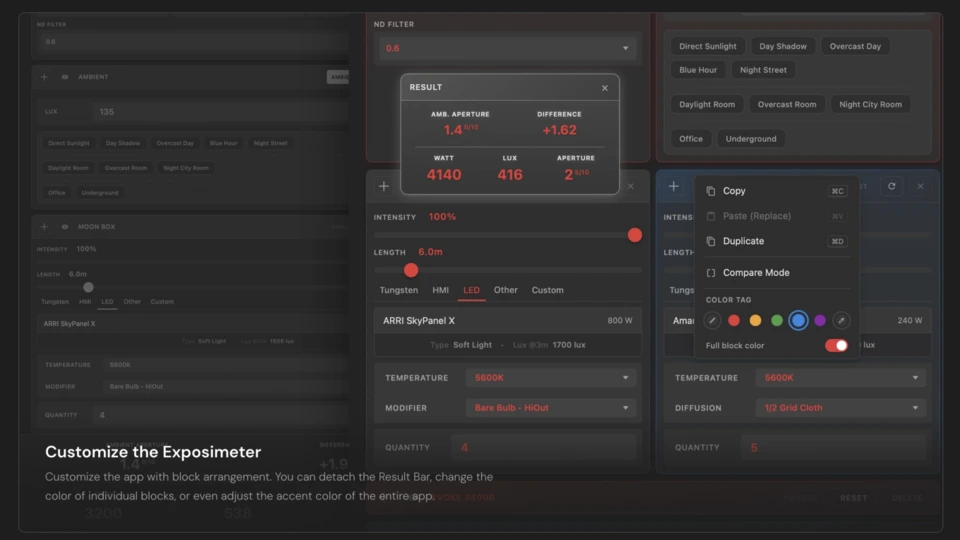
The app's modular design is also noted, allowing users to "start with very basic setups and advance to more complicated and tricky lighting scenarios." This suggests a scalable interface that can adapt from a simple two-light interview setup to intricate, multi-layered environments. In my early days as a camera assistant, before I was even touching a light meter directly, observing DPs and gaffers use them was always fascinating. It felt like they were conducting an orchestra of lumens. A tool that helps codify that process, even for complex arrangements, could be invaluable for ensuring consistency across setups and even different units.
A Database of Light
One of the most compelling aspects of Exposimeter is its built-in database of 225 different lights. This isn't a general "softbox" or "fresnel" option; it implies specific photometric data is tied to these fixtures. This granular detail is critical for any virtual tool claiming accuracy. When we're planning a setup, knowing the output, beam angle, and fall-off characteristics of a specific fixture is paramount. Trying to simulate exposure without this data would be akin to mixing paint colors without knowing their base pigments (or knowing precisely how they blend).
Consider the practical application: a gaffer might be spec'ing out a package for a scene, needing to decide between an ARRI SkyPanel S60-C and a Litepanels Gemini 2x1 for an overhead soft fill. Both are excellent fixtures, but their output profiles, color rendition, and how they react to diffusion can subtly differ. Understanding how soft sources interact with modifiers is already a core skill; having an app that quantifies those interactions adds another layer of precision. If the app incorporates accurate data from specific manufacturers, it allows for a more faithful simulation. This moves beyond a generic light meter reading and into a precise, predictive lighting design tool.
The database also facilitates collaboration. A DP could design a lighting scheme in the app during prep, send it to the gaffer, who can then verify fixture availability or suggest alternatives while maintaining the calculated exposure and fall-off. This kind of digital handshake before the trucks even roll out can head off miscommunications and costly on-set adjustments.
Beyond the Handheld Meter
For years, the Sekonic L-758DR or L-858D was effectively the gold standard. We'd use it for incident readings, spot readings, and even for correlating flash packs. Incident readings, particularly, have long been the cinematographer's preferred method for exposure because they measure the light falling on the subject, irrespective of the subject's reflectance (unless you're dealing with extreme cases of reflectivity). This gives you a clear F-stop value directly related to the lighting, not the camera's interpretation of reflected light and subject matter.
Exposimeter isn't trying to replace the incident meter entirely for on-set, real-time measurements. No app, to my knowledge, can achieve an incident reading without a physical sensor accessory. But it's clearly designed to augment, and in many ways, pre-plan the data a physical meter would confirm. It's about front-loading the decision-making process. By simulating the light, you can determine how many stops of difference exist between your key and fill, where your shadows will fall, and what your backlight ratio will be, all before committing to a physical setup. That approach aligns with building a cohesive visual language from the earliest stages of prep.
This predictive capability is especially beneficial for complex builds. Imagine an intricate practical lighting setup or a large green screen stage with multiple sources. Manually taking readings at every point, then adjusting each light, and re-reading, is time-consuming. If you can model that environment with the app beforehand, you're coming to set with a solid plan, and the physical meter becomes a verification tool rather than an exploratory one.
And for those "tricky lighting scenarios," where you're mixing sources, dealing with extreme contrasts, or trying to achieve a specific mood with a very limited lighting package, having a simulator could accelerate creative solutions faster. You're not burning expensive bulb hours or crew time experimenting; you're experimenting virtually. Knowing your grip toolkit before stepping into a virtual environment helps ground those simulations in real-world modifier behavior.
Bridging the Gap for Learning and Professional Refinement
The article mentions that while designed for professionals, Exposimeter is "also helpful for beginners who don't have experience using a light meter." This is a crucial point regarding skill development. Light meters can be intimidating. Understanding incident vs. reflected, interpreting stops and EV values, and knowing when to trust the meter versus your eye, all come with experience.
For a budding gaffer or cinematographer, being able to virtually construct a scene and see the exposure numbers change as they adjust light positions, add diffusion, or swap fixtures, offers a kind of hands-on learning that's hard to replicate without access to real gear and studio space. It's a low-stakes environment to learn the interplay of light intensity, distance, and aperture. This echoes what we see with virtual camera simulators or even basic 3D lighting software, it demystifies the craft by making the variables tangible and manipulable.
Conversely, for seasoned professionals, it's a tool for refinement. Maybe you're prepping for a shoot where you've never used a particular type of fixture before, or you're trying to replicate a very specific lighting ratio from a reference image. The app allows for calculated experimentation, helping you hone in on that precise look without the pressure of a crew waiting on set. This kind of pre-visualization saves money and, more importantly, facilitates artistic precision. Godox Unveils PaletteLab Color Engine and Five New Fixtures at NAB 2026, Targeting Spectral Accuracy is a good example of how manufacturers are increasingly providing detailed specifications that can feed into such virtual tools for enhanced accuracy.
Practical Considerations and The Price Tag
The pricing structure is notable: a one-time fee of $99.90 USD for lifetime access, or an annual plan for $29.90 USD. For a professional tool, especially one that promises ongoing updates given the rapid evolution of lighting technology, the flat fee is appealing. We're used to shelling out hundreds, if not thousands, for dedicated hardware. To get this level of predictive capability in an app for under a hundred bucks, considering the potential time savings and increased precision, feels like a solid investment. Even the annual sub is reasonable if you're not sure you'll use it consistently. And a 7-day free trial? Essential for any tool claiming specialized functionality; you need to kick the tires and see if it integrates into your specific workflow.
But let's be realistic. No app completely replaces the tangible feel of light on set. The way diffusion interacts, the subtle nuances of spill, reflections in a real environment, those are still things you verify with your eyes and, yes, a physical meter. What Exposimeter provides is a solid framework for planning and predicting. It gives you a strong starting point, allowing you to fine-tune on set rather than building from scratch. It's a digital assist, not a full replacement.
The strength of such a tool lies in the accuracy of its underlying data. If those 225 light sources are meticulously characterized across various settings (like beam angle, modifiers, and dimming curves), then the predictions will hold weight. Without precise data, it's just a fancy calculator. The fact that it's developed by a working cinematographer of the Association of Czech Cinematographers lends some credibility here; it suggests an understanding of the practical demands of the job.
The Future of Prep
We've seen a steady march towards integrating digital tools into every stage of filmmaking. From pre-visualization software that maps out camera movements (and could interface with concepts like Camera Movement Execution: Grips/Ops Choreography and Rehearsal Method) to virtual camera systems in game engines, the digital sandbox is growing. Fixtures like the Astera QuikBeam already ship with detailed photometric profiles that tools like Exposimeter can directly utilize. An app like Exposimeter fits squarely into this trend. It empowers DPs and gaffers to make more informed decisions earlier in the process, which invariably leads to more efficient sets and potentially more ambitious creative outcomes.
For a new generation of filmmakers, who are often more technologically inclined and comfortable with app-based workflows, this could become a standard part of their kit. And for veterans, it represents an evolution of tried-and-true methods, offering a faster, more flexible way to plan. My personal take: I'm always evaluating new tech with a healthy dose of skepticism, especially when it promises to augment classic techniques. But the core concept here, combining specific fixture data with virtual simulation for exposure planning, has tangible benefits. It respects the craft while using modern processing power. It's not about doing away with the art of lighting, but providing a sophisticated tool to help execute that art with greater precision and foresight.
---
© 2026 BlockReel DAO. All rights reserved. Licensed under CC BY-NC-ND 4.0 • No AI Training. Originally published on BlockReel DAO.