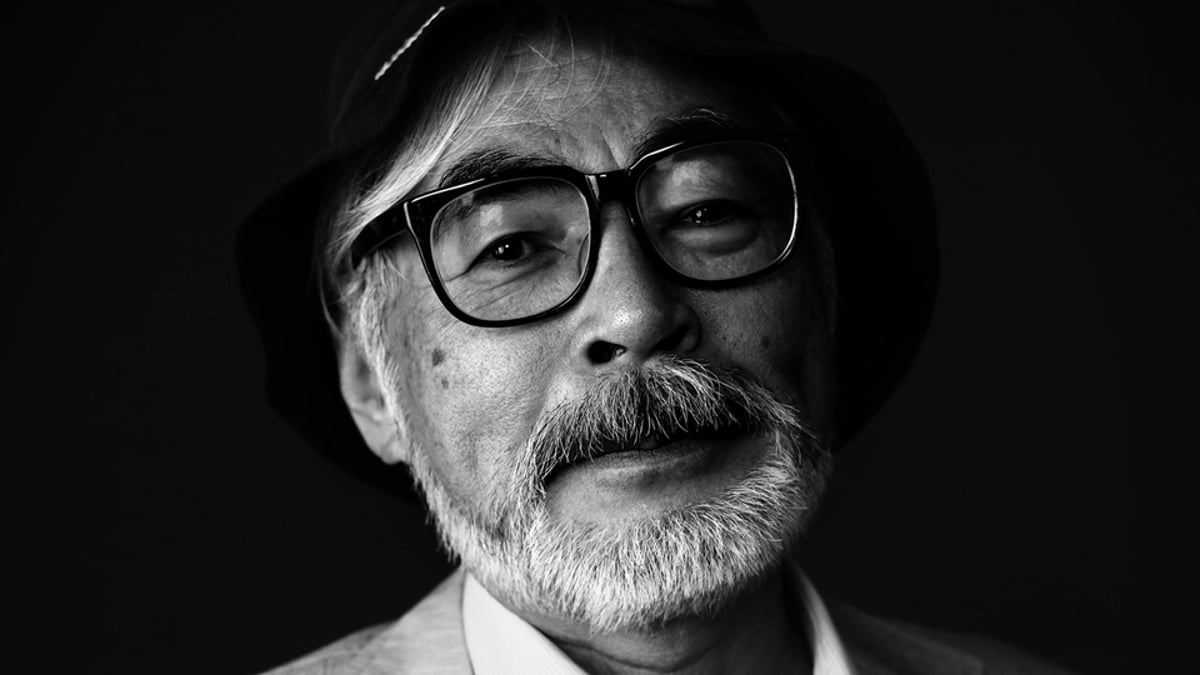
Hayao Miyazaki: Filmmaking Techniques, Ma & Spirited Away Analysis
> This guide contains affiliate links. BlockReel may earn a small commission on qualifying purchases at no extra cost to you. All commissions go directly toward funding our DAO Film Festival and supporting independent filmmakers.
The air in a Hayao Miyazaki film has weight. You feel it in the resistance against an airship's wing, the humid stillness of a forest floor, the sudden vacuum of a spiritual passage. Consider the bathhouse in Spirited Away (2001). The film's texture is built not only from its bursts of frantic action but from its commitment to what Miyazaki has called ma, a Japanese term for negative space or interval. A corridor stretches into the distance, empty. A character waits for a transport, saying nothing. These beats are not filler. They are the connective tissue of the world, letting characters and audience inhabit the space, feel its history and its scale. This is not the efficient plotting of a story machine. It is the patient observation of a world-builder. The camera doesn't just show us a fantastical realm; it invites us to breathe its air.
The same principle of lived-in fabrication animates the cluttered, unstable interiors of The Boy and the Heron (2023), where every object seems to carry the residue of a past life. The effect is a peculiar realism inside the impossible. The worlds are fantastical, but the experience of being inside them feels grounded, tactile, authentic. It is a cinema of presence.
The Arc
Miyazaki's career is a study in the cultivation of a singular cinematic territory. Born in Tokyo in 1941, during the height of the Pacific War, his work would become deeply imprinted with the specters of conflict, industrialization, and ecological fragility. He entered the film industry as an animator at Toei Doga in 1963, a period of apprenticeship that grounded his directorial vision in the fundamentals of drawing and movement. It was here that he began his long creative partnership with Isao Takahata, the collaborator and eventual co-founder of the studio that would define both their legacies. This period of formation was not a rapid ascent. It was a steady honing of craft and thematic obsession that would eventually require a new kind of creative structure to flourish.
That structure was forged in the success of Nausicaä of the Valley of the Wind (1984). Though not officially a Studio Ghibli production (the studio was founded in its wake), Nausicaä is the Rosetta Stone for the Miyazaki canon. It synthesized elements that would recur for four decades: a post-apocalyptic world grappling with ecological collapse, a fascination with the mechanics and wonder of flight, and a resilient female protagonist moving through a morally complex terrain. The film's critical and commercial success proved there was a substantial audience for ambitious, feature-length animation that defied the commercial formulas of the day. It made Studio Ghibli not just possible, but necessary.
With Ghibli established, Miyazaki began exploring different registers of his core concerns. If Nausicaä was an epic, My Neighbor Totoro (1988) was an idyll. The film is one of the purest expressions of his episodic, accumulative approach to narrative. Rejecting a conventional antagonist-driven plot, it is structured around the quiet rhythms of domestic life and the unhurried discoveries of its two young protagonists. The supernatural, embodied by the gentle forest spirits, is not an intrusion on the ordinary but an extension of it, perceived with the matter-of-fact acceptance of childhood. For a working filmmaker, Totoro offers a powerful lesson in pacing and atmosphere: a compelling cinematic experience can be built from texture, mood, and quiet observation rather than escalating conflict. It is a film about what it feels like to be a child in a specific place and time, where the largest dramatic event is waiting for a bus in the rain.
Nearly a decade later, that gentle animism curdled into the violent, irreconcilable conflict of Princess Mononoke (1997). Here the natural world is no longer a site of gentle wonder but an active, formidable power. The struggle between the encroaching industry of Iron Town and the ancient gods of the forest is notable for its refusal of simple moral categorization. Lady Eboshi, the leader of Iron Town, is not a one-dimensional villain; she gives refuge to lepers and former sex workers, building a functioning society. The wolf god Moro and the forest spirits are not purely benevolent forces; their defense of their domain is brutal and uncompromising. On this reading, the film is less an ecological parable than a tragedy, diagnosing a fundamental conflict between human ambition and the natural world in which both sides possess legitimate, and ultimately incompatible, claims. It marks a deepening of Miyazaki's worldview, from the possibility of harmony to the reality of intractable struggle.
The international triumph of Spirited Away saw these threads converge. The film won the Academy Award for Best Animated Feature in 2003, a first for a Japanese production in that category, cementing Miyazaki's status as a global master. It returns to the child's perspective of Totoro but plunges its protagonist, Chihiro, into a world as complex and dangerous as that of Princess Mononoke. The film is an allegorical journey through a spiritual bathhouse that functions as a microcosm of a hyper-capitalist, consumerist society. Its power derives from the synthesis of Miyazaki's signatures: the detailed, lived-in world-building; the ambiguous morality of its inhabitants (No-Face, Yubaba); and the crucial use of ma, the quiet pauses that let Chihiro's fear, resilience, and eventual growth register with emotional weight.
Across his later works, a long-running fascination with engineering and aviation becomes even more pronounced. The titular structure in Howl's Moving Castle (2004) is a steampunk marvel, a chimerical fusion of machine and organism that lumbers across a war-torn countryside. Flight and machinery arrive with a tactile, weighty presence. This obsession continues into The Boy and the Heron, where flight becomes a primary mode of passage between the mundane world and a collapsing psychic underworld. The film, which won Miyazaki his second competitive Oscar in 2024, feels like a culmination. Its densely layered, hand-drawn environments and its preoccupation with loss, memory, and the legacy of a violent past connect back to the director's earliest thematic seeds.
Miyazaki's Academy recognition arrived in stages. Spirited Away took Best Animated Feature in 2003. The Academy presented him with an Honorary Oscar in 2014 for a lifetime of achievement. A decade later, The Boy and the Heron returned him to the competitive category, winning Best Animated Feature in 2024. Three Oscars across three decades, all for hand-drawn work made outside the American studio system.
Having spanned more than five decades, the arc is not one of reinvention but of accretion. After several supposed retirements, he continues to work. His career demonstrates a rare, sustained commitment to a personal vision, proving that it is possible to build an independent studio into a global force without sacrificing artistic integrity. The concerns that animated Nausicaä (war, consumption, humanity's place in the natural order) are the same concerns that animate The Boy and the Heron. The journey has not been about finding new things to say, but about finding ever more complex, beautiful, and unsettling ways to say them.
Signature Techniques
Episodic, Accumulative Storytelling
Miyazaki frequently employs an episodic, accumulative narrative structure, favoring the accretion of experience and detail over conventional plot-heavy escalation. The approach often manifests as a slice-of-life pacing, even within fantastical settings, allowing for deeper immersion into the characters' lived realities rather than a relentless drive toward climactic confrontation. My Neighbor Totoro is the clearest example. The film has no traditional antagonist arc. It focuses on the everyday domestic rhythms of Satsuki and Mei as they adjust to a new home and discover the benevolent forest spirits. The narrative unfolds through a series of discoveries, small adventures, and quiet moments of childhood wonder: the girls' first encounter with the Totoros, the iconic bus stop scene, the seed-growing ritual. These moments build emotional resonance through cumulative effect rather than dramatic tension. The lesson for screenwriters wrestling with structure is that character intent can still carry a film even when the plot mechanics recede. Our Character Want vs. Need guide breaks down that dynamic in more detail.
Nature as an Active, Moral Presence
Nature in Miyazaki's films is rarely a backdrop. It functions as an active, often sentient force, imbued with moral weight and agency. Princess Mononoke is the textbook case. The film constructs a complex ecosystem where forests, animal gods, and the industrial world are all vital, interdependent, and often irreconcilably opposed. The central conflict is not good versus evil but a struggle between competing claims to survival and progress. The forest itself, embodied by the Great Forest Spirit and its animal guardians, actively resists human exploitation, while Iron Town, led by Lady Eboshi, represents humanity's drive to tame and utilize nature for its own advancement. Neither side is demonized. That moral ambiguity, where industrial expansion and the forces of nature are given legitimate, conflicting claims, makes the natural environment a dynamic participant in the ethical terrain rather than a passive setting for human drama.
Flight as Tactile Wonder and Mechanical Fascination
Miyazaki's fascination with aviation translates into a distinct cinematic technique in which flight is rendered with a blend of engineering detail and ethereal wonder. This is not simply about characters soaring through the sky; it is about the mechanics of propulsion, the sensation of air, the often-fragile nature of airborne contraptions. In Howl's Moving Castle, the castle itself is the marvel. It doesn't just float; it clanks, groans, and shuffles on mechanical legs, a hybrid organism of steam, metal, and magic. Its movement is ponderous yet purposeful, conveying both its fantastical nature and the underlying engineering (however magical) that lets it traverse the terrain. The Boy and the Heron repeatedly uses flight as passage between worlds, but always with a sense of physical effort and instability. The protagonist's early, awkward attempts and the more graceful movements of other characters are all presented as effort rather than magic. This dual emphasis on the physics and the poetry of flight is a signature that grounds the fantastic in a palpable reality.
Ma (Negative Space) Through Quiet Beats
The concept of ma, often translated as negative space or interval, is a foundational principle in Japanese aesthetics that Miyazaki applies to cinematic pacing. Rather than simply connecting action sequences, the quiet beats, pauses, and transitional moments in his films are freighted with significance, creating texture, suspense, and a sense of lived time. In Spirited Away, the bustling bathhouse setting is punctuated by numerous instances of ma. Chihiro navigates labyrinthine corridors, waits for an elevator, or simply observes the other spirits in moments of stillness. These are not narrative bridges; they are opportunities for the audience to absorb atmosphere, for Chihiro to process her experience, for the world itself to breathe. Deliberate pacing during these intervals allows the accumulation of detail, enhancing the sense of a vast, complex world. Narrative power can reside not only in what is shown but in the space and time given to what is not explicitly happening.
Hand-Drawn Detail and Lived-In Fabrication
Miyazaki's commitment to hand-drawn animation extends to a meticulous rendering of environments that feel profoundly lived-in and fabricated. Cluttered interiors, layered textures, architecture that reflects the passage of time or the quirks of its inhabitants. The Boy and the Heron continues this tradition with real precision. The interiors of the protagonist's temporary home and the fantastical tower are filled with objects, each drawn with careful attention to material quality and placement. Dusty bookshelves, worn wooden floors, intricate fabric patterns, subtle imperfections of handmade objects. The specificity grounds the story's often unstable, dreamlike reality in concrete elements. Shifting architecture and the way light plays across surfaces (revealing the texture of paint or the grain of wood) creates a world that feels both fantastical and utterly real. Filmmakers building their own worlds on tighter budgets can find the equivalent discipline in our world-building guide and in the practical constraints laid out in production design on micro-budgets.
Case Study: Princess Mononoke
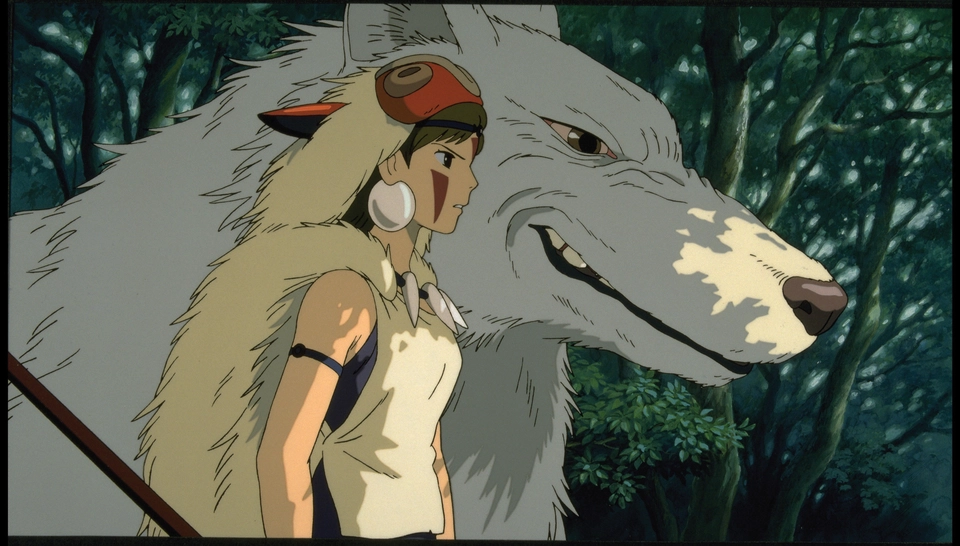
With Princess Mononoke, Miyazaki presented the global film community with a work of profound and troubling moral gravity, shattering any lingering Western assumption that animation was a medium for children only. Following the comparatively gentle My Neighbor Totoro by nearly a decade, the film was a watershed. It did not merely refine the ecological themes of Nausicaä; it complicated them to the point of irreconcilable conflict, cementing a reputation for philosophical rigor that would define the next phase of his career. For a working filmmaker, Princess Mononoke is a towering lesson in how to construct a narrative world where the antagonist is not a person but a system of competing, legitimate desires.
The central achievement is the refusal of a simple villain. The conflict is not between a hero and a tyrant but between two opposing societies with justifiable claims to existence. On one side stands Iron Town, led by the pragmatic Lady Eboshi. In a lesser film she would be a one-dimensional industrialist, a caricature of greed. Here she is a savior. She has built a functioning society for society's outcasts, providing refuge for former sex workers and lepers, giving them agency and purpose. Her ambition to clear the forest and mine its resources is not born of malice but of a fierce, protective drive to sustain her community. Her war against the forest gods is a rational, if ruthless, extension of her duty as a leader.
Opposing her is San, the "princess" of the film's title, raised by the wolf goddess Moro. She is the avatar of the natural world, but she is no peaceful steward. Her identity is forged in violence and a deep, abiding hatred for humanity. Her goal is not conservation but extermination. The film grants her rage its full, terrifying legitimacy. The forest itself is not a passive victim but an active, sovereign power. The boar clan, led by the blind Okkoto, charges into battle with tragic, suicidal fury. The ape tribe plants trees in a futile gesture of defiance. This is not backdrop; it is a world with its own politics, its own history, its own capacity for nobility and savagery.
What can a director or writer learn from this structure? The key is positioning the protagonist not as a champion for one side but as a mediator caught between them. Prince Ashitaka, cursed by a dying boar god, enters this conflict from the outside. His quest is not to choose the "right" side but to "see with eyes unclouded by hate." He is the audience's moral compass, but his needle is constantly spinning. He defends the men of Iron Town from San's attack, then moments later protects San from Lady Eboshi. That forces the viewer out of the passive mode of rooting for a hero and into active ethical consideration. The film poses a question it refuses to answer easily: when two valid ways of life are mutually exclusive, what does justice look like? The dramatic structure is closer to the tragedies of Kurosawa or the political dialectics of Pontecorvo's The Battle of Algiers (1966) than to a typical fantasy epic.
The visual language reinforces this systemic conflict. The design of Iron Town emphasizes function, community, and mechanical ingenuity; its bellows and forges are animated with a sense of lived-in purpose. The forest, by contrast, is a realm of deep shadow, dappled light, and ancient textures. The kodama, spirits rendered as simple, uncanny figures, signal the health of the woods by their presence. The film's most arresting sequences visualize the metaphysical consequences of this war: the curse on Ashitaka's arm writhes like a nest of demonic worms, and the death of a god is not a clean event but a grotesque explosion of flesh and rage. Animation used not to simplify reality but to give form to the terrifying and sublime forces that operate just beyond human understanding.
Case Study: Spirited Away
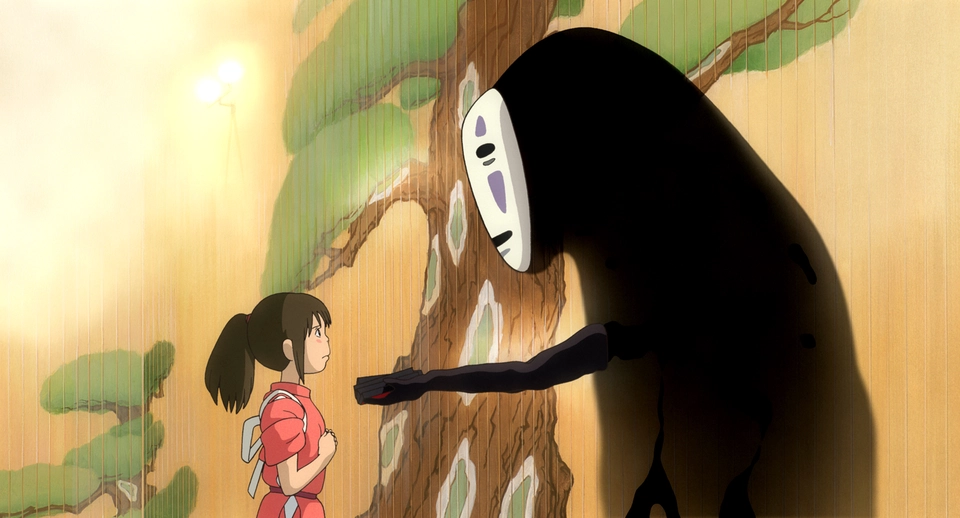
If Princess Mononoke demonstrated Miyazaki's thematic ambition, Spirited Away showcased his absolute mastery of narrative rhythm and world-building. The film became a global cultural event, proving that a story steeped in the specifics of Japanese Shinto folklore could achieve universal resonance. The primary lesson for filmmakers lies in its patient, accumulative storytelling and its radical confidence in quietness. It is the definitive text on the use of ma as an active narrative tool.
In much Western commercial filmmaking, and particularly in studio animation, every scene must propel the plot forward. Pauses are dead air, moments to be cut for efficiency. Spirited Away operates on the opposite principle. The film is rich with moments where nothing, in a conventional plot sense, happens. After her parents are transformed into pigs, a traumatized Chihiro huddles in a corner, shaking. Haku finds her and gives her a rice ball. She eats, and as she does, huge, silent tears begin to fall. The camera simply holds on her. There is no dialogue, no action, only the raw processing of grief and the small, human act of eating. That beat does more to establish her character and predicament than pages of exposition ever could. It is a pure interval, letting emotion land with devastating weight.
Consider the celebrated train sequence. Chihiro and the spirit No-Face take a journey across a vast, flooded plain to visit a witch. The train car is sparsely populated with silent, spectral figures. Outside, the world is a serene, melancholy watercolor of sea and sky. For minutes, the film simply lets the audience sit with Chihiro, experiencing the strange, sad beauty of this transitional space. The sequence does not advance the A-plot; it deepens the world's atmosphere and gives both the character and the viewer a necessary moment of contemplation before the next confrontation. What is the function of such a scene? It builds a texture of reality. It suggests the spirit world is not merely a series of obstacles for the hero but a place that exists on its own terms, with its own lonely expanses and quiet routines.
The narrative logic is the same. The world of the bathhouse is governed by a complex, sometimes contradictory set of rules that are never didactically explained. We learn them as Chihiro does: through observation, trial, error. Why must she keep her name? Why is the Stink Spirit a polluted river god? Why does No-Face become a monster when he consumes the greed of others? The film trusts its audience to connect these dots through visual and contextual clues. This method contrasts sharply with the exposition-heavy world-building of many contemporary blockbusters, where a character often serves as a proxy for the writer, explaining the rules of the game. Any screenwriter wrestling with how to seed information without slowing pace should study our exposition guide. By anchoring the audience completely in Chihiro's child perspective, the supernatural becomes an extension of her lived experience. The fantastic is not an intellectual puzzle to be solved but a reality to be navigated.
The hand-drawn aesthetic is integral to this process. The bathhouse is not a sterile set but a chaotic, lived-in environment, teeming with hundreds of distinct spirits, intricate woodwork, and the tangible textures of steam, water, and food. The animation conveys embodiment. We feel the strain in Chihiro's arms as she scrubs a floor, the slimy viscosity of the Stink Spirit, the unnerving weightlessness of Haku in his dragon form. This focus on the physical experience of labor and transformation is central to the story. Chihiro doesn't win through a clever trick or a magical gift; she survives and grows by learning to work, to persevere, to show kindness in a transactional world. A world becomes real not when you explain its rules but when you make its textures, its rhythms, and its silences felt.
Collaborators
To speak of a Miyazaki film is to speak of Studio Ghibli, the production house he co-founded in 1985. But the studio model is not one of anonymous functionaries. It is one of sustained, career-defining partnerships. Miyazaki is the singular authorial voice, but that voice has been amplified, refined, and made manifest by a core group of creative principals who have shaped the Ghibli aesthetic as much as he has.
The foundational partnership of Miyazaki's career was with Isao Takahata. More than a producer or co-founder, Takahata was Miyazaki's senior colleague from their early days at Toei Doga, a constant creative counterpoint, and a master director in his own right whose films provided a stark, often realist contrast to Miyazaki's fantasies. The existence of Takahata's devastating Grave of the Fireflies (1988), released as a double bill with My Neighbor Totoro, is the ultimate proof of the studio's artistic breadth. It prevented the Ghibli house style from ever calcifying into simple whimsy.
If Takahata was the artistic conscience, Toshio Suzuki has been the pragmatic engine. Joining Ghibli's leadership before the production of Totoro, Suzuki has served as the primary producer on every Miyazaki feature since. His contribution is not merely financial or logistical. By his own account and that of others, he is a key creative sounding board, acting as Miyazaki's first audience and most trusted critic. He protects the director's notoriously demanding, often improvisational process from the pressures of the commercial world, enabling the conditions for creation.
The sonic identity of a Miyazaki film belongs almost entirely to one man: Joe Hisaishi. Beginning with Nausicaä of the Valley of the Wind, Hisaishi has composed the score for every feature Miyazaki has directed. His work is inseparable from the films' emotional impact, capable of both monumental orchestral grandeur and profound intimacy. His score for Princess Mononoke gives the conflict its epic, tragic scale, while the simple, melancholic piano theme for the train ride in Spirited Away captures a feeling of wordless transition that is central to the film's power. Composers and directors thinking about the collaboration our sound design guide covers can find few better case studies.
In the modern Ghibli era, the task of integrating the studio's hand-drawn cels with digital tools has fallen to a consistent team. Atsushi Okui, serving as director of photography since Princess Mononoke, has been instrumental in this delicate fusion. His work ensures that digital compositing, lighting effects, and CGI elements enhance the texture of the hand-drawn animation rather than overwhelm it. Okui's supervision of the shimmering, translucent water spirits in Spirited Away is a prime example of using digital tools to achieve a painterly, organic effect that feels of a piece with the traditional animation.
The rhythm of a Miyazaki film, with its signature pauses and explosive bursts of action, is shaped in the edit suite. Takeshi Seyama has been a key figure here, credited as editor on major works from Princess Mononoke through The Wind Rises (2013). Seyama's cutting must balance the narrative demands of complex action sequences, like the aerial battles in Howl's Moving Castle, with the director's insistence on the contemplative quiet that lets scenes and emotions breathe.
Critical Reception and Counter-Readings
In the West, Miyazaki's popular reception was cemented by critics who positioned him as a vital alternative to the dominant American animation industry. Roger Ebert, one of his most influential American champions, repeatedly placed Miyazaki's films on his Great Movies list. In his essay on Spirited Away, Ebert praised its rejection of formula, admiring what he called the "gratuitous motion" in Miyazaki's films: "instead of every movement being dictated by the story, sometimes people will just sit for a moment, or sigh, or gaze at a running stream, or do something extra, not to advance the story but only to give the sense of time and place and who they are." For Ebert and his readership, Miyazaki offered a cinema of wonder, moral seriousness, and visual splendor that treated children as intelligent and emotionally complex beings, a reading that helped secure his canonical status for a generation of viewers.
The "anti-Disney" framework, though useful, has been complicated by more specific scholarly analysis. The work of academic Susan J. Napier, particularly in her book Miyazakiworld: A Life in Art, provides a crucial counter-reading to overly simplistic interpretations. Where a common reading sees Princess Mononoke as a straightforward ecological fable, Napier reframes it as a deeply Japanese narrative about the violent, traumatic transition from a pre-modern, animistic society to an industrial one. The struggle between Iron Town and the forest gods is not good versus evil but a tragic conflict between two irreconcilable, and equally vital, ways of life. Napier grounds the films in the context of Shinto belief, post-war anxieties, and Japanese history, moving the conversation beyond generic environmentalism.
Formalist critics, in the tradition of David Bordwell, offer another lens. A formalist reading focuses on how Miyazaki uses the unique properties of the animated medium to achieve his effects. The physical transformations of characters, a recurring motif, are not just plot devices but expressions of animation's inherent plasticity. In Howl's Moving Castle, Howl's metamorphosis into a bird-like creature is a visualization of his loss of humanity to the horrors of war. No-Face in Spirited Away swells and contorts based on the greed and desire it consumes, its unstable form a perfect animated representation of unchecked appetite. For the formalist, Miyazaki's genius lies not just in his stories but in his profound understanding of the medium's specific expressive capabilities, which allow him to render internal states as external realities.
Feminist criticism has also found a rich subject in his work. The films are populated by capable, independent, and psychologically resilient young women, from the warrior-scientist Nausicaä to the apprentice witch Kiki and the determined worker Chihiro. A feminist reading highlights how these protagonists achieve their goals through labor, empathy, and community-building rather than through romantic salvation or the exercise of violence. Chihiro's journey in Spirited Away is one of discovering her own competence and value through hard work in the bathhouse, a narrative of self-actualization that stands in stark contrast to the passive princess archetype. This focus on female agency, present since his earliest work, is one of the most consistent and celebrated threads in the critical discourse surrounding his filmography.
What Working Filmmakers Should Steal
Steal: The Ma of Negative Space Miyazaki's use of ma (emptiness, interval) is a powerful tool for pacing and atmosphere. It is the deliberate inclusion of quiet moments that do not advance the plot. The mechanic is simple: instead of cutting directly from one plot point to the next, hold on a shot of a character staring into space, a terrain empty of action, a detail of the environment. In Spirited Away, the long, quiet train sequence features Chihiro and her companions simply sitting and watching the spectral scenery pass by. The scene serves no narrative function, yet it is emotionally indispensable, letting both the character and the audience process the preceding chaos and contemplate the journey. Use these beats to build texture and give the viewer breathing room. It is a choice of subtraction, not addition.
Steal: Ground Fantasy in Tactile Mechanics Fantastical elements become believable when they are grounded in plausible physics and sensory detail. When you design a magical object or creature, give it limitations and a sense of physical effort. How does it operate? What does it sound like? Does it require fuel or maintenance? The titular castle in Howl's Moving Castle is not a graceful, floating marvel; it is a clanking, jury-rigged heap of buildings that belches steam and seems to move with immense, groaning effort. We believe in the castle because it feels heavy, precarious, subject to friction and decay, even as it defies the laws of architecture. The approach trades ethereal wonder for a more resonant, lived-in magic.
Steal: Animate the Environment as a Character In Miyazaki's films, the setting is never a passive backdrop. It is an active participant with its own agency. This is more than pathetic fallacy. The mechanic is to give the environment behaviors. In pre-production, treat the forest, the wind, or the sea as a character with motivations. In Princess Mononoke, the forest is not a location but a living system whose creatures and spirits actively respond to the narrative's events. The ground itself is shown healing after violence, then withering in response to the Deer God's decapitation. Environmental change is not weather; it is reaction. Storyboard weather, seasonal change, and biological response the same way you storyboard character behavior, then use foley and score to reinforce the environment as a speaker in the scene, not the room in which the scene happens.
Steal: The Ensemble of Female Protagonists Who Work Miyazaki's female leads earn their outcomes through labor and competence rather than rescue or romance. Nausicaä studies the toxic jungle to understand it. Kiki delivers packages to make rent. Chihiro scrubs floors. San hunts. Sophie cleans. The mechanic is to give the character a job, then let the film show her doing it. Skill is dramatized through repeated action, not through a single flashy display. When you introduce a female protagonist, write two or three concrete tasks she performs across the film and let audiences watch her get better at them. The Character Want vs. Need framework applies: the want is often external (get home, save the forest), but the need is competence, and competence has to be visible on screen.
Steal: The Ambiguous Antagonist Structure Give the opposing force a legitimate moral claim. Lady Eboshi is not evil; she is protecting a community that would be discarded elsewhere. Yubaba is not evil; she runs a business with a contract. The mechanic is to write the antagonist's opening statement of purpose as if you agreed with it, then build the conflict from the impossibility of two legitimate positions sharing the same ground. In dialogue passes, if the villain's justifications sound cartoonish, the piece has not done its work. Our subtext guide covers a related discipline: giving lines a surface argument and a deeper drive so that ideology is felt rather than announced.
Steal: World-Building Through Rules Never Explained The bathhouse in Spirited Away is governed by dozens of rules: names, contracts, food, spiritual pollution, hierarchy. None of them are explained through dialogue. Chihiro learns them by breaking them. The mechanic is to write a bible for the world (a document only you will read), then delete every scene in the script where a character speaks a rule aloud. Force the plot to teach the rule through consequence. If a scene needs a character to say "here is how it works," rewrite it so the character shows how it works, and the audience deduces the rule from the aftermath.
Further Study
Films in viewing order
Watch these seven in sequence and Miyazaki's arc will become legible as a single conversation with himself.1. Nausicaä of the Valley of the Wind (1984). The foundation. Ecology, flight, and a resilient female protagonist all begin here.
Primary reading
1. Miyazaki, Hayao. Starting Point: 1979-1996. VIZ Media, 2009.
Sources and Further Reading
Critical Texts and Scholarship
- McCarthy, Helen. Hayao Miyazaki: Master of Japanese Animation. Stone Bridge Press, 1999.
Research References
---
© 2026 BlockReel DAO. Master Studies series. Licensed under CC BY-NC-ND 4.0.