Open Door: Viral YouTube Short Lands 6-Figure Deal
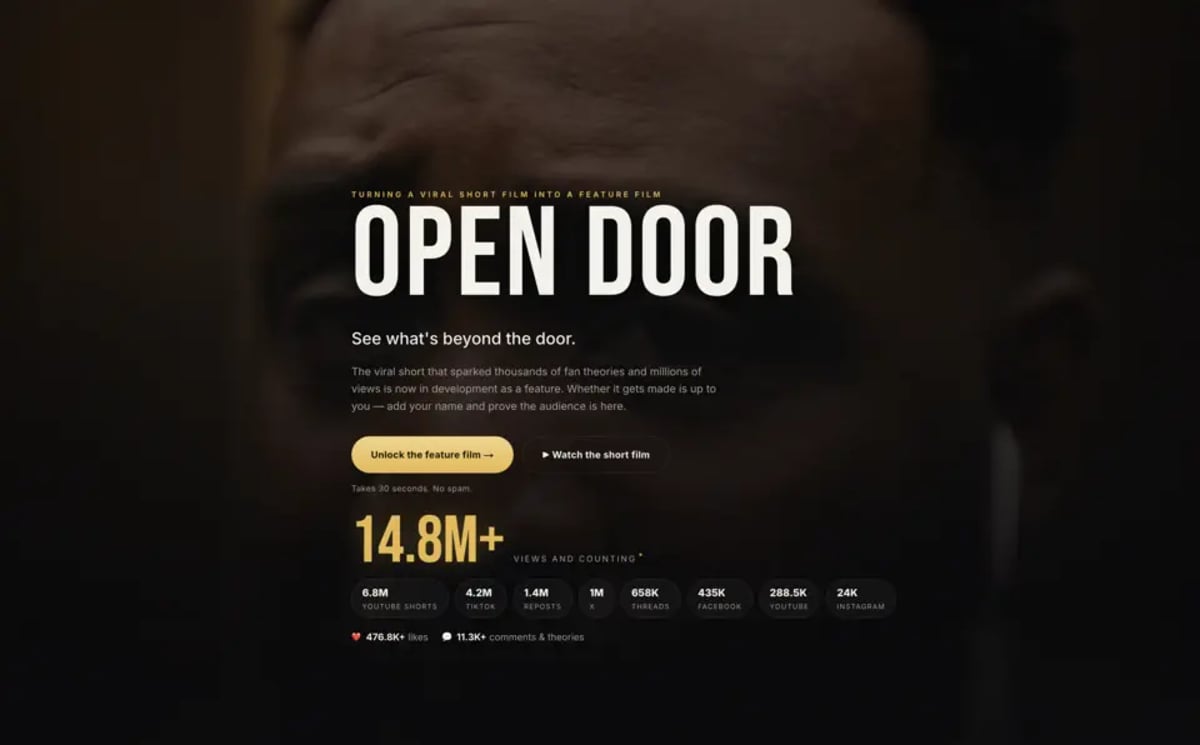
Another day, another viral sensation pivots toward Hollywood, or so it seems. Kevin Cate's sci-fi short, "Open Door," a three-minute foray into an elevator ride from hell, has reportedly secured a six-figure development deal to become a feature film. The news, broken by Variety, cites nearly 15 million collective views across YouTube shorts, TikTok, and Instagram, suggesting the industry is indeed keenly watching where the digital eyeballs land. This isn't just about a new project; it's a reiteration of a developing trend, one where established audience engagement on social platforms begins to dictate development slates.
When did a YouTube view count become a significant metric for studio greenlight committees, one might ask? Or perhaps, more accurately, a metric for the development executives looking to acquire material with a built-in fanbase? We've seen this play out before, of course, with "Backrooms" and "Obsession" cited in the Variety report as recent successes originating from online creators. It's a pragmatic, if somewhat opportunistic, approach for studios looking to mitigate risk in an increasingly fractured media landscape. Why spend millions on market research when you have organic, verifiable proof of concept in the form of millions of clicks and shares?
The reported six-figure development deal for "Open Door" signifies more than just an investment in a singular project. It's a clear signal to filmmakers, particularly those operating outside the traditional studio system, that demonstrating a pre-existing audience is a tangible asset. This isn't groundbreaking, precisely; independent filmmakers have always sought ways to prove market viability. What has shifted, however, is the democratization of the platform to achieve that proof. No longer solely dependent on film festival buzz or critical acclaim, a short film can now go "viral" and attract industry attention solely on the strength of its digital reach. This presents filmmakers with a specific kind of challenge: how to build an audience organically, not just for a proof-of-concept, but for continuous engagement.
Cate wrote the spec script for the feature adaptation with Charles Spano, known for his work on "IO." This detail subtly highlights another element of this new landscape: the necessity, or at least the perceived benefit, of pairing emerging digital talent with established screenwriters. While Cate clearly has a compelling vision for "Open Door," bringing in someone like Spano suggests an acknowledgment that translating a three-minute, high-concept short into a feature-length narrative requires a particular craft, one honed by years of diving into the nuances of three-act structures and character arcs. It's not simply about extending the runtime; it's about expanding the world without diluting the core hook that drew nearly 15 million viewers in the first place. You have to ask, what does an "elevator ride from hell" look like over 90 minutes, and how do you maintain that breathless tension beyond the initial concept? The process of adapting shorts into features often involves significant conceptual expansion, transforming terse, impactful sequences into a fully articulated narrative. Knowing when to escalate the stakes and how to keep a focused story from becoming diluted across a longer format is a fundamental skill. For screenwriters, understanding plant/payoff systems becomes especially critical in projects like this, layering in details that pay off in unexpected ways down the line.
The retention of the original short's cast, Sean Anthony Baker and Mia Matthews, as the leads for the feature, is a telling decision. "We are ride or die with our original cast and crew who made this all happen," Cate stated. This isn't just a nod to loyalty; it's a strategic move. The faces that resonated with millions of viewers are now part of the feature's package, offering a sense of continuity and familiarity to the pre-existing audience. For a project whose entire value proposition is tied to its viral roots, disconnecting it from its original performers could be a misstep. Think about the continuity of voice and presence when translating a beloved character from one medium to another; it's often the familiar elements that reassure the fanbase while the narrative expands. It demonstrates an understanding that audience connection isn't just with the concept, but with the specific iteration they first encountered. It's a calculated gamble to tap that existing emotional investment.
Malcolm Powers, the subject of this "surreal, genre-bending journey," as per the official statement, starts in an elevator. This initial setup is, by design, incredibly confined and thus dramatically efficient for a short. For the feature, that confinement presents both an opportunity and a challenge. What does "genre-bending" actually entail when a short is defined by its singularity of setup? Does it veer into psychological thriller territory, or embrace more overt sci-fi elements as the "elevator from hell" descends or ascends into unfamiliar narrative terrain? The expansion will require significant narrative ingenuity to maintain the specific tone and atmosphere that made the short compelling. This kind of creative expansion often dictates how well a project transitions from a concise, impactful moment to a sustained story. Thinking through character arcs and how they evolve within an increasingly complex plot becomes essential.
The production team also sees the continuity from the short to the feature. Rick Kearney is attached as executive producer, working with Cate’s Clinging Vine Films. This indie venture previously produced Cate’s upcoming film "Unbearable Christmas," which sounds like a title that promises a certain brand of dark comedy or psychological thriller, featuring a cast that includes Julia Stiles, David Cross, and Stephen Root. The involvement of experienced actors like Stiles, Cross, and Root in his prior work suggests Cate has already navigated the landscape of working with established talent, which could smooth the process for "Open Door." It indicates a filmmaker who isn't entirely new to the rodeo, even if his viral success is a more recent phenomenon.
Cate's quote, "I literally can’t go a day without someone asking me what our characters saw down there," is a telling observation about the power of an unresolved narrative hook. It speaks to the fundamental human desire for answers and closure, which is precisely what makes short-form content with a cliffhanger so potent. This isn't new; filmmakers have used intrigue to great effect for decades. What is new is the direct, unmediated feedback loop provided by social media. Viewers are not just passively consuming content; they are actively engaging, speculating, and, critically, demanding more. For studios, this demand is gold. It's a pre-validated market signal.
The launch of a dedicated website for the film, offering "clues and updates for fans," along with "theories and behind-the-scenes content," illustrates a savvy approach to maintaining audience engagement throughout the development process. It's a direct-to-consumer marketing strategy woven into the very fabric of the film's genesis. This cultivation of a community isn't just about hype; it’s about sustaining the viral momentum, transforming casual viewers into invested stakeholders long before principal photography even begins. It also generates valuable data and insights, allowing the creators a unique feedback loop.
Currently, the team is working on the budgeting process, with additional casting options being considered. "And we’ve written some of the most incredible roles to make this a next-level project," Cate added. "Right now, it’s just a matter of showing the demand and finding our village." This phrase, "finding our village," is a blunt reminder of the enduring challenge in filmmaking: raising capital. Even with a six-figure development deal and a viral pedigree, the actual production funds still need to be secured. The deal gets them started, but it doesn't guarantee the finish line. This is where the rubber meets the road, where the buzz of 15 million views needs to translate into hard cash from investors who believe in the expanded vision. Development deals, while crucial, are just that: development. They fund the writing, perhaps some early pre-visualization, and further packaging, but not the entirety of the production.
The Variety report also mentioned other YouTube creators, like Dylan Clark ("Portrait of God") and Sam Evenson ("Mora"), who are set to helm features. This further reinforces the idea that YouTube and platforms like it are becoming de facto proving grounds for a new wave of filmmakers. These creators are not merely making short videos; they are, often inadvertently, creating sophisticated proof-of-concept trailers for their larger cinematic ambitions. They are demonstrating an understanding of visual storytelling, tone, and audience capture that is increasingly valued by an industry perpetually searching for the next big thing.
What does this mean for professional filmmakers who have spent years honing their craft through traditional avenues, attending film schools, slaving over scripts in writers' rooms, and paying their dues on set? It suggests a broadening of the entry points into the industry, a parallel track, if you will. While the fundamentals of storytelling, cinematography, editing, and sound design remain immutable, the path to gaining attention has diversified. It also demands a certain adaptability from established professionals to recognize these new pipelines. How do you assess the quality of a viral short in the same way you might assess a meticulously shot festival darling? The metrics, while different, are both valid in their own contexts. The question isn't whether one path is superior, but how these diverging paths will intersect and shape the future of film production and distribution.
The success of "Open Door" will be a bellwether for many. Its transition from a three-minute online curiosity to a potential feature film will be a meticulous case study in how far audience engagement can propel a project. Will it retain the unique spark of its short form, or will the demands of feature-length storytelling dilute its impact? Will the "genre-bending journey" resonate with a broader theatrical audience, or will it remain a niche hit primarily appealing to its established online fanbase? These are the real questions that will be answered as Cate and his team move beyond development and into production, assuming they find their full "village" of backers. It is an evolving landscape, and projects like "Open Door" serve as critical markers in understanding its shifts. The industry, it seems, is still very much in search of compelling narratives, regardless of their origin, and sometimes, those narratives start with an elevator ride to unexpected places. It will be interesting to observe how Cate's approach to writing action lines translates from the concise form of a short to the expansive canvas of a feature, to keep the engagement tight and visual.
---
© 2026 BlockReel DAO. All rights reserved. Licensed under CC BY-NC-ND 4.0 • No AI Training. Originally published on BlockReel DAO.