Alfred Hitchcock: Filmmaking Techniques, Vertigo & Psycho Analysis
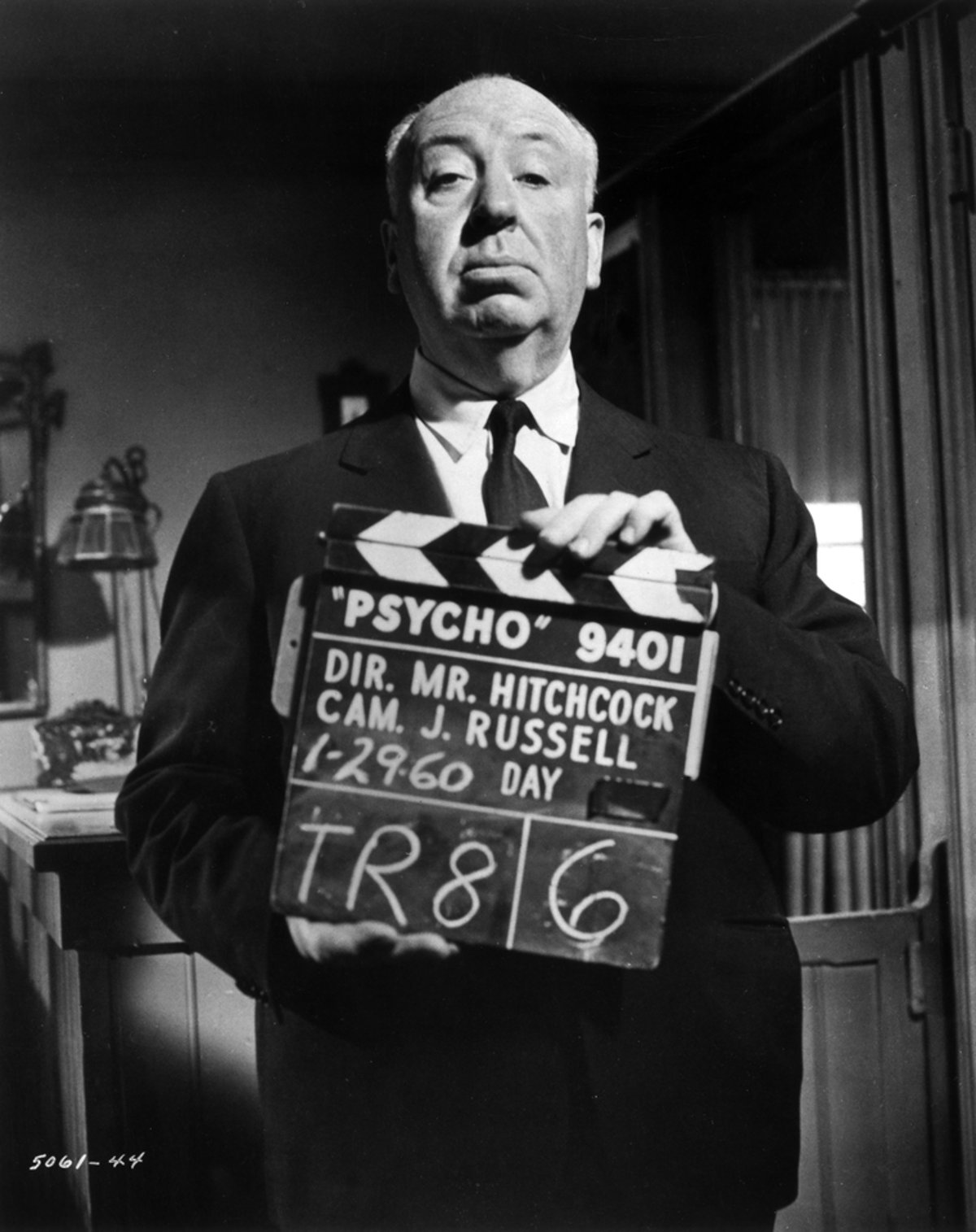
> This study contains affiliate links. BlockReel may earn a small commission on qualifying purchases at no extra cost to you. All commissions go directly toward funding our DAO Film Festival and supporting independent filmmakers.
A sudden, piercing shriek. The sound is not music, not dialogue, but an assault, a violation of the film's established sonic world. It is a moment of pure, unadulterated terror, achieved not through explicit gore but through the visceral impact of sound and rapid-fire cutting. The sequence in question, the shower murder in Psycho (1960), remains one of cinema's most analyzed and imitated set pieces, and it still sets the benchmark. Here, the camera does not linger on the blade's entry, but rather on the victim's contorted face, the frantic movements, and the gush of water turning crimson. The effect is less about seeing violence than experiencing its abrupt, shocking intrusion.
This carefully orchestrated sensory overload, where sound and image combine to create a psychological rather than a purely visual horror, exemplifies a core tenet of Hitchcock’s approach to filmmaking. He understood that the true locus of fear resides in the mind of the audience, manipulated by what is suggested, implied, or abruptly withheld. The staccato editing, a flurry of short takes, denies the viewer a stable perspective, mirroring the victim's disoriented panic. Bernard Herrmann’s shrieking strings, a deliberate choice over traditional orchestral accompaniment, carve a distinct sonic identity for the violence, making the scene unforgettable. This is not merely a moment of narrative shock; it is a carefully constructed exercise in cinematic manipulation, demonstrating a deep understanding of how to weaponize the tools of the medium to elicit a primal response. The scene transforms an intimate, vulnerable act into an arena of sudden, inexplicable brutality, leaving an indelible mark on cinematic history and the audience's psyche.
The Arc
Alfred Hitchcock's career spanned over five decades, a trajectory that began in the nascent British film industry of the 1920s and culminated in his status as a globally recognized auteur. His initial foray into cinema was not as a director but as a title-card designer for silent films at Famous Players-Lasky in London. This early exposure to the visual grammar of storytelling, even in its most rudimentary form, likely informed his later emphasis on precise visual communication. While accounts vary regarding his first directorial effort, with some sources citing an unfinished 1922 feature titled Number 13 and others pointing to The Pleasure Garden (1925) as his first completed feature, it was The Lodger: A Story of the London Fog (1927) that is widely considered to have established his signature style. This film, with its themes of suspicion and mistaken identity, laid groundwork for the psychological thrillers that would become his hallmark.
The 1930s saw Hitchcock solidify his reputation in Britain, with films like The 39 Steps (1935) achieving significant international recognition. These British productions honed his craft in building suspense, often through the careful control of information and the manipulation of audience expectations. His move to Hollywood in 1939 marked a significant turning point, ushering in what is often categorized as his first American phase. Rebecca (1940), his inaugural American film, immediately garnered critical acclaim and won the Academy Award for Best Picture, signaling his successful transition to the larger canvas of the American studio system. This period saw him working with Hollywood stars and expanding his thematic preoccupations, though his core interest in suspense and psychological tension remained constant.
The later American phase of his career, roughly from the mid-1950s through the 1960s, is perhaps his most celebrated, producing a string of films that are now considered classics of the medium. Works such as Rear Window (1954), Vertigo (1958), North by Northwest (1959), Psycho (1960), and The Birds (1963) exemplify a period of intense creative output and formal experimentation. During this era, Hitchcock frequently collaborated with a consistent team of craftspeople, including cinematographer Robert Burks, editor George Tomasini, and composer Bernard Herrmann, whose contributions were central to the distinct visual and sonic identity of these films. This period saw a deepening of his thematic concerns, exploring obsession, guilt, voyeurism, and the fragility of identity with increasing psychological complexity.
Hitchcock's evolution was characterized by an unwavering commitment to visual storytelling and the deliberate manipulation of audience perception. From his early British thrillers to his later, more ambitious Hollywood productions, he consistently refined his techniques for generating suspense, often prioritizing a prolonged state of tension over sudden plot twists. His films frequently transformed ordinary settings into sites of real danger, whether it was an apartment courtyard in Rear Window or a quiet coastal town in The Birds. This ability to imbue the mundane with menace became a signature element of his style. His career, which concluded with Family Plot (1976), represents a continuous exploration of cinematic language, leaving an indelible mark on the art form and establishing him as a master of suspense whose influence continues to resonate across generations of filmmakers.
Signature Techniques
The Confined Gaze: Subjectivity as Suspense
Hitchcock’s most influential structural device is the restriction of narrative information to a single character’s point of view. Where many filmmakers use omniscience to build dramatic irony, Hitchcock generates suspense by trapping the audience inside a limited, often fallible, consciousness. The definitive example remains Rear Window (1954). The film’s formal conceit, confining nearly its entire visual field to what L.B. Jefferies can see from his apartment window, is not a gimmick. It is the engine of the narrative. We, the audience, are forced into the same ethical and epistemological position as Jeff: we become voyeurs, assembling a story of a potential murder from fragmented, ambiguous visual data.
The grammar is built on the eyeline match. The rhythm of Jeff looking, followed by a shot of what he sees, then a shot of his reaction, is a sustained exercise in the Kuleshov effect. The meaning is not in the shot of the neighbor, Mr. Thorwald, but in the sequence: Jeff’s suspicious glance, Thorwald washing a knife, Jeff’s worried frown. The cinematographer Robert Burks, a key collaborator on Hitchcock’s major American works, renders the courtyard with a deep-focus clarity that makes it a perfect stage for this projected drama. Yet the system is not entirely rigid. When Lisa (Grace Kelly) enters Thorwald’s apartment, the camera stays with Jeff, rendering us as powerless as he is. Our viewpoint is suddenly severed from the agent of action. The suspense escalates precisely because our knowledge, once aligned with Jeff’s, is now terrifyingly incomplete. This manipulation of POV demonstrates that for Hitchcock, suspense was not about what was happening, but about what the character (and by extension, the audience) knew was happening.
The Uncanny Ordinary: Set-Pieces in Public Space
!Image The Birds (1963)
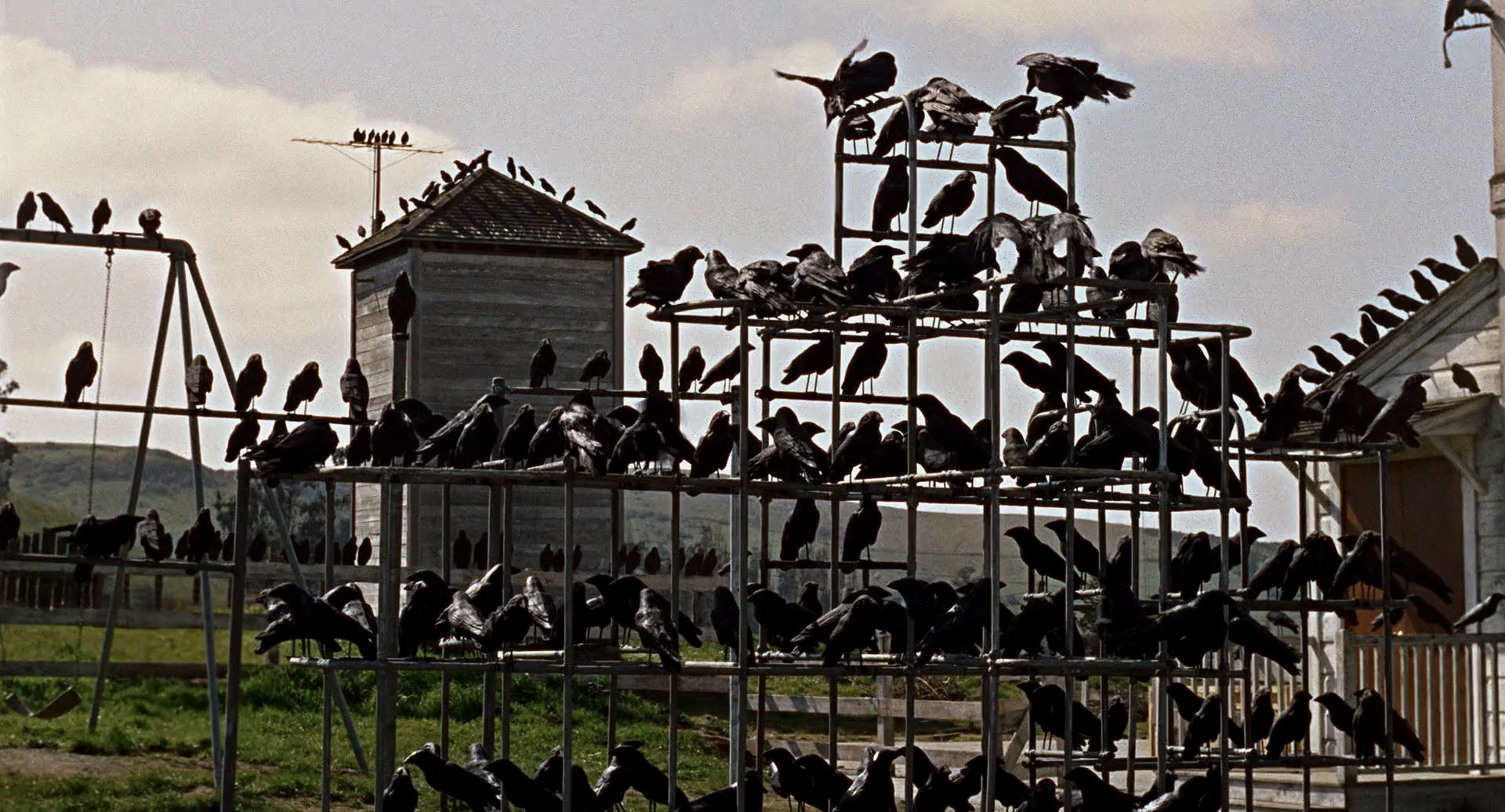
A recurring signature is the staging of extreme threat within mundane, even banal, environments. While his predecessors in German Expressionism found horror in stylized, gothic locales, Hitchcock brought it into the American daylight. The crop-duster sequence in North by Northwest (1959) is the archetype. Roger Thornhill (Cary Grant) is sent to a desolate, sun-drenched crossroads. There is no dark alley, no shadowy figure. The setting’s emptiness is the source of the tension. The threat, when it arrives, comes from the sky in the form of a crop-dusting plane, an object of agricultural utility turned into a weapon. The sequence is a masterclass in using negative space and open geography to create anxiety, subverting the audience’s expectation that danger requires shadow.
This technique extends across his work. The schoolyard in The Birds (1963) becomes a site of primal terror as the crows gather silently on the jungle gym behind an unsuspecting Tippi Hedren. The horror is amplified by the innocence of the location. Similarly, the climactic struggle of North by Northwest unfolds not in some abstract villain’s lair but on the face of Mount Rushmore, a public monument. By placing violence in these familiar, shared spaces, Hitchcock suggests that the mechanisms of civilization are a thin veneer. The order we take for granted can be ruptured at any moment, not by something from another world, but by the perversion of our own. It’s a powerful lesson for any filmmaker: the most effective scares are often those that invade the spaces we consider safe.
Psychological Doubling and the Fractured Self
Beyond plot mechanics, Hitchcock’s films are frequently organized around the theme of the fractured or doubled identity. This is not merely a narrative twist but a structural principle that shapes character, desire, and visual design. Vertigo (1958) is the central text for this obsession. The film is split into two clear halves: the investigation of Madeleine Elster and Scottie’s subsequent, pathological attempt to remake the living Judy Barton into the image of the dead Madeleine. The doubling of Kim Novak’s role is the film’s core trauma. Scottie is not solving a crime so much as directing a ghost, forcing a performance of an identity that never truly existed. The film’s power comes from this queasy, necrophilic project.
One way to see this is as a direct critique of a certain kind of male cinematic gaze, one that seeks to construct and control the female image. Is Scottie’s project not a dark reflection of the director’s own? The film leaves the question unnervingly open. Psycho (1960) presents a more literal, clinical fracture. The narrative’s brilliant misdirection hinges on the audience’s assumption that Norman Bates and his mother are two separate people. The final reveal, that Norman has subsumed his mother’s identity, reframes the entire film. Every interaction is retroactively doubled. The polite, stammering boy at the front desk is also the puritanical, murderous matriarch. This device, executed with the help of George Tomasini’s sharp editing, turns the film from a simple slasher into an inquiry into the dark corridors of the self, where identity is not a stable monolith but a contested, often violent, territory.
Audiovisual Architecture: Color and Sound as Character
!Image Kim Novak in Vertigo (1958)
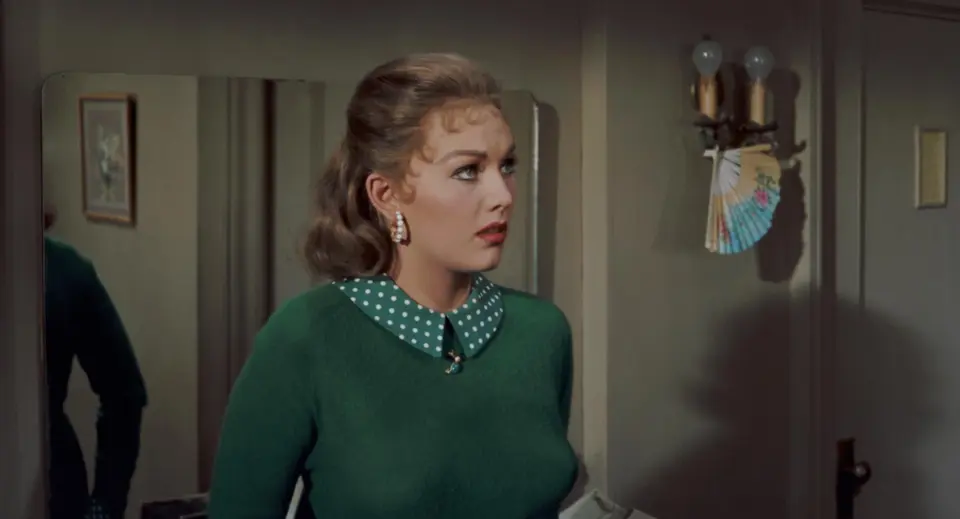
In Hitchcock’s mature period, color and sound cease to be adjunctive elements and become primary components of the psychological storytelling. The collaboration with composer Bernard Herrmann, in particular, produced scores that function less as accompaniment and more as a direct transmission of the films’ nervous state. The score for Psycho is the most famous example. Composed entirely for a string orchestra, its shrieking, stabbing violin glissandos in the shower scene are inseparable from the violence they portray. Herrmann’s music doesn’t just tell you to be scared; it is an active agent of the assault, a sonic weapon.
The inverse is true in The Birds. The decision to forgo a conventional score was a radical one. In its place, the soundscape is composed of electronically manipulated bird calls and an oppressive silence. The absence of music denies the audience the comfort of emotional guidance, forcing them to confront the raw, inexplicable nature of the attacks. The sound design becomes a procedural element, tracking the escalation from isolated incidents to apocalyptic siege.
Color operates with similar structural force in Vertigo. The film’s use of green is a recurring visual motif tied to the spectral presence of Madeleine. It appears in her car, in a dress, and most famously, as the ghostly neon light that bathes Judy during her final transformation back into Scottie’s obsession. The green is not merely symbolic of jealousy or ghosts; it is the very atmosphere of the uncanny, the color of a memory made flesh. Working with cinematographer Robert Burks, Hitchcock uses lighting and production design to make color an active participant in Scottie’s psychological unraveling. The visual world of the film is as sick as its protagonist.
Case Study: Rear Window (1954)
!Image Irene Winston in Rear Window (1954)
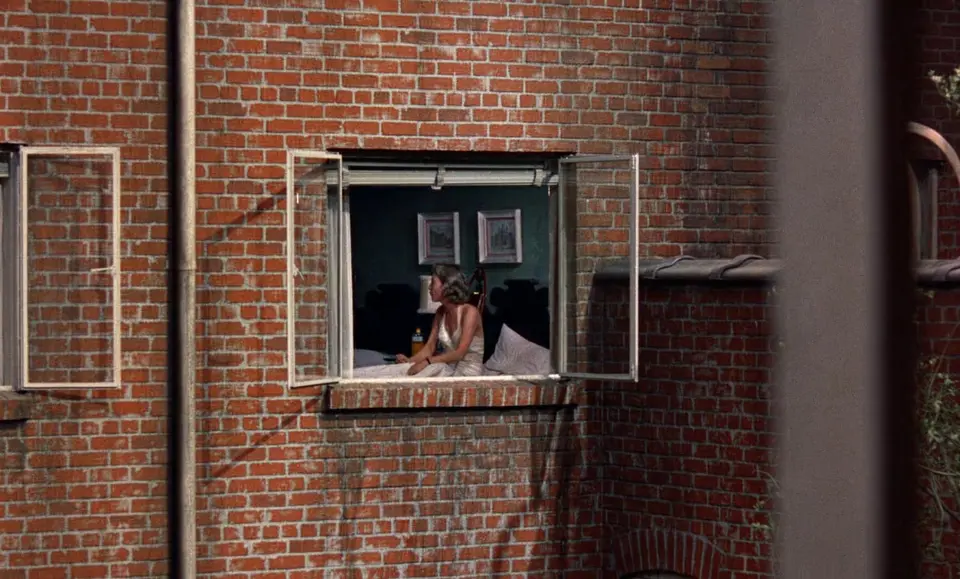
The premise of Rear Window (1954) is a formalist’s dream, a constraint so severe it becomes the engine of the entire film. A news photographer, L.B. "Jeff" Jefferies (James Stewart), is confined to his Greenwich Village apartment with a broken leg. His world shrinks to what he can see through his rear window: a courtyard and the lives of his neighbors playing out in their own apartments. This restriction is not merely a narrative setup. It is the film’s governing principle, aligning the audience’s perspective so completely with Jeff’s that we are trapped alongside him. Hitchcock, working with cinematographer Robert Burks, establishes a visual grammar where nearly every piece of information about the central mystery, the suspected murder of Mrs. Thorwald, is filtered through Jeff’s physical and perceptual limitations. We see what he sees, when he sees it.
This system is built on one of the foundational techniques of cinematic language: the point-of-view shot sequence. The film’s rhythm, established by editor George Tomasini, is a relentless pattern of Jeff looking, a shot of what he observes through his binoculars or long-focus lens, and a shot of his reaction. It is a feature-length application of the Kuleshov effect, where meaning is generated not within a single shot but through the juxtaposition of shots. A woman sunbathes, a composer struggles with a melody, a lonely woman stages a dinner for an imaginary lover. Each window becomes a separate screen, each life a silent film to which Jeff (and the audience) provides the narrative. The film’s genius lies in how this fragmented, observational mode gradually coalesces into a thriller plot. The audience becomes an active participant in Jeff’s detective work, piecing together clues from glances, drawn blinds, and objects carried in the night.
On this reading, Rear Window is one of cinema’s most direct interrogations of spectatorship itself. Jeff is a clear surrogate for the filmgoer, sitting in a darkened room and watching private lives unfold at a safe remove. His camera, with its telephoto lens, is an instrument of seeing, but it is also an instrument of intrusion. The film makes the audience complicit in his voyeurism. The central ethical question, voiced by his visiting nurse Stella (Thelma Ritter), is whether we have any right to look. Hitchcock doesn't provide a simple answer. Instead, he complicates the question by making the looking necessary. Jeff’s prying might be morally dubious, but it is also the only path to uncovering a potential murder. The film thus places the audience in a classic Hitchcockian bind, implicating us in an act that is simultaneously transgressive and potentially heroic.
Suspense is generated not by what we see, but by the constant threat of what we might miss or what might happen outside our fixed vantage point. When Jeff’s girlfriend, Lisa Fremont (Grace Kelly), crosses the courtyard and enters the suspected killer’s apartment, the camera does not follow her. It remains in Jeff’s room, sharing his helplessness. We watch her as a small figure in a distant window, her safety entirely outside our or Jeff’s control. The formal constraint, once a source of intellectual curiosity, becomes a source of genuine anxiety. This discipline is a lesson for any director in the power of withholding information. By refusing to give the audience a privileged, omniscient view, Hitchcock maximizes the tension of every uncertain moment. The most terrifying shot in the film is not of violence, but of the killer, Lars Thorwald (Raymond Burr), finally looking back, directly at Jeff, and therefore directly at us. The barrier between observer and observed is broken.
Case Study: Psycho (1960)
!Image Psycho (1960)
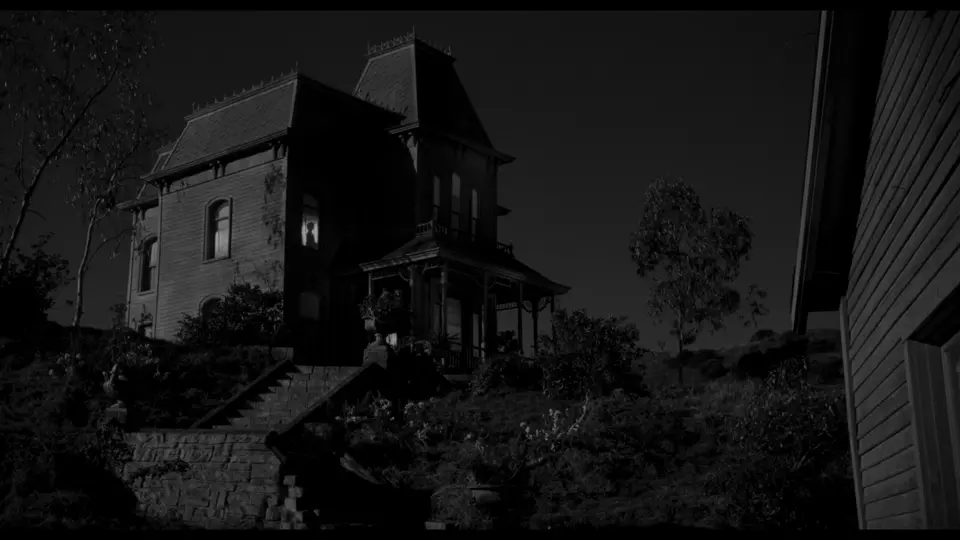
More than any of Hitchcock’s other major works, Psycho (1960) is a film about narrative assault. Its most famous contribution to the craft of filmmaking is not a single technique but a structural violation. For its first act, the film presents itself as a recognizable crime drama centered on Marion Crane (Janet Leigh), a secretary who impulsively steals $40,000 and goes on the run. We follow her flight, her mounting guilt, and her fateful decision to stop for the night at the Bates Motel. The audience is locked into her perspective, her anxieties becoming our own. Then, approximately 47 minutes into the film, Hitchcock does the unthinkable: he kills his protagonist. The shower scene is not just a moment of shocking violence; it is an act of narrative demolition. The story we thought we were watching is abruptly terminated.
The mechanics of that scene are a masterclass in suggestion and sensory overload. Working with Saul Bass on the storyboards and George Tomasini on the edit, Hitchcock constructs the murder from a barrage of fragments. The sequence, lasting less than a minute, is composed of dozens of shots: a silhouette through a shower curtain, a close-up of a screaming mouth, the glint of a knife, bare skin, and swirling water. We never see the knife penetrate flesh. The violence is an illusion created by the staccato cutting rhythm and the sonic attack of Bernard Herrmann’s score. Herrmann’s composition, written exclusively for a string section, provides the infamous shrieking violin stabs that have become synonymous with cinematic terror. The sound does not accompany the action; it is the action, a pure expression of psychic violence that bypasses rational analysis and strikes directly at the nervous system.
With Marion gone, the film executes its second brilliant maneuver, forcing a transfer of audience identification. The narrative vacuum is filled by Norman Bates (Anthony Perkins). We are made to watch as he discovers the crime, cleans the bathroom with methodical care, and sinks Marion’s car, containing her body and the money, into a nearby swamp. The suspense logic is inverted. We are no longer hoping the protagonist will escape; we are now caught in a deeply uncomfortable position, momentarily hoping the killer will succeed in hiding his crime. When the car briefly stops sinking, the audience shares Norman’s flicker of panic. This forced complicity is one of the film’s most disturbing and effective psychological ploys, implicating the viewer in the film’s pathology long before the final revelations.
The film’s visual and sonic design consistently reinforces its central theme of fractured identity. The black-and-white cinematography by John L. Russell gives the film a stark, grim texture, a world away from the saturated Technicolor of Hitchcock’s 1950s thrillers. Motifs of doubling and division are everywhere: the constant presence of mirrors, the Gothic house looming over the horizontal motel, and Norman’s own split speech patterns. Herrmann’s score mirrors this, often employing tense, unresolved musical phrases that seem to circle back on themselves. The entire aesthetic prepares the audience for the final psychological reveal, where Norman’s identity is shown to be a composite of himself and his taxidermied mother. While the closing scene, with a psychiatrist explaining Norman’s condition, is sometimes criticized as overly explicit, one can also read it as a final, formal shock, a cold, clinical explanation that is somehow more chilling than the supernatural horror the film had been feinting toward. Psycho tore up the rulebook, demonstrating that narrative structure itself could be the filmmaker’s most powerful tool for suspense and disorientation.
Collaborators
Alfred Hitchcock’s public persona as the singular, controlling “Master of Suspense” often obscures the long-term, deeply symbiotic relationships he built with his key department heads. While his command was absolute, his late-career masterpieces are unthinkable without the small, consistent team that translated his psychological blueprints into sound and image. This unit, largely stable from the mid-1950s to the early 1960s, formed one of the most effective creative ensembles in studio-era Hollywood.
The most significant of these partnerships was with cinematographer Robert Burks, ASC, who shot twelve of Hitchcock’s films, including every feature from Strangers on a Train (1951) to Marnie (1964). Burks was not a stylist in the flamboyant mode of a Freddie Young or a Vittorio Storaro; his genius was in his adaptability to Hitchcock’s precise, often psychologically-driven visual mandates. For Rear Window (1954), Burks engineered the complex lighting of the courtyard set, simulating a full 24-hour cycle and motivating the shifting quality of Jeff’s surveillance. His work on Vertigo (1958) is perhaps their pinnacle, where the soft-edged, dreamlike diffusion of the film’s first half gives way to a harder, more saturated look as the fantasy collapses, culminating in the sickly green light that bathes Judy’s transformation back into Madeleine.
As Burks was to the image, George Tomasini was to its temporal construction. The editor on nine of Hitchcock’s features, including the entire run from Rear Window to Marnie, Tomasini’s cutting is the engine of Hitchcockian suspense. His work gave rhythm to the voyeurism of Rear Window, cross-cutting between Jeff’s look, the object of his gaze, and his reaction to create a closed circuit of subjectivity. In Psycho (1960), Tomasini’s frantic, almost subliminal montage for the shower sequence, dozens of cuts in under a minute, creates an impression of brutal violence while showing almost nothing explicitly. This is not cutting for continuity, but cutting as a form of direct assault on the viewer’s sensorium. Compare it with the opposite strategy, the elliptical editing of Kieślowski and Weerasethakul, where the cut withholds rather than attacks.
The sonic dimension of this period was defined by composer Bernard Herrmann. Though their collaboration was famously turbulent and ended acrimoniously over the score for Torn Curtain (1966), Herrmann’s music for films like Vertigo, North by Northwest (1959), and Psycho is inseparable from their meaning. Herrmann’s score for Vertigo is a Wagnerian spiral of unresolved romantic obsession, its main theme circling endlessly without catharsis. For Psycho, his radical decision to compose for a string orchestra only, using percussive, shrieking glissandi, provided the film’s true voice of violence, a sound that has since become cultural shorthand for terror. The principle still governs sound design practice: score is not decoration, it is information.
Beyond this core trio, the contributions of Saul Bass were formative. As a graphic designer and “visual consultant,” Bass created the title sequences for Vertigo, North by Northwest, and Psycho, establishing the film’s entire graphic and thematic identity before the first scene. The kinetic, grid-like typography of North by Northwest visualizes a world of rigid modernity and intersecting lines of fate, while the fracturing, splitting bars of the Psycho titles prefigure the film’s splintered psyche. Bass also provided detailed storyboards for key sequences, most famously the shower murder and the staircase death in Psycho, mapping out the shots with a graphic artist’s eye for composition and impact. Bass later claimed a directing role in the shower sequence, a claim Hitchcock and members of the crew, including Janet Leigh and assistant director Hilton Green, disputed. The storyboards are documented; the authorship of the shooting is not settled.
Finally, Hitchcock’s casting of his male leads reveals a strategic use of established star personas. James Stewart, in his four films for Hitchcock, was systematically stripped of his folksy, everyman decency and remade into a vessel for obsession and moral compromise. The Stewart of Rear Window and Vertigo is a man trapped, by a wheelchair, by a fetish, and his watching is tainted with impotence and pathology. Cary Grant, by contrast, was Hitchcock’s avatar of idealized masculinity set adrift. In North by Northwest, Grant’s suaveness is the perfect camouflage, an empty suit into which a false identity can be inserted, forcing the unflappable star to improvise his way through a world where his sophisticated persona is useless.
Critical Reception and Counter-Readings
Hitchcock’s critical fortunes trace a fascinating arc from popular entertainer to pantheon auteur. For much of his career, especially in the British and American press, he was regarded as a supremely skilled craftsman of popular thrillers, a master of a disreputable genre. The decisive re-evaluation came from France in the 1950s. Writing for Cahiers du Cinéma, young critics like François Truffaut, Éric Rohmer, and Claude Chabrol championed Hitchcock as a true author, arguing that his technical choices, camera placement, editing patterns, narrative structure, were expressions of a coherent and consistent worldview, one preoccupied with themes of guilt, transference, and Catholic metaphysics. Their advocacy, culminating in the book-length interview Hitchcock/Truffaut (1966), effectively imported auteur theory to the English-speaking world, where Andrew Sarris enshrined Hitchcock in his "Pantheon" of great directors in The American Cinema.
This auteurist reading, which sees the films as direct expressions of Hitchcock’s personal obsessions, became the dominant paradigm for decades. Robin Wood’s influential 1965 study, Hitchcock’s Films, solidified this approach, offering sophisticated psychoanalytic readings that connected the films’ recurring motifs to a consistent authorial psychology. For Wood, a film like Marnie was not a flawed thriller but a complex, deeply personal work of therapeutic self-exploration.
The first major challenge to this consensus came from feminist film theory in the 1970s. In her foundational 1975 essay "Visual Pleasure and Narrative Cinema," Laura Mulvey used Hitchcock’s work, particularly Vertigo and Rear Window, as prime exhibits for her theory of the “male gaze.” On this reading, the very structure of classical cinematic language is gendered, organized around an active male protagonist who looks and a passive female spectacle who is looked at. Scottie’s obsessive remaking of Judy into Madeleine in Vertigo is, for Mulvey, the ultimate cinematic enactment of sadistic voyeurism and fetishistic scopophilia, where the female character is punished and remolded to fit a male fantasy. This critique reframed Hitchcock’s “obsessions” not as the mark of a tortured artist, but as a particularly clear articulation of a patriarchal ideology embedded in the apparatus of cinema itself. Tania Modleski’s book The Women Who Knew Too Much: Hitchcock and Feminist Theory (1988) further complicated this, arguing that Hitchcock’s films often simultaneously critique the male positions they seem to endorse, creating space for a female spectator to identify with the films’ contradictions.
A different kind of counter-reading comes from formalist and cognitivist critics like David Bordwell. Less interested in psychoanalyzing the director or the culture, Bordwell focuses on the mechanics of narration and style. For a formalist, a Hitchcock film is a masterclass in the control of information. The suspense of The Birds (1963), on this view, derives less from any symbolic meaning (apocalypse, nature’s revenge) and more from its rigorous procedural construction: the systematic withholding of explanation and the relentless, logical escalation of the attacks. From this perspective, Hitchcock is less a confessor than a brilliant engineer of spectator response, using point-of-view structures, editing, and sound to shape our knowledge and expectations moment by moment. Here, the films are not primarily about guilt or desire, but about the process of watching, guessing, and being manipulated by a supremely intelligent narrative machine.
What Working Filmmakers Should Steal
The Subjective Shot as Character. Hitchcock’s use of the point-of-view shot goes beyond simple eyeline matching. He uses the optical properties of the shot to define character. In Rear Window, the telephoto lens isn’t just a tool for Jeff to see across the courtyard; its compression of space and shallow depth of field make his gaze feel intrusive, flattening his neighbors into specimens under a microscope. The choice of lens becomes a moral statement. Steal this by asking not just "What does the character see?" but "How does their psychological state determine the quality of their seeing?"
Information Disparity as Suspense. The foundational Hitchcockian principle: give the audience information that a character in the scene lacks. This turns the audience from passive observers into active, anxious participants. We see the crop-dusting plane in North by Northwest long before Roger Thornhill recognizes it as a threat. The suspense isn’t in the attack itself, but in the agonizing wait for the character to catch up to our knowledge. A filmmaker can build this into a script by mapping out three columns for every scene: what Character A knows, what Character B knows, and what the audience knows. The tension lives in the gaps.
The MacGuffin as Narrative Liberator. Hitchcock’s famous term for the plot device that motivates the characters but is of little importance in itself, the government secrets in North by Northwest, the uranium in the wine bottles of Notorious (1946). By making the plot’s central object functionally meaningless, he freed the film to focus on what truly mattered: the psychology of the characters, the romantic tension, and the mechanics of the suspense set-pieces. For a working filmmaker, this is a powerful tool for decluttering a script. If the plot is getting bogged down in exposition about the "thing," consider making the "thing" irrelevant and focusing on the human drama it ignites.
Color as a Recurring Motif. In Vertigo, the color green is not just an aesthetic choice; it is the color of the ghost. It appears on Madeleine’s car, in a floral arrangement, and most famously, as the spectral neon glow that envelops Judy as she is reborn as Madeleine. This use of color as a thematic and psychological marker provides a subconscious layer of meaning. It’s a technique that requires discipline across production design, wardrobe, and lighting. Pick one color to associate with an idea or obsession and thread it through the film in moments of high emotional stakes.
Sound as Weapon, Silence as Threat. The score for Psycho is the obvious example, where Herrmann’s strings do the work of the knife. But the sound design of The Birds is arguably more radical. By removing music entirely and building a soundtrack from electronically manipulated bird calls, natural sounds, and unsettling silence, Hitchcock creates a world where the auditory environment itself is the antagonist. The silence before an attack is as terrifying as the attack itself. Contemporary horror still works this seam, as in Ian Tuason's audio-first debut Undertone. This demonstrates the power of a subtractive approach: what you take out of a mix can be more potent than what you put in.
Architectural Storytelling. Hitchcock used sets not as passive backdrops, but as active participants in the drama. The single courtyard of Rear Window is a prison and a cinema screen. The Bates Motel and house in Psycho are a physical manifestation of Norman’s split psyche, with the horizontal motel representing his public face and the vertical, Gothic house his repressed maternal superego. When designing or choosing locations, think of them as characters with their own internal logic and relationship to the protagonist’s journey. The geography of the space should dictate blocking and reveal theme.
Further Study
Films:
The 39 Steps* (1935): The template for his "man on the run" thrillers, executed with breathtaking economy in his British period. Notorious* (1946): A masterclass in romantic suspense, featuring one of cinema’s most politically and emotionally charged love triangles. Rope* (1948): A bold formal experiment attempting to feel like a single, continuous take, trapping the audience in a claustrophobic apartment with two murderers. Frenzy* (1972): A late-career return to Britain and to form, notable for its grim tone and a sequence that generates immense suspense by placing the camera outside a door while a murder occurs within.
Books:
Hitchcock/Truffaut* by François Truffaut (1966): The foundational text. An exhaustive, career-spanning conversation that is effectively a multi-day masterclass on directorial craft. Hitchcock's Films Revisited* by Robin Wood (Revised Edition, 2002): The most influential work of auteurist-psychoanalytic criticism on the director, essential for understanding how his films were first canonized. The Women Who Knew Too Much: Hitchcock and Feminist Theory* by Tania Modleski (1988): A key text in the feminist re-evaluation of Hitchcock, arguing for a more complex and contradictory relationship between his films and their female characters. A Long Hard Look at 'Psycho'* by Raymond Durgnat (2002): An astonishingly granular, frame-by-frame analysis of a single film, connecting it to a vast web of cultural, artistic, and psychological contexts.
Documentaries:
The Men Who Made the Movies: Alfred Hitchcock* (1973): A valuable television documentary featuring a lengthy interview with Hitchcock, allowing one to hear him discuss his methods in his own words. Hitchcock/Truffaut* (2015): Directed by Kent Jones, this film serves as a companion piece to the book, illustrating the original conversations with film clips and commentary from modern directors like Martin Scorsese, David Fincher, and Wes Anderson.
In this series:
* Akira Kurosawa: A Master Study of the Director, on staging, weather as drama, and structural audacity. * Ingmar Bergman: A Master Study of the Director, the chamber-drama counterweight to Hitchcock's public spaces. * Stanley Kubrick: A Master Study of the Director, on control, symmetry, and the camera as an instrument of dread.
Sources and Further Reading
Research References
1. David Bordwell, "Observations on Film Art: Hitchcock", sustained shot-by-shot analysis of Hitchcock's staging and narration from one of the field's leading formal critics.
© 2026 BlockReel DAO. Master Studies series. Licensed under CC BY-NC-ND 4.0.