Inside Man on Fire VFX: Tower Collapse & Learjet Breakdown
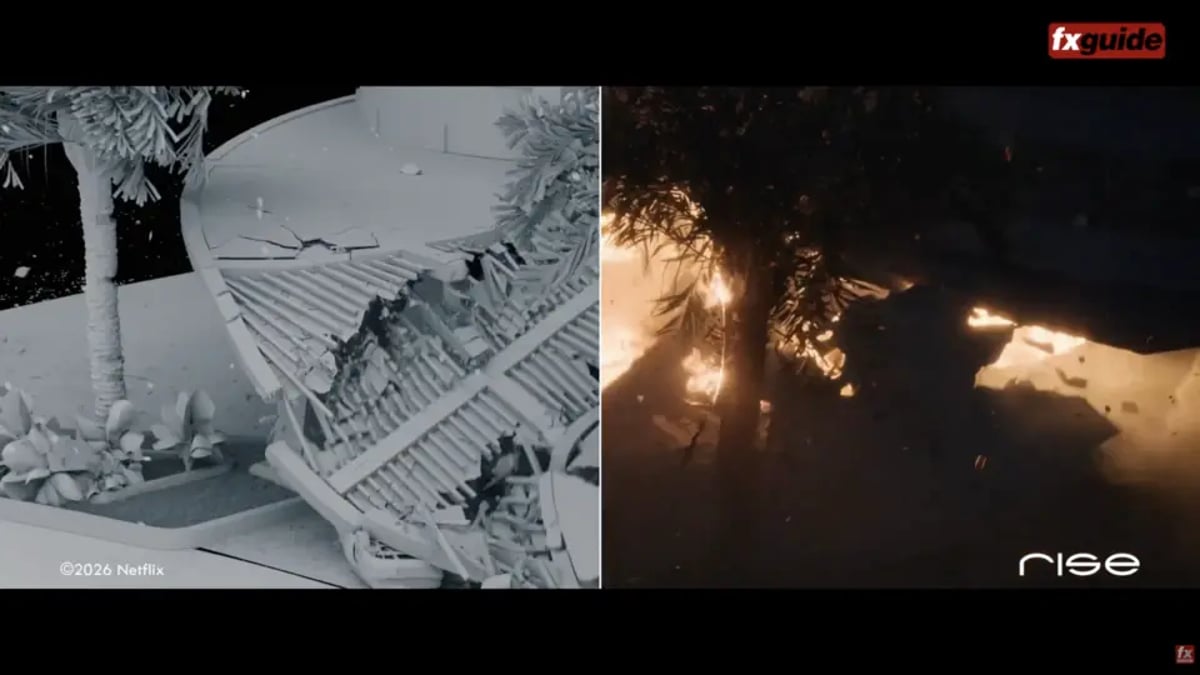
The visual effects in high-stakes action narratives often grapple with a core dichotomy: spectacle versus realism. How much should an audience perceive the digital intervention, especially when depicting scenarios meant to feel dangerous and uncontrolled? Kevin Lingenfelser, VFX Supervisor on Netflix's Man on Fire, offered insights into navigating this balance on a recent episode of the fxguide fxpodcast, detailing the extensive visual effects work that underpinned some of the series' most impactful sequences. His discussion highlighted an approach that prioritized organic chaos and tight integration of practical and digital elements, particularly in the series' major set pieces: an apartment tower collapse and a high-octane Learjet sequence.
Lingenfelser joined the production in May 2024. The original plan for Man on Fire comprised eight episodes across four production blocks, a structure later condensed to seven episodes during post-production. The initial block carried a substantial visual effects load, establishing the series' visual parameters and narrative scale. This front-loading of critical VFX sequences demanded a meticulous approach to pre-visualization and asset development to define the "invisible" nature of much of the show's digital work, the kind of upstream planning covered in our practical guide to VFX integration for independent films.
The Uncontrolled Demolition of a Skyscraper
One of the opening episode's defining moments is the apartment tower collapse. While Man on Fire is set in Rio de Janeiro, principal photography largely occurred in Mexico, with Mexico City and its surroundings serving as visual doubles for Brazilian locales. This common filmmaking practice of location standing-in requires significant environmental augmentation, a key area where "invisible VFX" excel. For the tower sequence, RISE VFX constructed two identical CG towers based on a 40-storey condominium structure found in Mexico. The imperative was not merely to create a building that could collapse, but to ensure its digital twin was entirely convincing in its intact state. This commitment to realism prior to destruction served to amplify the impact of the collapse, presenting it as a genuine, shocking event rather than a predictable visual effects exercise.
The design philosophy behind the destruction privileged a sense of violent, uncontrolled messiness over a clean, orchestrated demolition. This decision reflects a broader trend in high-end VFX, moving away from overly stylized or "perfect" destructions towards representations that feel physically plausible and emotionally resonant. Achieving this required RISE to develop multiple complex simulations. These were not simply simulations of falling debris, but intricate computational dynamics for dust plumes, cascading structural elements, and secondary impacts, all contributing to the visceral experience of a building tearing itself apart.
The sequence also exemplifies the synergy between practical and digital effects. While the large-scale destruction was inherently digital, the production incorporated practical elements where feasible. For instance, performer Billie Boullet's character, Poe, experienced a ratchet pull, a practical effect that grounds the physical sensation of impact and movement. Similarly, practical car flips were executed on set and subsequently augmented digitally. This layered approach ensures that key performances and immediate foreground actions retain a tangible quality, while the broader, destructive environment is rendered with the precision and scale only possible through advanced digital tools. The blend of practical and digital, particularly in sequences involving extensive environmental destruction, often leads to a more convincing final image, as covered in our look at retro VFX and forced perspective miniatures and our broader piece on blending reality and CGI to build unforgettable worlds.
The Learjet Escape: Integrating Practical Stunts with Digital Augmentation
Another significant challenge for the Man on Fire VFX team was the Learjet 'escape' sequence. This kind of aerial action, often requiring dynamic camera work and extreme stunts, typically demands a robust hybrid approach. The production team rented a physical Learjet for comprehensive scanning at an airport. This crucial step captured accurate geometric and textural data, providing RISE with a precise digital model for their CG assets, a workflow detailed in our guide to on-set scanning for VFX: photogrammetry, LiDAR, and actor capture. Beyond the digital twin, a partial aircraft buck was constructed and designed to be towed for on-location action photography. This buck served as a tangible reference for lighting, framing, and performer interaction, helping the digital aircraft integrate cleanly into the live-action plates.
A stunt performer executed a jump from a Jeep onto this physical buck, providing real-world momentum and body dynamics that would be nearly impossible to replicate perfectly with pure CG. Subsequently, the interior fight sequences were filmed against a green screen. This approach to interior work is standard practice for complex action, allowing for greater control over lighting, stunt choreography, and safety. A notable detail was the decision to construct the interior aircraft set 15 percent larger than a real Learjet. This seemingly minor alteration is a classic filmmaking workaround, providing crucial extra space for camera movement and efficient choreography for the fight scenes, a practical consideration often overlooked in discussions of pure digital production.
RISE's contribution to the Learjet sequence extended to various digital elements:
For the climactic road landing, a wooden buck was again deployed on location. This placeholder acted as a physical representation of the aircraft, enabling the cinematographers to capture accurate perspective, shadows, and interaction with the environment. This buck was later replaced with the fully rendered, bullet-damaged digital Learjet. This strategy provided the filmmakers with fundamental real-world framing and lighting references, mitigating the guesswork that can plague purely green screen-based compositions. It also allowed for full digital control over the final aircraft's appearance, specifically facilitating the integration of sophisticated damage texturing and dynamic lighting for the bullet impacts. The discipline required to track and deliver these shot-by-shot asset needs is exactly what we cover in VFX pull lists: how to create pulls that vendors can actually use.
The Art of Invisible Transformation
Much of the visual effects work in Man on Fire, as Lingenfelser articulated, was intentionally invisible. This includes major environmental transformations, such as converting Mexican locations to appear as Brazil. This involved meticulous attention to detail, from changing signage from Spanish to Portuguese to subtle adjustments in urban landscapes and backdrops. These aren't the large-scale explosions that grab headlines, but they are crucial for maintaining narrative immersion and geographical continuity. They represent the quiet diligence of the VFX team, helping the audience believe the world they are watching without being distracted by obvious digital seams.
The overarching result of this meticulous planning and execution is a series that carries a strong feature-film action aesthetic. The synergy between practical stunt work, large-scale CG destruction, complex aircraft simulation, significant environmental transformations, and subtle continuity effects converges to create a cohesive and believable world.
Lingenfelser expressed evident pride in the work, particularly concerning the early episodes. These episodes were designed to immediately establish Man on Fire's visual scale and tonal confidence. The apartment building collapse serves as a dramatic spectacle, while the subsequent depiction of the rubble-strewn environment provides immediate spatial and narrative consequence. The Learjet sequence, with its tight integration of practical action and digital effects, showcases how these disparate production elements can be combined to achieve a sense of urgency, danger, and physicality. This holistic approach to visual effects, where each element serves the narrative and enhances the practical foundations, underscores a core principle of high-level post-production: the ultimate goal is not merely to create stunning images, but to use those images to tell a more compelling story. The challenges of continuity and subtle digital augmentation frequently appear in discussions concerning the post-production pipeline, such as in QC for Picture: Dead Pixels, Banding, Cadence, and Artifact Hunting, which often touches on the nuances of visual integrity.
---
Source: fxguide fxpodcast, June 15 2026
© 2026 BlockReel DAO. All rights reserved. Licensed under CC BY-NC-ND 4.0 • No AI Training.