Roger Deakins Cinematography Master Study | Craft & Lighting
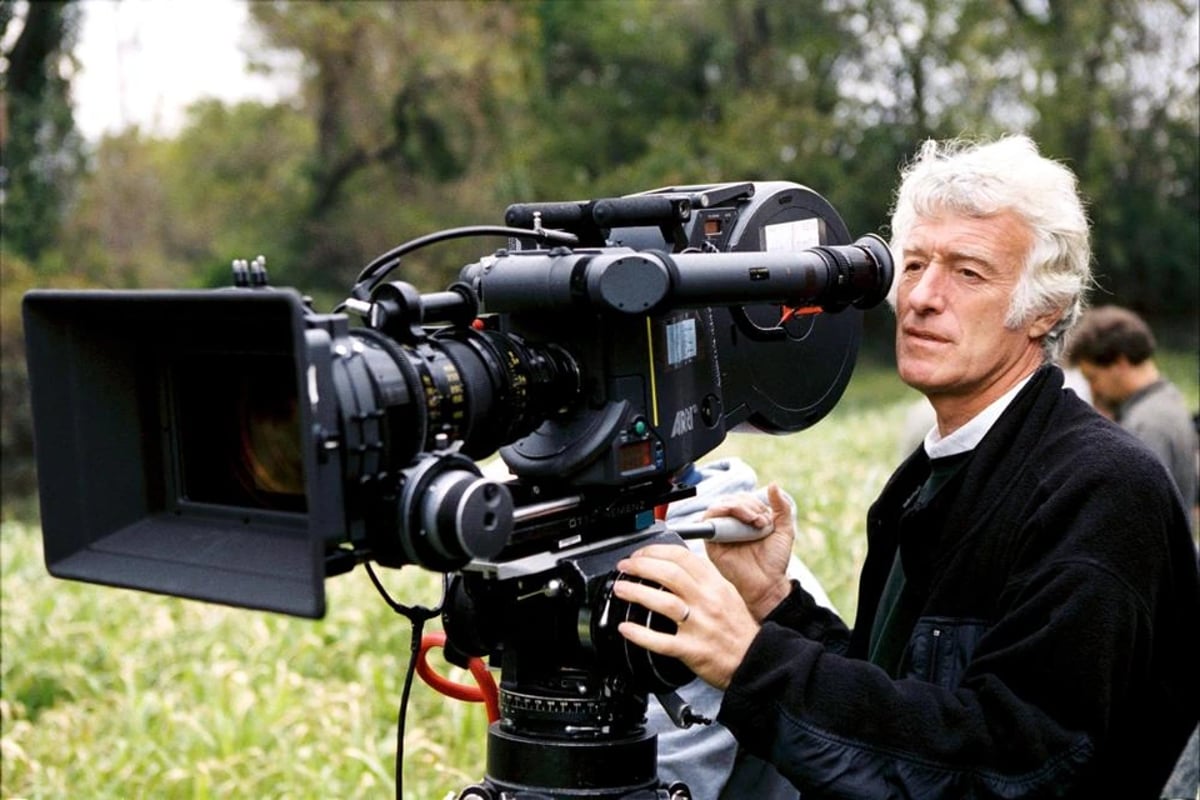
The light from the motel window in No Country for Old Men (2007) is not an aesthetic choice so much as a physical fact. It is a hard, unforgiving key that bisects the room, carving out a space of temporary safety while leaving the rest in an abyss of shadow. The darkness isn’t merely the absence of light; it’s a presence, a container for unseen threats. This is the elemental grammar of Roger Deakins. His compositions are often built from what is withheld. The vast, empty quadrants of a West Texas terrain make a lone figure not just small but exposed, a target defined by the negative space around him. The power of the image comes from its restraint, a disciplined refusal to embellish the scene with anything more than the story requires. It’s a visual philosophy rooted in a deep understanding of narrative pressure.
This foundational realism, however, is not a stylistic cage. It is a springboard. The same artist who renders a Coen brothers motel room with such stark minimalism can construct the monumental, saffron-dusted ruins of a futuristic Las Vegas in Blade Runner 2049 (2017). He can orchestrate the impossibly fluid, seemingly unbroken tracking shots that plunge a soldier into the visceral continuity of trench warfare in 1917 (2019). The common element isn't a "look" but a principle: the light, the frame, and the camera’s movement are all subordinate to the psychological and emotional reality of the character. Whether the environment is a dusty border town or a dystopian metropolis, the world feels tactile, the air has weight, and the stakes are rendered not in dialogue but in the precise architecture of the visible world.
The Arc
The career of Sir Roger Deakins is a study in the steady accumulation of mastery. His visual signature, often characterized by a kind of rigorous, sculpted naturalism, was not born in the world of high-concept features but in the observational rigor of documentary. After studying at the Bath Academy of Art, where photographer Roger Mayne was a formative influence, and the National Film and Television School, Deakins began his career shooting non-fiction. This grounding in capturing unscripted reality, in finding the story within an existing environment and its available light, became the bedrock of his entire aesthetic. When he transitioned to narrative features in the late 1970s, beginning with films like Cruel Passion (1977) and Michael Radford’s suffocating adaptation of 1984 (1984), he brought with him a documentarian’s eye for authenticity. The work was less about imposing a style and more about excavating the visual truth of a scene.
This sensibility found its most important and lasting partnership in 1991 with Joel and Ethan Coen. Their collaboration on Barton Fink initiated one of the most significant director-cinematographer relationships in modern cinema, spanning more than a dozen films. Through pictures as varied as the snow-bleached noir of Fargo (1996), the sun-blasted odyssey of O Brother, Where Art Thou? (2000), and the laconic comedy of The Big Lebowski (1998), Deakins and the Coens developed a shared language. It was a language that could accommodate both deadpan humor and deep dread, often within the same frame. For filmmakers, this body of work serves as a primary text on how cinematography can articulate a director’s specific tone. The camera is not a neutral observer in a Coen brothers film; its placement and movement are intrinsically linked to their ironic, fatalistic, and deeply humane worldview. Deakins’s contribution was to translate that complex authorial voice into a coherent visual system, one that felt grounded and real even at its most stylized.
As his reputation grew, Deakins’s name became synonymous with a particular kind of classical, legible excellence. His work on Frank Darabont’s The Shawshank Redemption (1994) is a case in point, a film whose enduring popularity rests in part on its immaculate, emotionally direct visual storytelling. The compositions feel balanced, the light carefully modulated to render the oppressive gloom of the prison without sacrificing the humanity of the men inside it. There is no overt flourish, no shot that calls attention to itself at the expense of the drama. Yet this very restraint is its own form of authorship. One way to read Deakins’s style is as a direct counterpoint to the more expressionistic impulses of a cinematographer like Vittorio Storaro, for whom color and camera movement are active, often dominant, participants in the drama. Deakins, by contrast, operates with a philosophy of potent invisibility. The craft is immense, but it is placed in service of the narrative’s gravity. This approach arguably reached its apotheosis in No Country for Old Men, where the visual scheme is stripped to its essentials: hard light, deep shadow, and compositions that weaponize the empty spaces of the American West to create an atmosphere of relentless, existential dread.
The last two decades have seen Deakins form new, essential partnerships that have pushed his work into different registers. His collaboration with Denis Villeneuve, beginning with the grim moral theater of Sicario (2015), saw him explore a world of tactical ambiguity. The film’s signature sequences, like the border convoy or the night-vision tunnel raid, use silhouettes, dust, and deliberately obscured perspectives to mirror the characters’ compromised ethics. The visual information is degraded, forcing the audience into a state of unease and uncertainty. This exploration of atmosphere as narrative culminated in Blade Runner 2049, a project that required Deakins to build a future that felt both monumental in scale and tangibly real. His Oscar-winning work on the film is a masterclass in world-building through light and color, from the oppressive, hazy glow of Los Angeles to the stark, radioactive orange of Las Vegas.
Simultaneously, his work with Sam Mendes on 1917 represented a different kind of evolution, one centered on a formidable technical challenge. The film’s conceit of appearing as a single, continuous shot demanded a near-total synthesis of camera choreography, production design, and lighting. The task wasn’t simply to execute long takes but to create a lighting plan that could evolve organically as the camera moved through radically different environments, from muddy trenches to a burning city, all while maintaining a sense of unbroken real-time immersion.
After a career spanning five decades, with more than fifteen Academy Award nominations and two wins (for Blade Runner 2049 and 1917), Deakins occupies a unique position. He is both a craftsman’s craftsman, revered by his peers for his technical precision and collaborative spirit, and an artist whose images have become an indelible part of film history. His knighthood and the recent publication of a book of his still photography signal a moment of public recognition for a lifetime of work that has often prioritized subtlety over spectacle. For working filmmakers, his career offers a powerful lesson: a singular vision doesn’t have to shout. It can be built quietly, frame by frame, in the patient and disciplined service of the story.
Signature Techniques
To speak of a Roger Deakins “signature” is to confront a paradox. His visual stamp is one of the most recognizable in contemporary cinema, yet its primary function is often a studied invisibility. He is a master of the motivated source, of light that feels discovered rather than placed, and of compositions that serve psychology over spectacle. Yet this apparent naturalism is the product of immense, careful control. A student of still photography under Roger Mayne at the Bath Academy of Art before attending the National Film and Television School, Deakins brought a photographer’s patience and compositional rigor to the moving image. His work, particularly in his long partnerships with the Coen brothers, Sam Mendes, and Denis Villeneuve, reveals a set of core principles that adapt to genre while remaining distinctly his own.
Sculpted Naturalism
The bedrock of Deakins’s craft is a commitment to a heightened, sculpted form of naturalism. It isn’t documentary realism, but a realism of feeling, where light and shadow are organized to articulate the emotional and psychological state of a character or scene. His method often begins with identifying the logical source of light in a space (a window, a table lamp, the sun) and then building an entire lighting scheme that feels obedient to that source, even when it is in fact a complex array of instruments. The goal is not to replicate reality, but to create a plausible reality that is more expressive than the original.
The Shawshank Redemption (1994) offers a foundational example of this technique. The film’s visual arc depends on our belief in the oppressive gloom of the prison and the transcendent power of hope. Deakins achieves this not with expressionistic flourishes, but with a disciplined modulation of light quality. The general ambiance of Shawshank is one of cool, top-heavy light, with faces often falling into shadow, creating a sense of institutional weight. Yet, in moments of grace or connection, the light softens and warms. The lighting on Andy Dufresne as he plays a Mozart aria over the prison PA system feels like a reprieve, a pocket of warmth in a cold world. This isn't a sudden shift in style; it is a subtle adjustment of the established visual grammar, a slight increase in fill or a change in color temperature that is felt more than it is noticed. This control over contrast and quality allows the cinematography to function as an emotional barometer, all while maintaining a consistent, believable world.
The Architecture of Emptiness
In his work with the Coen brothers, particularly No Country for Old Men (2007), Deakins weaponized composition to convey a deep sense of existential dread. The West Texas terrain of the film is not a picturesque backdrop; it is an active participant in the narrative, a vast, indifferent stage for a fatalistic drama. Deakins and the Coens frame their characters as small figures in immense, empty spaces. The wide, static shots of Llewelyn Moss hunting in the desert establish him as exposed and vulnerable from the outset, a solitary figure against an unforgiving horizon.
This principle extends from the exteriors to the now-iconic interiors. The motel room sequences are masterclasses in using negative space to build suspense. How does one visualize a threat that is both imminent and unseen? Deakins’s solution is to drain the frame of extraneous information. He lights the rooms with hard, unflattering practicals, creating deep pools of shadow where anything could be hiding. The compositions are often starkly symmetrical or unnervingly empty, directing the viewer’s eye to a dark doorway, the space under a bed, or the sliver of light beneath a door. The tension comes not from what we see, but from the charged emptiness of the spaces where we expect to see something. By denying the audience visual comfort and clutter, Deakins makes the viewer complicit in the characters’ paranoia, forcing us to scan the frame for threats alongside them. It is an architecture of absence, where the composition itself becomes a source of terror.
Tactile Futurism
When Denis Villeneuve enlisted Deakins for Blade Runner 2049 (2017), the challenge was immense: to create a future that felt both continuous with the rain-soaked noir of Jordan Cronenweth’s original and visually distinct. Deakins’s solution was to ground the film’s monumental science fiction in tangible, physical light. Where much contemporary sci-fi leans on the infinite possibilities of digital environments, the world of 2049 feels physically lit, its atmosphere thick with particulate matter that catches and shapes the light. The result is a tactile futurism, a world you can almost feel and breathe.
This is achieved through a bold and disciplined use of color and atmosphere. Entire sequences are rendered in near-monochrome palettes. The abandoned, irradiated Las Vegas is a terrain of ochre dust and sickly orange light, a world choked by its own toxic past. The headquarters of the Wallace Corporation is a study in minimalism, with light from a caustic, rippling water effect providing the sole, moving key on the actors. This is not the cluttered, hyper-detailed future of many blockbusters. Instead, Deakins and Villeneuve opt for a brutalist simplicity, using monolithic shapes, strong silhouettes, and vast, empty spaces to convey power and alienation. The ever-present haze is not just a visual motif; it’s a lighting tool, allowing beams of light to become solid, architectural forms that carve up the space. For this work, Deakins finally won his first Academy Award, a recognition of his ability to build an entire world not just through design, but through the physical properties of light itself.
The Illusion of Continuity
For Sam Mendes’s 1917 (2019), Deakins undertook one of the most demanding technical exercises of his career: shooting a feature-length film to appear as if it were constructed from a handful of continuous, unbroken takes. The aesthetic goal was total immersion, to lock the audience into the real-time perspective of its soldier protagonists. While the technique itself is not new, a lineage that runs from Hitchcock’s Rope (1948) to Iñárritu’s Birdman (2014), Deakins’s execution was on an unprecedented scale, moving from trenches to open battlefields to raging rivers.
The primary challenge was not just the intricate camera choreography, but the lighting. In a conventional production with extensive coverage, a cinematographer can relight for every new camera position. In 1917, the lighting had to be designed to work from every conceivable angle as the camera moved 360 degrees around the actors and through vast terrain. This required an extraordinary synthesis of natural light, which was often unpredictable, and massive-scale artificial lighting that had to be hidden from the constantly moving camera. The night sequence in the ruined, burning village of Écoust is a bravura example. The primary light sources are the flares fired into the sky and the fires from the burning church. Deakins and his team built a custom lighting rig with thousands of bulbs, programmed to simulate the flickering, directional light of the fires, allowing the camera to move freely through the town square while maintaining a consistent, motivated, and terrifyingly beautiful illumination. This work challenges the reading of Deakins as a simple naturalist; it reveals the immense artifice and technical construction required to produce an illusion of unmediated reality.
Moral Opacity Through Atmosphere
In Denis Villeneuve’s Sicario (2015), the cinematography functions as a visual correlative to the film’s central theme: the erosion of moral clarity. The film follows an idealistic FBI agent into a world of clandestine operations where the lines between law and crime have been deliberately blurred. Deakins visualizes this descent by systematically obscuring the viewer’s vision. The Arizona and Mexico terrain are rendered not with the crisp clarity of a classic Western, but through a constant haze of dust, heat shimmer, and pollution.
Strong silhouettes are a recurring motif. Characters are frequently framed against blindingly bright skies or plunged into near-total darkness, their faces and expressions unreadable. This technique is most potent in the film’s signature border-crossing sequence. As the convoy of black SUVs approaches the Juárez checkpoint, the setting sun creates extreme lens flare and long, distorted shadows, transforming a mundane traffic jam into a terrain of pure menace. Later, during the night-vision tunnel raid, the visual language dissolves completely into the abstract, grainy green-and-black of military technology. We are denied a clear view, forced to interpret events through the same compromised, distorted lens as the characters. It is a perfect fusion of technique and theme, where the film’s very atmosphere becomes an expression of its moral ambiguity. The viewer is left as uncertain as the protagonist, unable to get a clean look at the truth.
Case Study: No Country for Old Men
If a cinematographer’s career can be understood through their long-term collaborations, then Roger Deakins’s work with Joel and Ethan Coen represents a foundational pillar. Their partnership, which began with Barton Fink (1991), produced a dozen films of remarkable visual range, from the snow-bleached absurdism of Fargo (1996) to the sepia-toned mythmaking of O Brother, Where Art Thou? (2000). Yet it is No Country for Old Men (2007) that stands as the partnership’s most austere and potent visual statement. The film is a watershed not for what Deakins adds, but for what he and the Coens so rigorously subtract. It is a masterclass in the narrative power of restraint.
The film’s visual strategy is rooted in a philosophy of negation. Deakins’s lighting and composition work to drain the West Texas terrain of romance, presenting it instead as a flat, indifferent stage for predation. The briefing materials note his use of “hard daylight” and “negative space,” and nowhere is this more apparent than in the exteriors. Wide lenses and deep focus render the scrubland with punishing clarity, exposing Llewelyn Moss (Josh Brolin) as a solitary figure in an unforgiving environment. There is no painterly grandeur here, none of the majestic framing John Ford brought to Monument Valley. Instead, the terrain becomes an instrument of narrative pressure. Its vast emptiness offers no cover, its harsh sun no comfort. On this reading, the cinematography visualizes the film’s core fatalism; the world itself is as implacable and devoid of mercy as Anton Chigurh.
This principle of environmental hostility extends from the desert to the film’s iconic motel sequences. How does the cinematography build suspense in these anonymous, interchangeable rooms? The answer lies in what the briefing terms an “architecture of suspense through composition and emptiness.” Deakins composes for the edges of the frame. A shot of Moss sitting on a bed is not merely a medium shot; it is a composition that derives its tension from the dark doorway behind him or the sliver of light under the door. The frame is a container for imminent threat. The lighting is almost exclusively motivated by practicals: a single bedside lamp, the glow of a television, the headlights of a passing truck. This commitment to realism forces the shadows to become active participants in the scene. The darkness is not an absence of light but a textured, menacing presence, sculpted with negative fill to conceal and reveal with terrifying precision.
Watching these sequences, one notices the discipline of the camera itself. There are no elaborate Steadicam moves to heighten the chase, no rapid cutting to manufacture excitement. The camera is often locked off or performs simple, deliberate pans and tracks, its movements as methodical as Chigurh’s pursuit. This formal stillness forces the viewer to scan the frame, to anticipate the violence that the composition implies is just beyond view. It is a deep lesson for any filmmaker in earning suspense rather than signaling it. By refusing to embellish, Deakins and the Coens create a procedural dread that feels chillingly authentic. The craft becomes invisible, sublimated entirely into the film’s bleak tone.
Ultimately, No Country for Old Men showcases a cinematographer working at the peak of his confidence. It is the work of an artist who understands that a dark corner can be more frightening than a monster, and that an empty terrain can say more about mortality than any dialogue. For the working filmmaker, it remains an essential study in the power of subtraction, demonstrating how much can be achieved by leaving the frame half-empty and the light brutally honest.
Case Study: Blade Runner 2049
A full decade after the stripped-down realism of No Country for Old Men, Deakins’s work on Denis Villeneuve’s Blade Runner 2049 (2017) demonstrated a dramatically different, yet equally controlled, mode of visual storytelling. The challenge was immense: to create a visual language for the sequel to Blade Runner (1982), a film whose noir-inflected futurism, captured by cinematographer Jordan Cronenweth, had become one of the most influential aesthetic templates in modern cinema. The achievement of Blade Runner 2049 is that it honors the original’s atmospheric legacy while building a distinct world of its own, a feat of “tactile futurism” that finally earned Deakins his first Academy Award.
Where No Country for Old Men subtracts, Blade Runner 2049 builds. The film’s primary visual signature is its monumental scale, used to communicate a world grown beyond a human dimension. Deakins and Villeneuve consistently dwarf their characters with overwhelming architecture and desolate environments. The monolithic, brutalist pyramid of the Wallace Corporation headquarters and the colossal, decaying statues in the Las Vegas ruins are not mere backdrops; they are compositional anchors that render the protagonist, K (Ryan Gosling), small and searching. This sense of scale is amplified by a heavy use of atmosphere. Thick layers of haze, snow, and radioactive dust permeate nearly every frame, a technique that both suggests a polluted future and creates a deep sense of visual depth. The world feels simultaneously vast and claustrophobic.
The film’s most discussed element is its audacious and expressive use of color. In a departure from the muted palette of his more naturalistic work, Deakins assigns bold, often monochromatic color schemes to entire locations, turning them into distinct emotional and thematic zones. The sterile, cold blues and ambers of the Wallace Corporation’s interiors reflect its founder’s god complex and the manufactured nature of his creations. The chaotic, multi-hued neon of the city streets evokes the sensory overload of a hyper-commercialized society. Most memorably, the ruins of Las Vegas are bathed in a thick, radioactive orange-yellow haze. This is not a subtle color grade; it is an immersive, environmental choice that makes the desolation feel palpable and toxic.
Yet even within this highly stylized framework, Deakins’s foundational principles remain. The light, however extreme in color, always feels motivated by a source within the world: the oppressive orange is the color of the sky, the clinical blues are generated by architectural lighting, and the strobing neons come from the towering holographic advertisements. This commitment to motivation is what gives the film’s futurism its tactile quality. One can observe this same discipline in his lighting of the human face. Amidst the spectacle, the key light on an actor is often simple and soft, a classic portraitist’s approach that preserves the nuance of the performance. The light on K in his apartment, for instance, is gentle and emotionally legible, creating a space of intimacy that contrasts sharply with the hostile world outside.
For filmmakers, Blade Runner 2049 serves as a powerful counterpoint to the minimalism of No Country for Old Men. It is a study in world-building through light and composition. It proves that a commitment to realism in motivation does not preclude radical expressionism in execution. Deakins’s work here is not invisible; it is a primary authorial voice. The film affirms that the same master of shadow and restraint can also construct entire worlds of breathtaking color and scale, all while keeping the human story at the center of the frame.
Collaborators
A cinematographer’s vision is realized through a network of key department heads, and Roger Deakins’s career is defined by a series of sustained, near-telepathic partnerships. His most formative and prolific collaboration was with Joel and Ethan Coen, a relationship that began with Barton Fink (1991) and spanned twelve features. On a film like No Country for Old Men (2007), Deakins’s stark, patient framing found its perfect narrative match in the Coens’ fatalistic screenplay and their own editorial sensibility (under the pseudonym Roderick Jaynes). The collaboration with production designer Jess Gonchor on that film was essential, creating motel rooms and border-town storefronts that were not merely backdrops but active participants in the drama, each one a plausible container for sudden violence. The spartan dressing and authentic textures allowed Deakins’s hard, single-source lighting to feel both brutally realistic and mythic.
His work with director Sam Mendes, particularly on 1917 (2019), represents a different kind of synthesis, one built on logistical and technical precision. The film’s ambition to present its narrative as a series of extended, unbroken takes required a complete fusion of direction, cinematography, and production design. Deakins worked in lockstep with production designer Dennis Gassner to build sets, including miles of trenches, that were not designed for traditional coverage but for a constantly moving camera. The geography of the set was the blocking diagram. Every berm, crater, and burnt-out farmhouse was a cue for the camera operator and a marker in the film’s continuous, subjective journey, with editor Lee Smith’s primary role being the seamless stitching of these massive, pre-planned camera paths into a coherent whole.
The partnership with Denis Villeneuve has yielded some of Deakins’s most visually monumental work. Their collaboration began with the oppressive, dust-choked atmosphere of Sicario (2015), where Deakins and production designer Patrice Vermette established a palette of beige, ochre, and sun-bleached concrete to communicate the moral desiccation of the war on drugs. For Blade Runner 2049 (2017), Deakins re-teamed with Villeneuve and production designer Dennis Gassner to construct a future that felt both immense and tactile. Gassner’s brutalist architecture and vast, empty interiors provided the canvas for Deakins’s boldest color work, from the radioactive orange of a derelict Las Vegas to the sterile, water-logged blues of the Wallace Corporation. The director’s trust in Deakins is evident in the film’s pacing; Villeneuve and editor Joe Walker are comfortable holding on a single, perfectly composed frame, allowing the world’s texture and atmosphere to carry the narrative weight.
Even in his earlier career, these foundational relationships were evident. Working with director Michael Radford on 1984 (1984), Deakins helped translate the literary dystopia of Orwell into a tangible, grimy reality. The film’s look of exhaustion and decay was a direct result of the synergy between Deakins’s desaturated photography and Allan Cameron’s production design, which rendered Oceania as a world of peeling paint, omnipresent screens, and crumbling concrete, a vision that depended on total creative alignment.
Critical Reception and Counter-Readings
Critical consensus has long positioned Roger Deakins as a master of atmospheric realism, a cinematographer whose formidable technique serves story above all else. In outlets from Sight & Sound to American Cinematographer, his work is frequently praised for its "invisibility," a term meant not as a slight but as the highest compliment for a craftsman who resists ostentatious displays. The dominant reading of his career, particularly his collaborations with the Coen brothers, centers on a kind of photographic stoicism. In his review of No Country for Old Men, for instance, Roger Ebert observed how the film’s visual strategy makes the terrain itself an accomplice to the unfolding horror, writing that the characters are “not colorful characters in a thriller, but plausible people who have wandered into a situation of extreme danger.” This view casts Deakins as a documentarian of narrative, capturing events with a stark, observational clarity that amplifies the inherent drama without imposing an external style.
This reading of expert restraint extends to his work with other directors. For The Shawshank Redemption (1994), his compositions are seen as a model of classical Hollywood lucidity, creating a visual space that is oppressive yet allows for moments of grace to register with immense power. With 1917, the critical narrative shifted to focus on technical immersion. The long takes were widely interpreted as a device for generating radical subjectivity, forcing the viewer into the real-time perspective of its soldier protagonists. The craft, while monumental, was seen as being in service of an experiential goal: to erase the mediating presence of the cut and plunge the audience directly into the chaos of the trenches.
However, a significant counter-reading challenges the very notion of Deakins’s invisibility. Formalist analysis, for one, argues that the perception of "naturalism" in his work is itself a highly constructed effect. The seamlessness of 1917 is the product of immense artifice: hidden edits, digitally erased equipment, and lighting schemes that must imperceptibly evolve over the course of a ten-minute shot. On this reading, the film isn't an absence of style but a proof to a style so controlled that it effaces the evidence of its own construction. To mistake this for simple realism is to overlook the sheer architectural complexity of the filmmaking.
Another counter-reading, rooted more in auteur theory, pushes back against the idea of Deakins as a mere technician executing a director’s vision. It posits that his visual signature is so distinct and consistent across different collaborators that he functions as a co-author of the films he shoots. One can observe a "Deakins film" in the same way one observes a "Scorsese film." The use of silhouettes in Sicario, the monolithic compositions in Blade Runner 2049, the lonely figures dwarfed by terrain in The Assassination of Jesse James by the Coward Robert Ford (2007), these are not neutral choices. They are recurring thematic and aesthetic preoccupations. This perspective argues that to praise his work as "invisible" is to diminish his authorial contribution, reframing him from a master craftsman to a key cinematic artist whose name above the title carries as much weight as the director’s. His visual language doesn't just support the narrative; in many cases, it is the narrative.
What Working Filmmakers Should Steal
Sculpting with Negative Fill Instead of adding more light to create shape, Deakins often carves it away. The mechanic involves using large black solids (floppies, 4x4 flags) to absorb ambient or reflected light, creating deeper, more defined shadows. This technique, known as negative fill, increases contrast and models a subject without raising the overall exposure or requiring another lighting unit. In the motel scenes of No Country for Old Men, the darkness surrounding Llewelyn Moss is not just an absence of light; it is an active, menacing presence shaped by taking light away. This makes the shadows feel substantive and deepens the sense of dread.
The Horizon as a Narrative Tool Pay attention to the vertical placement of the horizon line within the frame. Deakins frequently uses the horizon to create psychological pressure. In Sicario, many of the desert convoy sequences are composed with a very low horizon, dedicating the top two-thirds of the frame to a vast, empty sky. This dwarfs the characters and their vehicles, visually reinforcing their vulnerability and the indifference of the terrain. Conversely, a high horizon line can create a sense of claustrophobia, pinning characters to the bottom of the frame and suggesting the world is closing in on them.
Color via Environment, Not Gels Build your color palette into the production design and practical lighting rather than relying solely on gelling your sources. In Blade Runner 2049, the iconic orange haze of Las Vegas was not achieved by simply slapping a CTO gel on a few HMIs. It was a holistic effect created with colored light sources, heavy atmospherics, and a production design by Dennis Gassner that committed entirely to that monochromatic scheme. By making the color part of the physical environment, the effect becomes more immersive and believable, allowing the light to wrap around subjects in a way that feels organic to the world.
The Silhouette as Revelation and Obfuscation A silhouette is not a lack of information; it is a different kind of information. By placing a powerful backlight behind a subject and underexposing their front, you can reduce them to a pure shape. This forces the audience to read character and intent through posture, gesture, and movement alone. The initial appearance of the Delta Force operators in Sicario, framed as black shapes against the blinding Juárez sun, is a masterclass in this technique. It renders them an anonymous, almost inhuman force, withholding their identities to amplify their menace and mystique.
Motivating the Unmotivated Source Great naturalism is often a beautiful lie. Deakins frequently lights scenes with large, soft sources that have no logical motivation within the diegesis, but he makes them feel correct by matching the quality of light the environment suggests. A basement might be lit with a soft top light that feels like ambient bounce from a single bare bulb, even though the actual source is a 20K bounced into muslin just out of frame. The key is to sell the effect, not the source. The light should feel emotionally and atmospherically right for the space, allowing the audience to accept it without question.
Blocking for a Path, Not a Position When designing a scene, think about the entire path of movement for both actors and camera, rather than just hitting static marks for coverage. The choreography of 1917 is the most extreme example, where every scene was a sustained ballet of movement through a pre-defined space. For a more conventional scene, this means blocking actors to move between windows, through doorways, or past practicals. This gives the camera a reason to pan, tilt, or track, creating dynamic frames that evolve with the performance and reveal information naturally over time.
Further Study
1917* (2019) Blade Runner 2049* (2017) Sicario* (2015) No Country for Old Men* (2007) The Assassination of Jesse James by the Coward Robert Ford* (2007) O Brother, Where Art Thou?* (2000) Fargo* (1996)
Sources and Further Reading
Research References
1. Roger Deakins, official website and forum. rogerdeakins.com
© 2026 BlockReel DAO. Master Studies series. Licensed under CC BY-NC-ND 4.0.