Soderbergh's 'Production 02074' App: Jaws, Frame by Frame
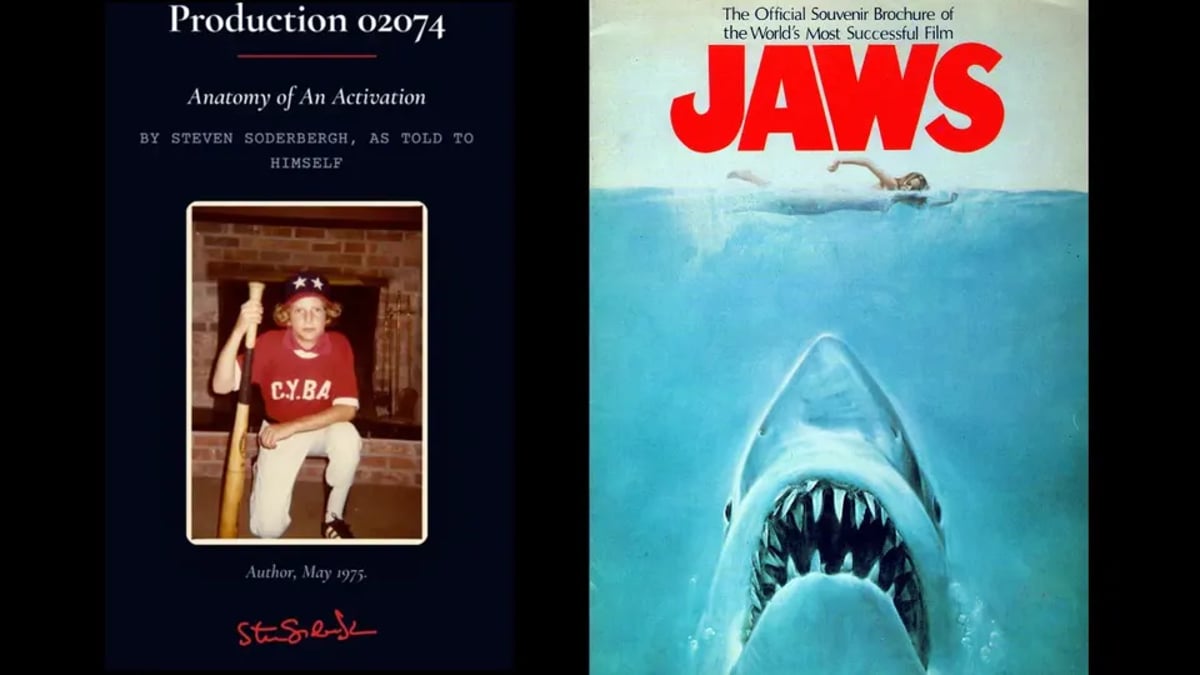
One might occasionally wonder, after decades of retrospectives, "making-of" documentaries, and meticulously bound coffee-table books, whether there's anything genuinely new to say about the canonical works that shaped our industry. Has every frame been dissected, every production anecdote exhausted? Steven Soderbergh, for one, evidently believes there are still insights to be gleaned, and perhaps more importantly, novel ways to deliver them. His latest endeavor, Production 02074, eschews the traditional tome, landing instead in the Apple Store as a dedicated application (an Android tablet version is expected within the same week), an inventive compilation designed to dissect the 1975 leviathan, Steven Spielberg's Jaws. It's a move that should give pause to anyone who believes that exhaustive film analysis must adhere to print and linear documentary formats.
Soderbergh's motivation, as revealed in a Deadline interview, stemmed from a profound personal connection, Jaws being the film that, in his youth, compelled him into filmmaking, viewed some 31 times in theaters alone (and, by his own account, roughly three times that many since). The application itself, published exactly 51 years after the film's release, is described as an "inventive compilation of still images from the film along with Spielberg's observations written in the production log, and Soderbergh's analysis." This immediately differentiates it from the passive viewing of a documentary or the sequential reading of a book. Instead, it proposes an interactive experience, allowing users to scroll through images synchronized with the production timeline, day by staggering day across Jaws' 143-day shoot.
This method of "showing instead of telling" feels particularly relevant in an era saturated with information. Soderbergh himself noted a dissatisfaction with the static nature of his earlier lectures on directing (the first delivered at NYU in 2007), and even high-end, granular books like Taschen's Stanley Kubrick's The Shining: "what I thought while I was reading it was that it would be cool to be able to see what he's describing as they shot that day. It would be cool to be able to see it when he says, this was the shot that we did 15 takes of." The bespoke app format directly addresses that desire for visual correlation, bridging the gap between narrative explanation and immediate visual evidence of the production process. For practitioners, this isn't merely academic; it's an opportunity to observe, in a highly curated fashion, the choices made on set and their eventual on-screen manifestation.
The cost for this digital deep dive, $24.99, with proceeds directed to an animal charity, positions Production 02074 not as a typical commercial product, but rather a "true labor of love." Soderbergh's rationale for the price point, framing it as "51 years of study and experience, so that's 50 cents a year. Look at it that way. It's a film school and an app," underlines the educational intent. For professional filmmakers, accustomed to the prohibitive costs of specialized training and reference materials (Soderbergh cites $2,500 coffee-table editions as the alternative he wanted to avoid), this accessibility argument resonates. It hints at a future where archival analysis, coupled with contemporary insights, might become an increasingly democratized resource, leveraging digital platforms to circumvent the expense of traditional publishing or the logistical nightmares of physical masterclasses.
What Production 02074 aims to do is dissect, with surgical precision, the "how" and "why" behind Jaws' enduring impact. Soderbergh's focus is less on the often-recounted tales of budgetary woes and the mechanical shark's malfunctions, and more on the craft choices that solidified the film's status. He explicitly calls out two scenes as "clinics in how you get information across to an audience": the first with Mayor Vaughn (Murray Hamilton) on the ferry, and the second in front of the defaced billboard.
"They feel utterly real and you don't feel like you're being fed information," Soderbergh explains. His analysis here touches on a fundamental principle of effective visual storytelling: the art of masking exposition. He marvels at Spielberg's ability to stage these moments "largely in one shot, with characters and movement that allows you to do some editing of your own while you're watching the scene, instead of trying to point you toward something." This speaks to an observational approach to blocking and camera work, where the audience is invited to discover details rather than being force-fed through aggressive cutting.
This philosophy on exposition runs counter to prevailing trends in much of contemporary filmmaking, where rapid-fire editing often serves to amplify emotional beats or to artificially inject energy into dialogue-heavy scenes. Soderbergh, however, champions a more restrained, almost classical, approach: "I always feel like the fewer cuts the better, to try and undercut the idea that the audience is being fed information by taking a less choppy approach to covering the scene. You mask the fact that you're feeding them exposition." The notion of "undercutting" the didactic nature of exposition through a deliberate reduction in cuts is a nuanced perspective worth weighing against any standard coverage strategy. It implies a trust in the audience's intelligence and an emphasis on the composition and spatial relationships within the frame to convey meaning organically.
Another example cited by Soderbergh, the dinner table scene with Brody and his son, further illustrates this point. He describes it as "spectacular. So simple and utterly real and funny and heartfelt." His appreciation stems from the understanding that amidst the "mayhem and chaos of the production," Spielberg remained "focused on the characters and the story. Because he knows we can do all the technical stuff in the world, but if you don't get the story and the characters correct, nobody cares." This sentiment, while seemingly self-evident, is often lost in the maelstrom of tentpole productions, where technical bravado sometimes overshadows character development. It serves as a stark reminder that even a film often celebrated for its suspense and technical innovation ultimately derives its lasting power from its human core.
The genesis of this app, from a desire for accessibility, carries a significant implication for filmmaking education. Soderbergh explicitly states his father, a college professor specializing in education, instilled in him "the idea of passing along knowledge." This lineage, combined with Soderbergh's own early learning from "watching things, but from reading books about movies, whether they be about filmmakers, or by filmmakers," positions Production 02074 as a continuation of this educational impulse. The app format is a direct response to a perceived limitation of static media, aiming to make deep analysis more "accessible" and less cost-prohibitive than a $2,500 coffee table book often relegated to a niche market. This democratizing impulse, while ambitious, seeks to transform passive consumption into an interactive learning experience.
For professionals immersed in the day-to-day realities of production, the concept of a digital film school, accessible via an app, offers a compelling proposition. It allows for on-demand examination of masterworks, a potential complement to the demanding schedules that often preclude extended academic study. Imagine, for instance, a cinematographer grappling with lighting a difficult exterior, being able to pull up the Jaws app and instantly cross-reference a specific day's shoot logs with still images of Spielberg's approach to the constantly changing ocean light. Or an editor, struggling with a scene full of vital exposition, being able to study the rhythms of Spielberg's wider, unfettered takes, as championed by Soderbergh. This is a pragmatic, on-the-go research tool, not merely a fan's indulgence.
AI's role, for those curious about its application in Soderbergh's previous projects, appears to be distinct from Production 02074. While Soderbergh's Cannes 2026 John Lennon documentary leaned on AI tooling, the Jaws app's description focuses on human curation, analysis, and data compilation. This is notable because, as an industry, we are constantly evaluating the practical utility of emerging technologies. Here, the innovation lies not in synthetic content generation, but in the intelligent organization and presentation of existing archival material. This grounds the project in verifiable craft rather than speculative technological wizardry, a distinction often critical for professional audiences, and one that echoes Spielberg's own public stance on AI in the creative process.
Reflecting on Soderbergh's historical fascination with process and technique, this venture shouldn't come as an enormous surprise. His body of work, whether as a director or, at times, acting as his own cinematographer, has always demonstrated a keen understanding of the mechanics of filmmaking. Notably, Soderbergh told Deadline that the app was finally completed in the immediate aftermath of Disney's cancellation of his Adam Driver-led Star Wars project, The Hunt for Ben Solo: "Had I gone off and made that movie, this thing would not have gotten done." This new app is a natural extension of his analytical sensibility, turning intellectual curiosity into a tangible, if unconventional, teaching tool. It's an analyst's project, filtered through the lens of a working filmmaker who knows the demands and intricacies of bringing a vision to screen.
Ultimately, Production 02074 isn't just another tribute. It's a statement about the evolving nature of film scholarship and its potential for accessibility beyond traditional academic and publishing silos. It proposes an interactive, visually driven methodology for professionals to learn from the past, examining the precise choices made by masters under pressure. In an industry perpetually grappling with technological shifts, Soderbergh's latest move serves as a reminder that fundamental storytelling mastery remains paramount, and that new tools can, and should, serve to illuminate rather than obscure its enduring principles. The app stands as a testament, not just to Jaws, but to the possibility of reinventing how we learn from, and disseminate knowledge about, the cinematic classics.
---
© 2026 BlockReel DAO. All rights reserved. Licensed under CC BY-NC-ND 4.0 - No AI Training. Originally published on BlockReel DAO.