Cinematic Handheld: Operating Choices That Feel Intentional
Executive Summary
Cinematic handheld is a discipline, not a fallback. This guide breaks down how experienced operators make handheld read as authored rather than accidental: motivating every move against a scene beat, building the body into the rig, matching movement texture to genre, and using IBIS and post stabilization as polish rather than rescue. It covers focal length and shutter angle conventions, rig balance targets, contact-point mechanics, and the signature approaches of Lubezki, Kaminski, the Dardennes, Greengrass, and Barry Ackroyd. Use it before prep to lock a movement language for the film, on set to correct fatigue and drift, and in post to protect the organic feel while removing distraction.
Table of Contents
- Handheld with Purpose: Why Movement Needs Motivation
The distinction between accidental wobble and motivated imperfection is crucial. Masters like Emmanuel Lubezki, known for his fluid, often handheld camera in films like Children of Men (2006) and Birdman (2014), demonstrate how the camera can become a character itself, breathing and reacting alongside the actors. Janusz Kaminski's work on Saving Private Ryan (1998) pushed the opposite pole: a 45-degree shutter angle combined with reactive handheld to create staccato, war-newsreel violence. Barry Ackroyd on The Hurt Locker (2008) and Oliver Wood on the Bourne films built a documentary-vérité language on long lenses and reactive reframing. The Dardenne brothers use a patient, tethered handheld to lock the audience to a single character's shoulder for an entire scene. Each of these choices is authored, not incidental.
Handheld with Purpose: Why Movement Needs Motivation
The fundamental principle of cinematic handheld is that its movement must be motivated. Without a clear intention, handheld footage risks becoming a distracting visual noise, pulling the audience out of the story rather than drawing them in. This motivation can stem from a character's emotional state, a narrative beat, or a desire for a specific aesthetic texture.
Consider the difference between a shot that is shaky because the operator is unstable, and a shot that is subtly unstable to reflect a character's anxiety. The latter enriches the storytelling. When contemplating handheld, ask: what is the camera's emotional state in this moment? Is it observing calmly, reacting frantically, or searching tentatively? This approach ensures that the handheld choice serves the story, rather than existing as a default or a compromise.
Every handheld move should have a clear justification. This might involve following a character through a chaotic environment, revealing information as a character discovers it, or mirroring the emotional turbulence of a scene. A key practice is to focus on one primary movement at a time. Instead of combining pans, tilts, and rolls simultaneously, a skilled operator will favor a single dominant direction, a slow push-in, a lateral follow, or a reactive sway. This singular focus maintains clarity and purpose, preventing the visual chaos that can arise from stacking too many movements.
The character of the movement should also match the genre and tone of the film. For action sequences, horror, or a documentary-style realism, a more pronounced, jittery handheld might be appropriate. Think of Gareth Evans' The Raid (2011), where the raw, visceral handheld operating places the audience directly into the intense hand-to-hand combat. Conversely, for drama, romance, or intimate character moments, a more subtle, controlled handheld might be used. This provides a sense of life and presence without distracting from the emotional core of the scene. The camera "breathes" with the scene, rather than shaking violently through it.
A common pitfall is using handheld as a default "indie" look without tying it to the scene's intention. This can lead to audience fatigue and a sense that the camera work is unrefined. Another mistake is mixing too many camera movement styles in one sequence, a handheld shot followed by a whip pan and then a crash zoom, without a consistent logic. This can cause the viewer to lose narrative focus. Instead, treat handheld moves like dolly moves: they should start intentionally, execute a purposeful movement, and land on a specific composition or beat.
💡 Pro Tip: Before a take, operators often establish a "movement rule" for the scene. This could be, "The camera only moves when the character moves," or "The camera drifts forward only when the character makes a firm decision." This discipline ensures every movement has a narrative anchor.
Your Body Is the Rig: Operator Mechanics for Cinematic Handheld
The true artistry of cinematic handheld lies in the operator's body. It's the primary stabilization and articulation system, capable of imparting subtle, organic movements that mechanical rigs often struggle to replicate. Mastering this involves discipline in contact points, stance, and breathing.
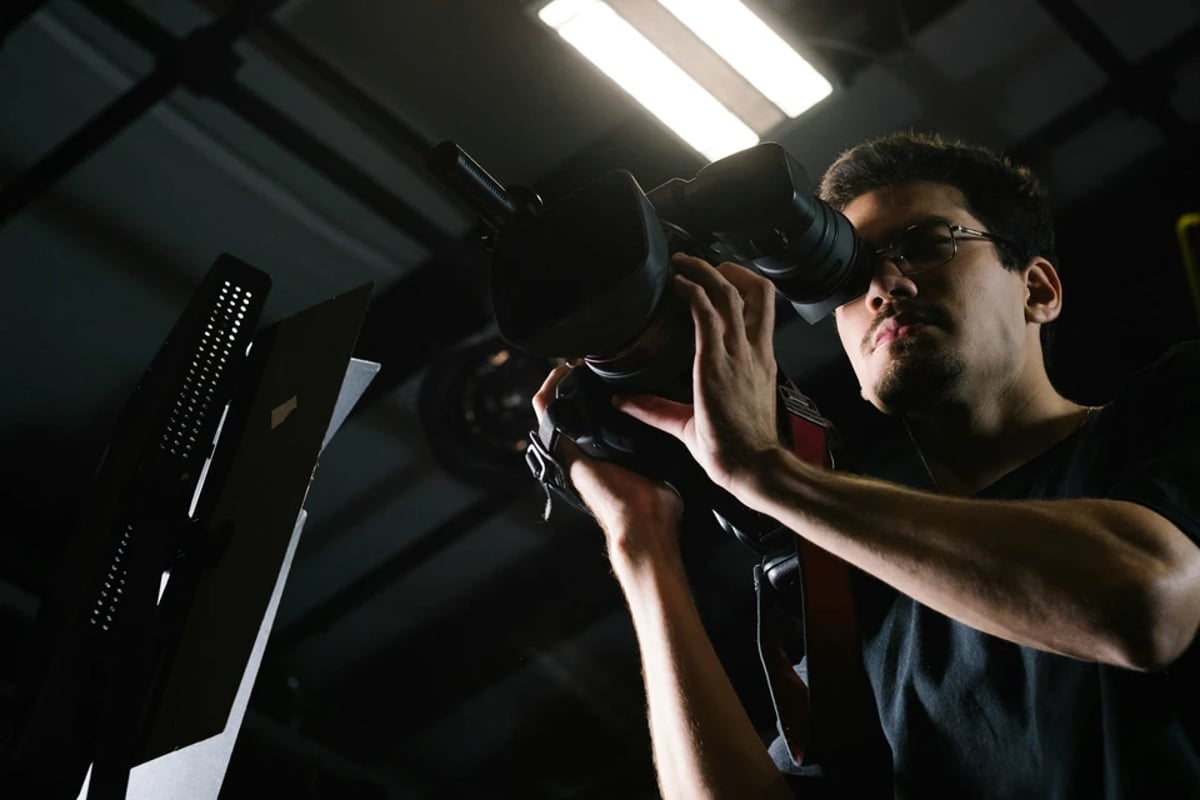
The foundational principle is to keep the camera close to the body. Holding the camera near the sternum or chest, with elbows tightly tucked against the ribs, maximizes stability. This creates a solid base, reducing the leverage that magnifies hand tremors when arms are extended. The goal is to achieve three contact points with the camera system. Typically, this involves both hands on the camera, and a third point such as the EVF pressed against the forehead, the camera body against the sternum, or a shoulder rig resting firmly on the shoulder. Bracing against a wall, doorway, or even a knee can also serve as a crucial third anchor point, providing moments of enhanced stability within a dynamic shot.
When operating with a shoulder rig, proper balance is paramount. The rig should be configured so that most of the weight sits directly over the shoulder pad, with the eye cup or EVF providing the third contact point. This distributes the weight efficiently, reducing strain on the arms and allowing for longer, more controlled takes.
Movement discipline extends to the operator's stance and gait. Instead of swinging the camera with the arms, the operator should pivot from the hips and torso. The arms should act as locked rails, with reframing accomplished by rotating the torso or shifting the lower body. This technique produces smoother, more controlled pans and tilts, avoiding the jerky, unmotivated movements that can arise from arm-only swings. Walking with a disciplined stride, knees slightly bent, stepping onto the heel, rolling through the ball of the foot, and pushing off the toes in one fluid motion, helps minimize vertical bobbing and creates a more even, intentional drift.
For static moments within a handheld sequence, leaning against any available surface provides an instant reduction in micro-shake, allowing for a more composed frame.
Breathing is also a critical, often overlooked, aspect of handheld operating. Slow, continuous breathing is essential to maintain a steady rhythm. Holding one's breath for an entire take can lead to sudden, uncontrolled movements when the operator inevitably exhales. For precise moments, such as a close-up reveal, exhaling gently and holding at the natural pause between breaths can provide a brief window of maximal stillness, as chest movement is minimal.
Compact cinema cameras like the Sony FX3, Canon C70, and Blackmagic Pocket Cinema Camera 6K G2 are frequently used in bare or minimally rigged configurations due to their form factor, which facilitates responsive, body-led handheld work. For more sustained or heavier setups, shoulder rigs from manufacturers like Shape, Tilta, and SmallRig provide essential contact points and weight distribution. These rigs typically include shoulder pads, front handles for two-handed control, and provisions for EVF mounts to secure that crucial third contact point. For smaller cameras, a technique involves looping the neck strap around the neck, extending the arms, and pulling forward to create tension between the neck and hands, adding a surprising degree of stability.
A common mistake is holding the camera far from the body with arms extended, akin to a "tablet posture." This magnifies every tiny tremor and makes longer focal lengths virtually unusable handheld. Similarly, reframing solely with arm swings leads to jerky pans and unmotivated roll. Operators also often over-tighten their bodies and hold their breath, resulting in sudden shakes when they finally need to breathe. Ignoring lens choice is another pitfall; attempting intimate handheld work with long telephoto lenses will magnify every micro-movement, often necessitating a wider focal length or additional support.
💡 Pro Tip: Many experienced operators think in terms of "anchor points." They start a shot anchored (braced against a surface), release into movement on a character's cue, and then re-anchor at the landing frame. This creates controlled pockets of stability within a dynamic shot.
Building the Right Handheld Rig: Cameras, Weight, and Accessories
The configuration of a handheld rig directly influences the feel and control of the camera movement. The goal is to build a system that supports intentional operating, providing sufficient stability without inhibiting fluidity or causing undue operator fatigue.
Balance and weight distribution are paramount. An effective handheld rig possesses a slight mass and inertia. It needs enough weight to smooth out small jitters and micro-movements, imparting a sense of gravity and deliberate motion. However, it must not be so heavy that the operator quickly fatigues, leading to loss of control and inconsistent movement. As a working reference, many operators target roughly 4-7 kg (9-15 lb) for a full shoulder build: heavy enough to damp micro-jitter, light enough to sustain a 10-12 hour day. Crucially, the center of gravity should be kept as close to the operator's body as possible, avoiding front-heavy setups that strain the arms and introduce bobbing motions. For shoulder rigs, ensuring that the majority of the weight sits directly over the shoulder, rather than cantilevered far forward, is key to maintaining balance and comfort.
Strategic rigging choices further enhance handheld control. A top handle is invaluable for low-angle shots, allowing the operator to grip the camera from above for a different ergonomic approach. It also facilitates two-handed operation in varying planes, providing more options for control. The inclusion of an EVF (Electronic Viewfinder) or a loupe viewfinder is critical for establishing the essential third contact point, with the eye pressed against the camera. This contact point provides significant stability, particularly in controlling pitch and roll, and offers a more immersive viewing experience than an external monitor alone.
Placing batteries, such as V-mounts, at the rear of the rig serves a dual purpose: they power the camera and act as counterweights, helping to balance front-heavy lenses. Their position at the back also allows them to rest against the operator's chest or stomach, providing an additional point of contact and support.
Several cinema cameras are especially well-suited for handheld work due to their compact size and modular design. The Sony FX3 and FX6, both full-frame cinema cameras with built-in sensor-shift IBIS, are often used bare or with minimal rigging for their responsiveness. The Canon EOS C70 and C80, RF-mount cinema cameras, are popular choices for documentary and narrative handheld setups. The Blackmagic Pocket Cinema Camera 6K G2 and the Panasonic S5 II / S1H, lightweight Super 35 and full-frame bodies, frequently pair with small shoulder rigs for added stability. For higher-end work, the ARRI Alexa Mini LF and Sony VENICE 2 Rialto extension remain the standard for feature handheld builds. For rigging solutions, brands like SmallRig, Tilta, Shape, and Wooden Camera offer shoulder rigs and cages that provide shoulder pads, 15mm rods for accessory mounting (like EVFs and battery plates), and top handles.
A common mistake is over-building the rig with too many accessories and monitor arms. While tempting to add every possible component, an overly complex or front-heavy rig becomes sluggish and difficult to control with precision. Similarly, attempting handheld with large, heavy zoom lenses without properly balancing the rig will inevitably lead to constant tilting and horizon drift. Neglecting operator comfort is another pitfall; a rig that feels fine for a 30-second test take can become unmanageable over a full day of shooting, leading to deteriorating performance.
💡 Pro Tip: Many professionals maintain two handheld configurations: a "stripped" kit (camera, simple top handle, small battery) for reactive, intimate scenes, and a "shoulder" kit (pads, EVF, rear battery) for longer takes and more composed movement. This allows for quick adaptation to the scene's demands.
Technical Specs: Focal Length, Shutter, and Frame Rate
Handheld texture is not just body mechanics, it is optics and exposure choices. A few working conventions worth internalizing:
Focal length. Wider lenses forgive micro-movement because angular shake is a smaller percentage of the frame. On a full-frame sensor, 21-35mm is the working window for intimate, character-tethered handheld; 40-50mm reads as a "human eye" observational lens (favored by the Dardennes and Ackroyd on United 93); 75mm+ handheld is possible but demands strong contact points and typically a shoulder build. Above 100mm, expect to brace or add mechanical support. Zooms in the 24-70mm and 24-105mm range are common for docu-style operating because they let the operator reframe without cutting.
Shutter angle. 180 degrees (1/48 at 24 fps) is the default and preserves natural motion blur, which softens handheld micro-jitter. Narrower shutter angles (90, 45 degrees, as Kaminski used on Saving Private Ryan) sharpen every frame and make handheld feel more violent and staccato; use them for combat, panic, or trauma, and expect strobing on quick pans. Wider than 180 (270-360 degrees) is rare in narrative but can soften handheld further for dream or intoxication beats.
Frame rate. 24 fps remains the narrative baseline. Shooting handheld at 25 or 30 fps for a 24 fps timeline (with a matching shutter) is a common trick to gain a subtle 4-25 percent slow-down that smooths jitter without reading as slow motion. Overcranking to 48-60 fps for action inserts also masks operator shake, but conform back to 24 fps deliberately, not as a rescue for weak operating.
IBIS and OIS behavior. Modern sensor-shift IBIS (Sony FX3/FX6, Panasonic S1H/S5 II, Canon R5 C) is genuinely useful at 24-50mm but can introduce edge warping and "wobble" artifacts at very wide focal lengths (under 16mm equivalent) and can fight the operator on whip pans. Rolling-shutter skew is the other constant: fast lateral moves on CMOS sensors bend verticals. Test IBIS behavior on the specific lens and camera combination during camera prep; do not discover it in dailies.
Lens weight and inertia. A slightly heavier prime (500-900 g) often handhelds better than a very light mirrorless lens because inertia damps small tremors. This is one reason cine primes feel more "composed" handheld than photo primes of the same focal length.
Autofocus vs. manual focus. For reactive handheld, reliable eye-detect AF (Sony, Canon, ARRI face-detect on the Alexa 35) is now standard on documentary and small-crew narrative. For choreographed handheld with a focus puller, manual pulls off a wireless monitor still win on precision and intention.
Handheld vs. Steadicam vs. Gimbal: Choosing Movement Texture
Understanding when to choose handheld over other camera movement tools, Steadicam, gimbals, or dolly and track, is fundamental to intentional cinematography. Each tool offers a distinct "movement texture" that should align with the emotional and narrative demands of the scene.
A clear definition of each tool's role is helpful: Steadicam provides ultra-smooth, fluid tracking shots, isolating the camera almost entirely from the operator's body movement. It excels at creating a floating, dreamlike quality or a sense of omnipresent observation. Kubrick's The Shining* (1980) hallway sequences remain the reference.
* Gimbals, with their motorized 3-axis stabilization, offer swift, smooth tracking, controlled pans, and a consistently level horizon. They are effective for dynamic, often complex movements that still retain a high degree of smoothness.
* Dolly and track deliver precise linear movements with very smooth starts and stops, typically across flat surfaces. This tool is ideal for highly controlled, repeatable shots that emphasize composition and framing.
* Handheld offers an organic, responsive, and subtly imperfect camera movement that communicates energy, presence, and intimacy.
Handheld is the intentional choice when the story benefits from human imperfection and presence. This is particularly true in scenes depicting characters in crisis, moments of raw emotional vulnerability, documentary-style observation, or intimate conversations where the camera should "breathe" with the actors. For instance, in Captain Phillips (2013), the intense, reactive handheld during the hijacking sequences places the audience directly into the terrifying ordeal, mirroring the protagonist's fear and disorientation. Paul Greengrass and Barry Ackroyd have made this vérité approach a signature across the Bourne series and United 93 (2006).
Conversely, avoid treating camera movement techniques as a grab bag. The choice of tool should always be driven by the emotional intention of the scene, ensuring that the movement texture consistently serves the narrative. If a commercial demands polished elegance, handheld might be used sparingly and with extreme control, or mechanical stabilization might be favored. For more on managing various camera systems, including multi-cam color matching, refer to Matching Cameras: Practical Multi-Cam Color Matching on Set.
A common mistake is overusing gimbals in situations where a more grounded, organic handheld approach would better serve the scene. While gimbals provide impressive smoothness, their inherent perfection can sometimes feel detached, especially in tense conversations or vérité documentary moments where subtle imperfections convey authenticity. Another pitfall is slipping into a haphazard mix of dolly, gimbal, and handheld within a single sequence without a clear, underlying rule. This inconsistency can break the visual language and confuse the audience. Perhaps the most significant error is trying to force handheld to look like perfect Steadicam.
This often results in stiff, unnatural operating, with occasional jolts that feel like errors rather than intentional character.
💡 Pro Tip: Some operators define a "movement character per sequence." For example, Act 1 might feature gentle, nearly-static handheld; Act 2, more energetic handheld; and Act 3, chaotic, reactive handheld. This progression mirrors the narrative arc and gives the camera its own emotional journey.
Stabilization Without Sterilization: In-Camera and Post Techniques
Even with the most disciplined operating, some level of stabilization might be desired to polish the footage without eradicating its intentional handheld character. The key is to enhance, not erase, the organic feel.
Many modern cameras feature in-body image stabilization (IBIS) or electronic stabilization. These technologies can effectively tame micro-jitters and minor shakes, preserving the handheld character while making the footage more palatable. Best practice involves using IBIS moderately, especially when engaged in subtle handheld work at normal focal lengths. However, caution is advised at very wide or very long focal lengths, or when executing whip pans. Aggressive in-camera stabilization in these scenarios can introduce undesirable artifacts such as skew, warping, or a "jello" effect.
Post-production stabilization, available in NLEs like Adobe Premiere Pro, DaVinci Resolve, and Final Cut Pro, offers further refinement. These tools typically provide warp, optical, positional, or perspective stabilization options. Professionals generally apply light stabilization in post to reduce small bumps and rolling shutter artifacts. The objective is to smooth out accidental jitters, not to remove all motion. Heavy stabilization, which often leads to excessive cropping, frame warping, or "rubber band" edges, should be avoided, as these distortions look less cinematic than controlled, intentional handheld.
Framing and cropping are also critical considerations. Shooting slightly wider than the final intended frame provides latitude for refinement in post. A common practice is to protect roughly 5-10 percent headroom on the sensor for stabilization crop. This allows for subtle digital push-ins or minor reframing to emphasize specific beats without destroying the handheld feel. However, extreme reframing or zooming in post should be avoided, as it can amplify visible noise, reduce resolution, and exacerbate any IBIS artifacts.
Contemporary cinematography tutorials consistently emphasize that post-stabilization is a polishing tool, not a substitute for good handheld operating. Solid body mechanics, contact points, stance, and breathing remain the foundation. Many operators combine gentle in-camera IBIS with their physical discipline rather than relying solely on the camera's internal systems. For managing your footage from capture to post, understanding disciplined media management is critical; explore Media Management 101: Checksums, Folder Rules, and Backup Strategies.
A common mistake is shooting very shaky handheld with the intention to "fix it in post." Applying heavy Warp Stabilizer or similar tools often results in excessive cropping, introduces distracting distortions, and ultimately removes the very organic, intentional motion that handheld aims to achieve. Over-stabilizing shots that are meant to feel tense or alive can neutralize their emotional impact. Inconsistent stabilization settings across a sequence can also break visual rhythm, creating jarring transitions between angles.
💡 Pro Tip: Editorial teams sometimes apply micro push-ins or subtle drifts in post to complement the natural handheld movement. This reinforces the shot's direction and emotional emphasis, working with the camera's inherent motion rather than fighting it.
Common Handheld Pitfalls and Professional-Level Corrections
Even experienced operators can fall into common handheld traps. Recognizing these pitfalls and applying professional corrections is key to consistently achieving intentional, cinematic handheld.
Frequent Mistakes: * No clear intention: Using handheld as a default or habit, rather than a deliberate choice aligned with the scene's motivation. This leads to arbitrary movement that distracts rather than engages.
* Uncontrolled vertical bounce: Often caused by walking with locked knees or heavy heel strikes. This creates a distracting "bobbing" motion that can feel amateurish.
* Horizon drift: Resulting from uneven shoulder or arm posture, especially during pans or extended takes, leading to a tilted frame that feels unstable rather than dynamic.
* Mixing movement types without logic: Incorporating crash zooms, whip pans, or erratic re-framing without a coherent visual language. This creates visual chaos and undermines narrative focus.
* Ignoring operator fatigue: Failing to acknowledge that performance deteriorates over time. A rig or operating style that is manageable for a short take might become uncontrollable during a long shooting day.
Professional Corrections and Tips: * Movement rehearsal without rolling: Experienced operators routinely "walk the shot" multiple times before the camera rolls. This practice focuses on footwork, breath control, maintaining contact points, and hitting precise start and stop beats. This mental and physical rehearsal builds muscle memory and refines the intended movement.
* Use architecture and environment: Whenever a moment of increased stability is needed within a dynamic handheld sequence, lean or brace against available surfaces. Doorframes, walls, railings, or even furniture can provide crucial anchor points that reduce micro-shake and allow for more composed framing.
* Lock the arms, free the torso: This is a core principle. Treat the camera and your arms as a single, rigid unit. All major movements, including pans and tilts, should originate from your hips, knees, and feet, allowing your lower body to manage orientation and position. This creates a smoother, more deliberate movement quality.
* Maintain a mental "movement vocabulary": Develop a range of handheld styles. A gentle, almost imperceptible sway for quiet, intimate scenes; faster, more abrupt re-framing for chaotic or urgent moments; and moments of stillness punctuated by sudden, reactive moves for shocks or reveals. This allows the operator to dynamically match the camera's character to the evolving narrative.
* Choose the right tools for the job: Well-designed shoulder rigs with proper padding and balance (from manufacturers like SmallRig, Tilta, and Shape) significantly reduce fatigue and help prevent horizon drift. EVFs and viewfinders are essential for adding the third contact point, crucial for controlling pitch and roll. Compact cinema cameras like the Sony FX3, Canon C70, and Blackmagic Pocket Cinema Camera 6K G2 are light enough to facilitate precise, body-led movement without quickly fatiguing the operator. For managing the technical aspects of your shoot, including camera reports, consider the guidance in Camera Reports That Help Post: Metadata That Prevents Reconform Pain.
Interface & Handoff Notes
Upstream Inputs (What you receive): * Shot list & Storyboards: Detailed breakdown of required shots, camera movements, and coverage.
* Creative North Star Documents: Director's vision, tone, and specific emotional beats for scenes involving handheld.
* Location Scouts/Tech Scouts: Information on terrain, obstacles, and potential bracing points for the operator.
* Blocking Rehearsals: Understanding actor movement and marks to plan camera choreography.
* Camera Test Reports: Data on sensor characteristics, lens performance, and in-camera stabilization behavior.
Downstream Outputs (What you deliver): * Handheld Footage: Log or RAW footage with intentional movement character.
* Camera Reports: Detailed documentation of lens, focal length, frame rate, and any in-camera stabilization settings used per take.
* Operator Notes: Specific comments on takes, such as "good energy," "too shaky," or "stabilization on/off." * DIT Handoff: Clearly labeled media with checksums, ready for ingest and backup.
Top 3 Failure Modes for Cinematic Handheld:
2. Operator Fatigue: Poor rig balance or lack of physical conditioning leads to inconsistent, uncontrolled movement and deteriorating performance over a shooting day.
3. Over-Stabilization in Post: Attempting to "fix" poorly operated handheld with aggressive post-stabilization, resulting in distorted, artificial-looking footage that loses its organic quality.
Browse This Cluster
- Cinematography Pipeline Guide: From Camera Tests to Deliverables
Next Steps
Ready to see how this fits into the bigger picture? Start with the complete guide.
📚 Complete Guide: Cinematography Pipeline Guide: From Camera Tests to Deliverables
---
© 2026 BlockReel DAO. All rights reserved. Licensed under CC BY-NC-ND 4.0 • No AI Training.