Aguirre, the Wrath of God (1972): Herzog's Techniques, Available Light
> This study contains affiliate links. BlockReel may earn a small commission on qualifying purchases at no extra cost to you. All commissions go directly toward funding our DAO Film Festival and supporting independent filmmakers.
In this study
- Why This Film Still Gets Studied
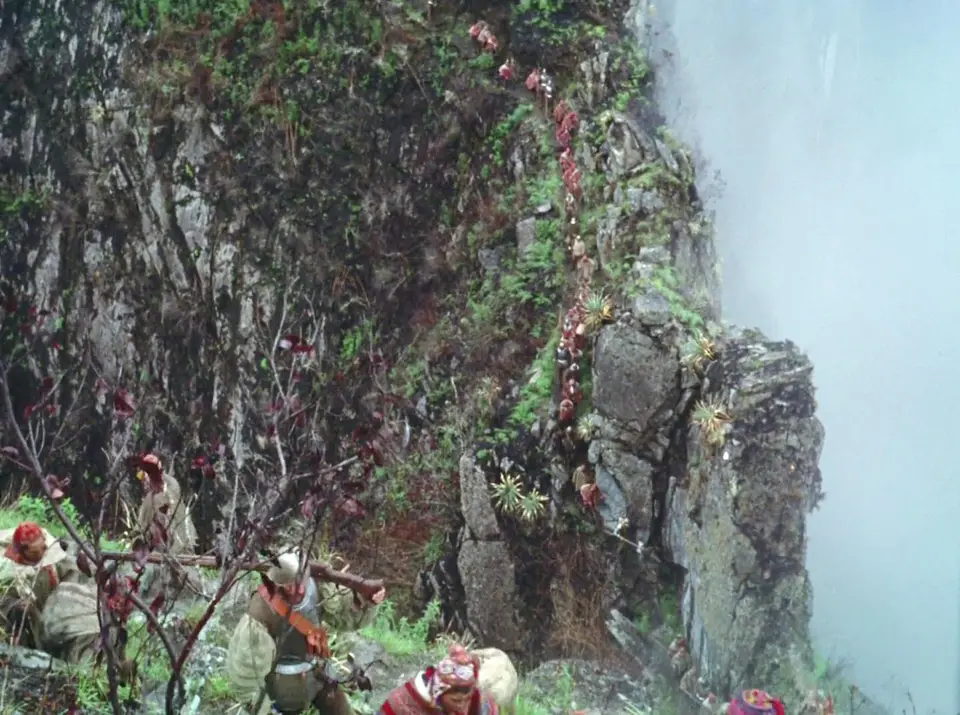
The film opens on an image of impossible scale. A long line of conquistadors, Inca porters, and livestock snakes down a precipitous mountain path, half-swallowed by cloud. Werner Herzog's Aguirre, the Wrath of God (1972) does not begin with an establishing shot in the conventional sense. There is no sweeping vista to orient the viewer, no map or title card explaining the context of the 1560 expedition. The camera is already there, a patient observer positioned on the opposing slope, tilting down to find the procession. Some of the men wear steel helmets and breastplates. Some of the women are carried in enclosed sedan chairs. They are dressed for a court pageant, not a rainforest, and the film says so without a word of exposition.
The 1.37:1 Academy frame, squarer than the widescreen formats favored by contemporary historical epics, constricts the terrain. It emphasizes the vertical drop rather than the horizontal sweep, turning the Andes into a wall rather than a backdrop. Scale here comes from duration and detail, not from breadth: the sheer number of bodies, the precariousness of the footing, the moisture that will eventually spatter Thomas Mauch's lens and stay there.
This opening refuses the grammar of the epic. Where Lawrence of Arabia (1962) uses its vast frame to celebrate ambition against a spectacular canvas, Aguirre uses a confined format to document a descent. The perspective is not heroic. It reads less like a composed cinematic image than like recovered footage from a doomed enterprise. That choice, to present history as a fevered ordeal rather than a reconstruction, defines the film's formal project and separates it from nearly everything else being made at the time.
Why This Film Still Gets Studied
Aguirre remains fixed in film curricula because it offers a transferable solution to a real production problem: how to achieve world-building scale and visceral authenticity with almost no resources. The reported budget was around US$370,000, with roughly a third of that committed to Klaus Kinski. That left Werner Herzog Filmproduktion with means more appropriate to a chamber drama than to a period epic set on the Amazon. The film's power comes from converting that shortfall into a coherent aesthetic. Call it production by subtraction.
For a production designer or director, the first lesson is the authentic location as a substitute for the built set. Herzog did not construct a jungle. He took eight or so people into one. The mud, the swollen river, the humidity were conditions to be endured and photographed, not effects to be generated. That collapses the distinction between production design and reality. The practical consequence is a prompt to re-weigh the art department line against the logistical cost, and creative return, of shooting somewhere that does the work for you. Rotting balsa, genuine exhaustion on an actor's face, a real current under an unstable raft: this is production value that a backlot cannot buy at any sane price. Our location scouting and management guide covers how to evaluate that trade-off before you commit a schedule to it.
The film also demonstrates directing performance through environment. The cast, drawn from a wide mix of nationalities with English as the working language on set, was subjected to the conditions their characters endure. The shiver in a downpour and the strain on a slippery incline are physical facts, not performed ones. For a director, this suggests a method where the location becomes an uncredited scene partner. That method has limits and costs, and it does not replace preparation.
Then there is the coverage question. With a crew Herzog has described as not much more than eight people, conventional coverage was impossible. The camera is often locked off, on a raft or on sticks, observing in long takes. Shot/reverse-shot patterns that ordinarily build dialogue dynamics are largely absent. The cutting is elliptical, jumping between violent incident and long torpor. That rhythm, forced by a short shoot in an unforgiving place, produces the hallucinatory quality the film is known for. A filmmaker on a compressed schedule can study Aguirre to see how minimal coverage, embraced rather than apologized for, yields a subjective point of view. Read it alongside our definitive guide to camera movement and blocking, which treats the same problem from the planning side.
How It Got Made
The aesthetic of Aguirre is a consequence of its constraints. The film was not a studio commission. It was financed by Herzog's own company with participation from the German public broadcaster Hessischer Rundfunk, on a budget the director has consistently described as around $370,000. With roughly a third going to secure Kinski, the remainder could not fund a conventional historical film. That reality dictated the first decision: the production would not simulate the Amazon. It would go there.
Shooting took place over roughly five weeks in Peru, on Amazon tributaries, and, for the opening sequence, on the steep path near Huayna Picchu above Machu Picchu. Herzog has described the ground as extremely slippery, and it shows in the unsteady footwork of the actors and porters. Several hundred local participants swelled the number of people on that mountain, many of them suffering from altitude. The core filmmaking crew stayed tiny.
That crew size is the key to the look. With no capacity for a lighting package, the film runs almost entirely on available light. The deep shadows and hot highlights are not the product of a managed key-to-fill ratio but of the canopy and the sky. Camera placement was determined by what could physically be carried and rigged: mounted on the raft, set on sticks on a rare patch of solid ground, or on Mauch's shoulder. The camera itself has become part of the legend. Herzog has said for decades that the 35mm Arriflex he used was taken from the Munich film school, a claim he later framed as a natural right rather than a theft. The result is a camera that behaves less like an omniscient narrator than like another exhausted member of the expedition, its movement dictated by the rocking of the vessel it stands on.
The schedule compressed post as well. Herzog has said the cut was completed quickly, with editor Beate Mainka-Jellinghaus working from limited material and no money for refinement. The structure that follows, with abrupt transitions and a preference for tableaux over connective tissue, reads as the direct result. The 35mm Eastmancolor stock and the 1.37:1 Academy ratio were partly economic choices, but the frame serves the theme precisely: there is no lateral room, and therefore no escape. Every major aesthetic decision traces back to the same starting condition of no time and no resources. If you want to understand how a schedule shapes a picture before a frame is exposed, our film scheduling and stripboard guide shows where those pressures actually land.
Direction and Blocking
Herzog's direction here is organized desperation, a model for turning logistics into signature. Conventional control was unavailable, so the primary directorial choice was to subordinate the production to the environment.
That approach is declared in the opening. On the mountain path, the descent of conquistadors and porters is not a staged epic but a documented event. Hundreds of people were placed on a slope where altitude sickness was common. The blocking is a single vector: down. Characters stumble, slide, and fight the incline. There is no choreography, only gravity and the mechanics of a narrow path. The director's job was to manage a hazardous logistical problem and be present with a camera when it happened.
!Image Aguirre, the Wrath of God (1972)
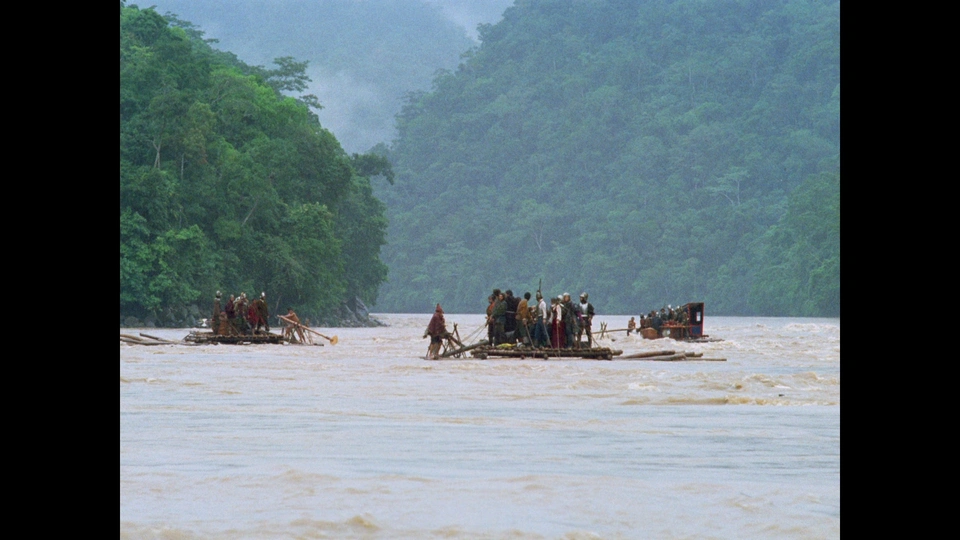
On the river, the rafts become floating stages of confinement. Blocking is governed by a few square meters of unstable balsa. Herzog exploits that trap to generate tension. Characters are forced into proximity, eyelines constantly crossing. Aguirre is repeatedly given a point of visual dominance, elevated or isolated at an edge of the platform, while the soldiers cluster. The camera does not need to manufacture claustrophobia with close-ups. When rafts are lashed together, movement between them becomes a perilous act and a physical expression of shifting allegiance. Working within severe spatial limits is a skill in itself, and our guide to blocking and lighting in small spaces breaks down the same problem on an interior.
Cinematography and Lighting
Thomas Mauch shot the film, and his contribution is inseparable from its authority. Working on 35mm in 1.37:1, Mauch rejects the widescreen grandeur typical of the historical epic. The nearly square frame feels classical and confining at once. On the mountain, verticality dominates. On the river, the format boxes the characters in, canopy pressing from the top of the image and water from the bottom. The composition denies a panoramic view, which mirrors the characters' own inability to see what is ahead.
Lighting was a matter of necessity. The film runs on available light, with the canopy acting as gaffer. Dense foliage delivers a constant soft top-light broken by shafts of hard sun, producing a dappled, high-contrast look that is both beautiful and unsettled. Faces drop into shadow or silhouette against a blown-out sky or river. Contrast ratios are frequently extreme, and features disappear. Night interiors on the raft are motivated by torches and fires, a flickering warm source that reinforces isolation. Working from a single practical source is a discipline of its own; our guide to practical lighting, dimming, and color control covers the modern equivalent. For a study of how another film built an entire visual system from window light alone, read how Jeanne Dielman weaponized natural light.
The camera behaves like a weary observer. Long shots drift with the current on raft-mounted or handheld setups. The motion is not the smooth glide of a dolly but the unsteady organic movement of a floating object. Mauch also lets the apparatus show. Water and mud land on the lens and stay there. Characters occasionally look directly into the camera. Those Brechtian intrusions, as the BFI's essay on the film notes, break the illusion at precisely the moments the physical ordeal feels most documentary, and they keep the viewer aware that this is a constructed account of a colonial fantasy rather than a transparent window onto 1560.
Production Design and Art Direction
The most significant production design decision in Aguirre was to have very little production design. No sets, no soundstage, no backlot. The design work was location selection and endurance. The mud is real, the insects are real, and the decay is real.
That philosophy extends to props and costume. Armor, cloth, and weapons are not pristine rentals; they are objects subjected to the same abuse as the people wearing them. Steel rusts. Fabric frays and stains. The rafts are the clearest case: introduced as functional craft, they waterlog and come apart as the journey continues. Their breakdown is a visual account of the expedition's collapse, achieved through weeks of exposure rather than paint and sandpaper in a shop.
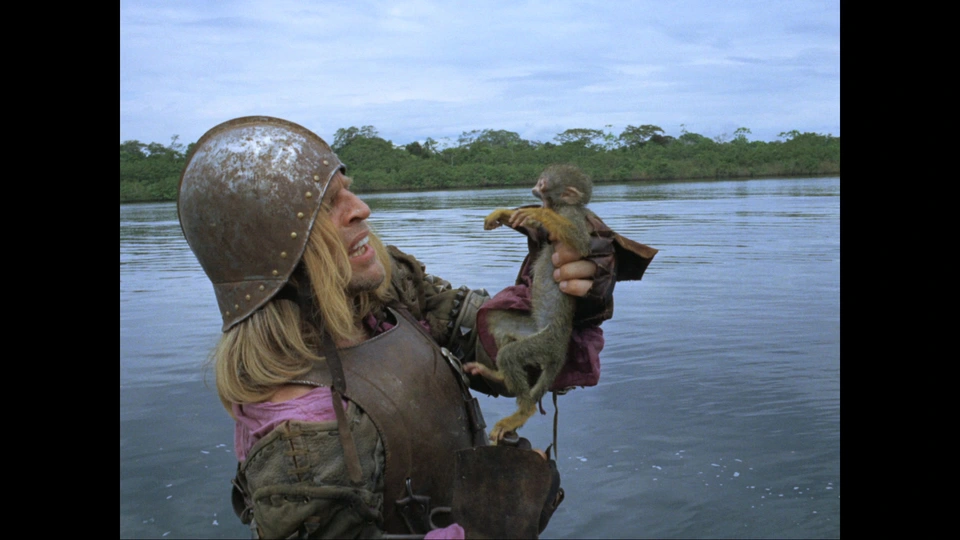
The main raft becomes a stage that grows steadily more absurd. A cannon, a small shelter, a horse. By the final sequence, when Aguirre is the last human aboard a platform overrun with small monkeys, the design has fused with the theme. Nature has reclaimed the made object, and madness has found its ideal stage.
!Image Klaus Kinski in Aguirre, the Wrath of God (1972)
Editing and Rhythm
Post was short. Mainka-Jellinghaus cut from limited coverage under financial pressure, and the constraint produced a decisive style. The rhythm blends protracted duration with shocking brevity, mirroring the psychological state of the expedition: long stretches of sun-dazed monotony punctuated by sudden death.
Long unbroken takes define the river passages. Shots of drifting rafts play out. Slow dissolves link them, functioning less as scene transitions than as hallucinatory bleeds where one image melts into another. That pacing creates a baseline of dread and trains the audience to scan the green wall for movement.
The cutting then violates the hypnosis. An arrow appears in a man's neck with no warning. A character speaking mid-sentence is cut down, and in the film's most quoted moment a severed head finishes the sentence its owner had started. The edits are blunt and unsentimental. There is no anticipatory music and no camera move signaling the violence. The cut often arrives after the impact, holding on a face that has not yet registered what happened. This refusal of catharsis is the point. Death here is swift, absurd, and almost administrative. Herzog and Mainka-Jellinghaus are working in a tradition of elliptical construction that our study of elliptical editing in Kieślowski and Weerasethakul traces into contemporary art cinema.
Sound Design and Score
The soundtrack operates on two conflicting planes. The first is a dense diegetic bed: insects, birds, the river, the rustle of unseen movement. Dialogue, recorded on location under difficult conditions, often has to fight through it. That is a thematic strength rather than a technical failure, because the characters are also failing to impose order on an indifferent place. Anyone recording dialogue in an environment that loud should read our production sound guide before committing to the location.
Against that naturalism sits the score by Popol Vuh, Florian Fricke's group. Herzog described the instrument used for the opening to Roger Ebert: a so-called choir-organ containing three dozen tape loops running in parallel, played from a keyboard so that it sounds like a human choir and simultaneously like something artificial and eerie. Researchers who have catalogued Fricke's instruments describe it as a Mellotron-type device whose exact provenance remains disputed. The effect is a sustained choral drone that belongs to no period and no place in the story. It does not swell on cue. It floats above the action with something like cosmic indifference, and its power comes from its complete detachment from the diegetic world.
The mix keeps that separation. There is no attempt to blend score and environment into a single texture. They occupy distinct spaces, producing an audio-visual counterpoint that most contemporary films would smooth away. In the final sequence the design strips down to three elements: chattering monkeys, Aguirre's monologue, and the drone. Using music against the image rather than under it is one of the film's most portable ideas, and our complete sound design guide covers how to build that kind of counterpoint deliberately.
Performance and Casting
Casting Kinski was the production's single largest expense, and the film is built around what he does with it. His Aguirre is stylized physicality: a pronounced limp, a hunched crab-like carriage, a scuttling gait across the raft. The gestures are sharp, but the most effective tool is stillness. Kinski can hold a scene with an unblinking stare that reads as paranoia and messianic certainty at once.
The performance rejects naturalism on purpose. The other actors work in a grounded, reactive register while Kinski operates on a theatrical plane, a Jacobean figure who has wandered into a documentary. The contrast is the engine. The realism of the environment and the surrounding performances is the surface on which his operatic madness is painted. When he declares himself the wrath of God, the camera records it with the same flat attention it gives to a raft being loaded.
The supporting cast, a mix of professionals and non-professionals including Ruy Guerra as Ursúa, Helena Rojo as Inés, Peter Berling as Guzmán, and Cecilia Rivera as Aguirre's daughter Flores, grounds the film. Their register is exhaustion, fear, and disbelief. The hundreds of local Peruvian participants carry the expedition physically, and their presence is what makes the scale legible. It is also, as the counter-readings below argue, the part of the production that the film's mythology has been least willing to examine.
Scene Study: The Descent from the Mountain
The opening establishes the film's visual language through a sustained, arduous descent. The line of Spanish conquistadors, Inca porters, and enslaved people moves down a fog-shrouded path. The camera, high on the opposing slope, frames the procession as a continuous serpentine movement against indifferent terrain. The framing dwarfs the figures. The 1.37:1 ratio, associated with an earlier era of cinema, is used here for height rather than width, containing both the drop below the path and the mass of jungle beyond it.
The initial shots are wide and static, letting scale accumulate. As the column moves, the camera occasionally tracks alongside at a consistent distance that keeps the group collective rather than individual. Light is diffuse: overcast, filtered, no hard shadows, which reads as humidity and limited visibility. The sound during the descent is sparse and physical. Footfalls, the clink of armor, breathing, effort, and behind it the indistinct noise of the forest. Above that, the choir-organ enters, and the gap between the documentary texture of the image and the liturgical texture of the music is the film's whole thesis stated in the first two minutes.
Cutting is unhurried. Shots run long as the line traverses the terrain, and the editing rhythm matches the grinding pace of the expedition. The consistent distance prevents identification with any single character and presents the group as one organism driven by a purpose it has not examined. The documented reality behind the sequence, a steep and slippery path with altitude sickness among the participants, is visible in the footwork.
What the sequence teaches. Scale does not require a wide frame. It requires duration, a consistent camera distance, and something in the shot the audience can count. A tall aspect ratio can carry vertical drama that a wide one dissipates. And placing a non-diegetic sound world against a documentary image is a faster way to establish tone than any line of dialogue.
Scene Study: The Whirlpool and the Silent Arrows
The film's method is clearest in how it stages danger. Early in the river journey, one raft is caught in an eddy on the far bank. The men aboard row and the raft does not move. Herzog keeps the camera on the near side of the water, holding a wide shot. The distress is legible but distant and unreachable. Aguirre dismisses a rescue. A party is sent anyway. By morning the raft still sits in the same water and everyone aboard is dead, and the film never shows how. The refusal to cut in is the dramatic choice. Withholding coverage transfers the event to the viewer's imagination, which is both free and more frightening than anything the budget could have staged.
The arrow attacks work on the same principle inverted. There is no build. No stinger, no rack focus to the treeline, no reaction shot preparing the audience. Arrows arrive softly out of the green and land in necks and backs, and the men often do not react immediately because they do not yet know. As Ebert observed, death here happens mostly offscreen or so quickly and quietly that it barely registers as an event. The most extreme instance is comic and horrifying at once: a decapitated head completes the sentence its owner was speaking. The camera stays put. The cut lands after the impact rather than on it.
What makes this work is the monotony that precedes it. The river passages establish a rhythm of drift, ambient sound, and long takes. Violence enters that rhythm without changing its tempo, which is far more disturbing than acceleration would be. The jungle stays impassive. The score does not comment. The soldiers keep floating.
What the sequence teaches. Restraint reads as confidence. Holding a wide shot on a catastrophe you cannot afford to stage is not a compromise, it is a technique with a long lineage. Refuse the anticipatory cues (music, camera move, reaction shot) and violence becomes genuinely unpredictable. Establish a pace first, then let the terrible thing happen inside it rather than against it.
Historical and Critical Framework
Technical Firsts and What Was Actually New
Aguirre gets discussed in terms of raw, unprecedented quality, but its innovations are less about new tools than about an extreme commitment to existing ones. The novelty is one of degree.
Shooting in remote, hostile locations was not new. Italian neorealism had taken cameras into the street decades earlier, and The Wages of Fear (1953) had put a crew through genuine hardship. Herzog's contribution was to subordinate the entire production apparatus to the location. The rainforest was not a backdrop but an active antagonist dictating the visual language. The short schedule and the skeleton crew made conventional coverage impossible, and that impossibility became an aesthetic principle. The long takes are born as much from the impracticality of striking and resetting on a slippery path as from a pacing strategy.
The 1.37:1 choice is the most instructive decision. In an era of widescreen epics, Herzog frames unconquerable terrain in a nearly square classical box. The format works against spectacle. There is no panorama for the audience to survey comfortably; canopy and riverbank press in from every side. The camera, frequently locked off or executing a slow pan, becomes a helpless observer whose stillness contrasts with the churn inside the frame.
The film was shot on 35mm, but its texture reads closer to 16mm documentary. That is a consequence of use, not of format. Available light, minimal grip, and a camera exposed to weather produce a grainy and sometimes underexposed image that feels recovered rather than composed. The real innovation was methodological: the production treated its own hardship as material to be photographed.
Influence and Inheritance
Aguirre's legacy travels through production ethos more than visual quotation. The clearest inheritance is Apocalypse Now (1979). The parallels are structural: a river journey into a literal and metaphorical interior, a charismatic madman at its end, and a shoot so punishing that it started to reproduce the narrative. Critics have drawn the connection since the film's release, and the two are now routinely taught together as a pair.
Beyond that lineage, Aguirre is foundational to a strain of auteur-driven location filmmaking that uses the natural world as a dramatic force rather than a setting. Its shadow falls on The Mission (1986) and its use of the Iguazú Falls, and more recently on Alejandro G. Iñárritu's The Revenant (2015), which similarly treated the physical suffering of its cast and crew as a guarantee of authenticity. The staging conceit of a group trapped on a slow-moving vessel has been revisited constantly, from survival thrillers to contemplative drama.
Its most consequential inheritance is an archetype: the obsessive director in combat with the elements, a myth Herzog has cultivated across his career and interrogated in his own writing. Aguirre established a model in which the story of the making is inseparable from the film. That idea, that serious cinema requires confrontation with physical reality rather than its simulation, remains powerful and remains worth questioning.
Critical Reception and Counter-Readings
On its 1972 West German release the film was not a commercial success. Its theatrical run was undercut by a television broadcast arranged as part of the Hessischer Rundfunk financing, which arrived almost immediately after the cinema opening. Its reputation grew slowly through festivals and word of mouth, and it eventually became a cornerstone of the New German Cinema alongside Fassbinder and Wenders.
The consensus since has hardened into acclaim. Roger Ebert added it to his Great Movies collection and called it one of the great haunting visions of the cinema, noting that Herzog's films conclude not in an ending but in the creation of a mood. Critics celebrate the uncompromising vision and Kinski's performance. The film is treated as a historical epic that behaves like an avant-garde horror picture.
That celebration is not the only available reading. A substantive postcolonial critique questions the ethics of the production method itself. The argument is that the film's authenticity was purchased through the labor and physical risk of the location and its people. Hundreds of local Peruvian participants worked in dangerous conditions, and they appear on screen largely as anonymous figures whose presence supplies historical realism for a European art film.
From that angle, the directorial struggle is not a heroic battle with nature but a partial reenactment of the colonial arrogance the film sets out to critique. The director, like Aguirre, leads a party into a hostile environment in pursuit of a personal vision and asserts his will over the land and the people in it. The beauty and the power are, on this reading, entangled with a history of extraction where the resource being mined is the hardship of the global south. This does not cancel the artistic achievement. It reframes the making from a myth of obsession into a harder case study in the power dynamics of international production, and any filmmaker planning to shoot in a community not their own should sit with the question rather than around it.
Practical Application
What Working Filmmakers Should Steal
Cast the environment as a character. The jungle, the river, and the weather are participants that dictate blocking and pace. Instead of fighting an unpredictable location, build its interruptions into the scene.
Trust the static camera. The strongest sequences use a locked-off frame filled with chaotic movement. On a low budget, a stable frame around dynamic action delivers more energy than a move you do not have the time to execute well.
Use the logistical long take. Extended takes here are often a practical answer to a location where resetting is impossible. If you have complex action in a difficult space, design it as one rehearsed shot that captures geography and performance together.
Design by subtraction. Herzog could not build a world, so he found one. Put the resources into locating the right place and dressing it minimally rather than constructing from scratch.
Withhold the coverage. The whirlpool raft is the model. When you cannot afford to stage a catastrophe, hold wide, stay on the wrong side of the river, and cut away before the answer arrives.
Score against the picture. Popol Vuh's choir-organ works in direct opposition to the gritty image, producing a sense of divine madness the visuals alone do not carry. Use music as a psychological counter-argument, not as reinforcement.
Earn the final image. The film closes on Aguirre alone among monkeys, still describing an empire. One perfectly executed closing shot can carry more finality than a montage.
Plan around animals, not through them. The monkeys were not trained performers. The scene was designed around what they were going to do anyway. Budget for behavior, not obedience.
How to Watch and Study It
The best available presentation is a proper restoration that preserves the 1.37:1 ratio and the grain structure of the 35mm photography, such as the BFI's 4K UHD release. Poor transfers turn the image into a muddy green smear and strip the compositions of their power.
On a first viewing, let the rhythm carry you. Watch the gradual disintegration of order and the escalation in Kinski's register from restraint to full derangement. Do not look for conventional plot mechanics.
On a second pass, watch a reel with the sound off. This isolates the staging inside the Academy frame: figures in deep space, foreground and background in conflict, and the blocking on the rafts as a study in composition under severe spatial limits. Then run the same reel with the picture off. Listen to how thick the diegetic bed is, how hard the dialogue works to cut through it, and how completely the choir-organ refuses to belong to the same world.
For companion viewing, three films:
1. Fitzcarraldo (1982). Herzog's spiritual sequel and another Kinski collaboration, pushing production-as-ordeal to its limit. Watch it after Aguirre and the earlier film starts to look almost restrained. Pair it with Les Blank's Burden of Dreams (1982) for the documentary record.
If this study is useful, our Master Series covers the directors and cinematographers whose methods sit behind films like this one, including Akira Kurosawa on staging in depth and Vittorio Storaro on the relationship between light and meaning.
Further Reading
- Werner Herzog: A Guide for the Perplexed, conversations with Paul Cronin. The essential primary source on Herzog's working method, including the Aguirre shoot.
Sources and References
1. Aguirre, the Wrath of God: real history and Herzog's otherworldly allegory of empire, BFI
© 2026 BlockReel DAO. Film Studies series. All rights reserved. Licensed under CC BY-NC-ND 4.0 • No AI Training. Originally published on BlockReel DAO.