Andrei Tarkovsky Master Study: Technique, Craft & Directing
> This study contains affiliate links. BlockReel may earn a small commission on qualifying purchases at no extra cost to you. All commissions go directly toward funding our DAO Film Festival and supporting independent filmmakers.
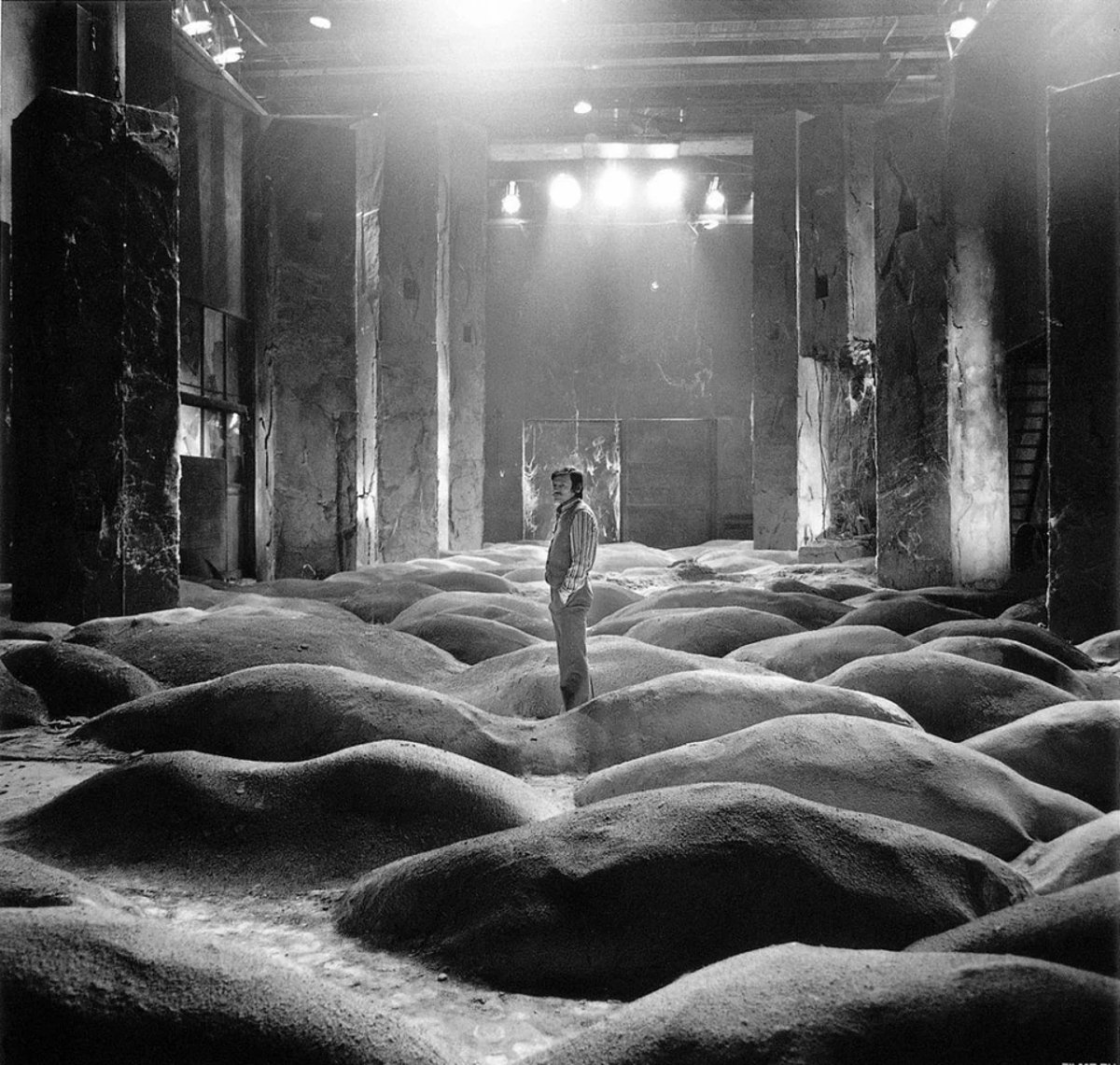
A camera tracks, unhurried, over a waterlogged floor. Objects float in the still, murky water: debris, papers, perhaps a syringe. The movement isn’t motivated by a character’s point of view or a narrative event demanding attention. It is a contemplative gaze, an act of looking that itself becomes the subject. The sound is of dripping water, a distant, indeterminate hum, the texture of a space breathing. This is the temporal fabric of an Andrei Tarkovsky film. His cinema operates on a different clock, one calibrated to the rhythm of memory and the slow erosion of the material world.
For the working filmmaker, encountering this pacing can be a confrontation. It rejects the economy of conventional screen storytelling, where every shot must advance plot or reveal character in a chain of causality. Instead, Tarkovsky’s long takes, particularly in a film like Stalker (1979), build atmosphere as a primary goal. The duration forces a shift in the viewer's attention from "what happens next?" to "what is the quality of this moment?" The elemental imagery, water, fire, fog, wind, is not backdrop but an active agent in the drama, a physical manifestation of the characters' inner states. One does not simply watch a Tarkovsky film; one submits to its unique sensory and philosophical conditions, entering a space where the spiritual and the material are held in a strange, decaying equilibrium.
The Arc
Andrei Tarkovsky’s career describes a near-perfect modernist trajectory: a rigorous state-sponsored education, a festival breakthrough that announced a major new voice, a period of intense authorial consolidation against political headwinds, and a final chapter in exile. His formal training took place at the All-Union State Institute of Cinematography (VGIK), the world’s oldest film school, where he studied under the respected director Mikhail Romm. This education provided a technical and theoretical foundation that Tarkovsky would both honor and systematically subvert. Before committing to cinema, he had studied at the Moscow Institute of Oriental Studies, a biographical detail that perhaps points to a scholarly and philosophical disposition that predated his work in film.
His student work already showed promise. The diploma film, The Steamroller and the Violin (1961), earned a prize at the New York Film Festival, but it was his first feature that established him on the world stage. Ivan’s Childhood (1962) was a startling debut. A war film that largely eschewed combat for the fractured, dream-haunted consciousness of its child protagonist, it won the Golden Lion at the Venice Film Festival. The film’s visual confidence, developed with cinematographer Vadim Yusov, signaled the arrival of a director with a fully formed aesthetic. Where other filmmakers might have used the Eastern Front setting for kinetic action or patriotic drama, Tarkovsky used it to explore trauma and memory, establishing a thematic preoccupation that would define his entire body of work.
The international success of Ivan's Childhood afforded Tarkovsky the capital to mount his first epic, Andrei Rublev. Completed in 1966 but withheld by Soviet censors for years, the film is a monumental inquiry into the role of the artist in a brutal society. Co-written with Andrei Konchalovsky, it follows the life of the 15th-century icon painter through a series of stark, violent, and lyrical episodes. The film’s production and subsequent suppression marked a turning point in Tarkovsky’s relationship with the state apparatus. On this reading, the film’s central drama, Rublev’s crisis of faith and his vow of silence in the face of cruelty, becomes a direct allegory for the artist’s struggle for integrity under an oppressive political system.
This conflict with state ideology would shadow the remainder of his Soviet period, yet it was also a period of extraordinary creative output. He followed Rublev with three films that cemented his reputation as a cinematic philosopher. Solaris (1972), his second collaboration with DP Vadim Yusov, used a science-fiction framework to stage a drama of grief and memory. In a direct counterpoint to the technological optimism of Stanley Kubrick’s 2001: A Space Odyssey (1968), Tarkovsky’s film presents space travel as a catalyst for a painful, internal reckoning. The film’s space station interiors and its lush, rain-soaked Earth sequences are best understood as contrasting psychological zones rather than genre spectacle. The contrast with Kubrick is worth drawing out, because the two films share a premise and almost nothing else. Kubrick treats space as a frontier: the camera glides through immaculate white interiors, the tools work, and the crisis arrives when the machine reasons better than the men. Distance from Earth is the point, and the ending pushes past the human entirely. Tarkovsky reverses the vector. His station is cluttered, humid, and already decaying, more a neglected apartment than a vessel, and the planet below answers scientific inquiry by returning the crew’s buried grief in physical form. Where Kubrick’s astronauts move outward and are transformed, Kelvin travels an enormous distance only to end up kneeling in a replica of his father’s house. Solaris is not a frontier at all. It is a confinement in which the only unexplored territory is the character’s own conscience.
Then came Mirror (1975), a radically associative and autobiographical work that abandons linear narrative for a fragmented structure of memory, dreams, and historical newsreel footage. It remains one of the most complex and debated films in his canon, a direct translation of personal consciousness into cinematic form. With Stalker (1979), he returned to a metaphysical sci-fi premise, depicting a journey by three men into a mysterious "Zone" where wishes are said to be granted. The film’s deliberate pacing and its focus on ruined, post-industrial environments create a powerful sense of spiritual exhaustion and faint hope. The long, hypnotic tracking shots through the Zone’s waterlogged terrain are a signature of his method, what he would later codify in his book Sculpting in Time as a process of fixing reality through durational observation.
By the early 1980s, the creative constraints of the Soviet system became untenable. Tarkovsky left the USSR, directing his final two features in exile. Nostalghia (1983), shot in Italy, is a film saturated with the pain of displacement, following a Russian writer whose spiritual malaise mirrors the director’s own estrangement from his homeland. His final work, The Sacrifice (1986), was made in Sweden with a crew that included collaborators associated with Ingmar Bergman. A stark, chamber-drama apocalypse, the film is a final, desperate prayer, culminating in an act of personal sacrifice intended to avert nuclear catastrophe.
Tarkovsky died from cancer shortly after completing the film, leaving a compact but formidable body of seven features. His stature has only grown in the decades since. Named an Honored Art Worker of the RSFSR in 1974 and a People’s Artist of the RSFSR in January 1980, then awarded the Lenin Prize posthumously in 1990, his true recognition lies in his deep influence on generations of filmmakers and the permanent place his work holds in critical and academic discourse. His career was not a sequence of jobs, but the determined construction of a singular, uncompromising worldview.
Signature Techniques
Andrei Tarkovsky’s authorial signature is not a collection of stylistic tics but a unified aesthetic system, a cinematic language developed to articulate states of being that resist conventional narrative. His methods are demanding, both for his collaborators and for his audience, prioritizing duration, sensory texture, and associative logic over the mechanics of plot. In his book Sculpting in Time, he articulated a vision of cinema as an art form uniquely capable of capturing and fixing time itself. This principle informs every major technique he deployed, from the construction of the individual shot to the assembly of the entire film. What follows is an examination of several key components of this system, grounded in the films that defined his career from the Soviet period through his final works in exile.
Duration and the Meditative Camera
The long take is perhaps Tarkovsky’s most immediately recognizable device, yet to focus only on shot length is to miss the point. Unlike the complex, choreographed blocking of a Welles or the virtuosic Steadicam of a Kubrick, Tarkovsky’s use of duration serves a different function. It is not about demonstrating technical mastery or compressing complex action into a single fluid frame. Instead, it is a tool for altering the viewer’s perception of time and space. The camera’s movement is often slow, deliberate, and seemingly unmotivated by character action, possessing its own contemplative agency.
In Stalker (1979), the camera’s prolonged, lateral tracks across the waterlogged floors of the Zone’s mysterious rooms are a primary example. The movement is not following a character to a destination. It is observing the texture of the world: the gentle ripples in the water, the submerged objects from a forgotten life, the play of light on damp walls. The duration forces the audience to cease anticipating the next plot point and instead to simply inhabit the space, to feel its history and its palpable atmosphere. The practical demands of shots like these are covered in our guide to camera movement and blocking. This method asks the filmmaker to trust the frame itself, to believe that an image held long enough can accrue meaning beyond its narrative information. One way to see this is as a direct challenge to the montage-driven cinema that dominated Soviet filmmaking theory. Where Eisenstein’s "montage of attractions" used the collision of images to generate ideas, Tarkovsky’s durational aesthetic generates a state of being through patient observation within a single, unfolding shot. The experience is closer to looking at a painting or listening to a piece of ambient music than it is to watching a conventional scene. Paul Schrader gave this approach a critical frame in Transcendental Style in Film, his 1972 study of Ozu, Bresson, and Dreyer, filmmakers who withhold conventional emotional cues so that stillness and repetition carry the weight. Schrader placed Tarkovsky in that lineage in the long essay added to the 2018 edition, and the connection is useful for a working director: the effect depends on restraint applied consistently, not on a single held shot dropped into an otherwise conventional cutting pattern.
Elemental Phenomenology: Water, Fire, and Air
Across Tarkovsky’s filmography, natural elements are not passive backdrops but active, expressive forces. Water, fire, wind, and mud are treated as primary subjects, filmed with a material intensity that grants them an almost spiritual presence. This is not simple symbolism, where water equals purity or fire equals destruction. It is a phenomenological approach, where the sensory experience of the element itself is the core of the scene.
The technique is pervasive. Consider the persistent rain, both indoors and out, in Solaris (1972), which seems to materialize the protagonist’s grief and longing for a lost Earth. In Mirror (1975), a sudden gust of wind across a field of buckwheat or the slow-motion levitation of a character are rendered as physical manifestations of memory and psychic disturbance. Stalker is perhaps the ultimate expression of this, a film saturated in water, dampness, and fog. The dripping that provides the near-constant soundtrack to the Zone is not merely atmospheric; it is the rhythm of a world in a state of simultaneous decay and becoming.
The burning of the house at the conclusion of The Sacrifice (1986) is the apotheosis of this method. The sequence is an extended, real-time observation of an act of ritual destruction. The camera does not cut away to reaction shots or employ conventional editing to heighten the drama. It simply watches the fire consume the structure. By holding the shot, Tarkovsky transforms a dramatic event into a meditative one. The audience is made to confront the physical reality of the flame, its textures and movements, until the act transcends its narrative purpose and becomes a purely cinematic event of terrifying and cleansing beauty. The elements in his films are characters in their own right, shaping the narrative and embodying the metaphysical questions at its heart.
Associative Structure and the Logic of Memory
While many of Tarkovsky’s films bend linear chronology, Mirror stands as his most radical experiment in narrative form. The film abandons traditional plot almost entirely, organizing itself according to the fluid, associative logic of memory. For a working filmmaker, studying its structure is an exercise in de-conditioning, a lesson in how to build a feature-length work on principles of poetry rather than prose. Scenes are not linked by cause and effect but by sensory triggers, emotional rhymes, and recurring visual motifs.
How is this coherence achieved without a plot? Tarkovsky builds a system of internal echoes. A shot of the narrator’s mother (Margarita Terekhova) in the 1930s might be followed by a scene with his wife (also played by Terekhova) in the present, the connection made not through dialogue but through a shared gesture, a similar framing, or the quality of the light. A childhood memory of a barn fire is not presented as a flashback to explain a later event; it exists as a standalone sensory impression, a fragment of a life that floats alongside other fragments. The film drifts between color and monochrome, between past and present, between dream and waking reality, with the narrator’s off-screen voice providing a loose thread of consciousness. This structure places enormous faith in the power of the image to carry emotional and thematic weight independently of a narrative framework. It suggests that a life is not a linear story but a constellation of resonant moments, and that a film can be built to reflect that truth.
Acoustic Space and the Weight of Silence
In a Tarkovsky film, the soundtrack is not an accompaniment to the image; it is a parallel dimension of the cinematic world. His use of sound moves far beyond diegetic realism or illustrative scoring, creating complex acoustic environments that shape the viewer’s psychological experience. Long passages are built not on dialogue or music but on the intricate layering of ambient sound: the ubiquitous dripping of water, the sigh of wind through ruins, the hum of unseen machinery, the distinct echo of a footstep in a vast, empty hall.
This is especially evident in Stalker and The Sacrifice. The sound design of the Zone in Stalker is as key as Alexander Knyazhinsky’s cinematography in defining it as a place outside normal reality. (Georgi Rerberg shot the first version of the film, which was lost to a lab failure; Knyazhinsky photographed the reshot picture that exists today.) The sonic texture is one of dampness, metallic resonance, and an unnerving quiet that is punctuated by sudden, inexplicable noises. Silence in these films is never empty. It is a charged, active presence, a space for contemplation that makes the eventual arrival of a word or a musical cue feel like a significant event. The electronic soundscapes, often developed in collaboration with composer Eduard Artemyev, frequently blur the line between music and sound design. Artemyev worked on the ANS synthesizer, a Soviet instrument built by engineer Evgeny Murzin that read images rather than notes. The composer scratched shapes into an opaque coating on a glass plate, and the machine converted those drawings into sound photoelectronically, with vertical position setting pitch and horizontal movement setting time. That drawn origin explains the character of the scores for Solaris, Mirror, and Stalker: tones that slide and hover instead of resolving, closer to weather than to melody. In Solaris, the ambient tones of the space station are inseparable from the emotional state of its inhabitants, creating a sound world that is both futuristic and deeply melancholic. For Tarkovsky, what you hear is as important as what you see, and the resonant character of a space, conveyed through sound, is a key narrative tool. Our complete sound design guide and the companion piece on ambience design break down how those layered environments are actually built.
The Metaphysics of Landscape and Ruin
Tarkovsky consistently uses landscape not as a setting, but as a vessel for spiritual and historical meaning. His locations are rarely neutral. They are charged with the weight of the past and the anxieties of the present, becoming arenas for moral and metaphysical inquiry. This is achieved by filming them with the same patient, meditative intensity usually reserved for the human face. The landscape becomes a character.
In Andrei Rublev (1966), the brutal, muddy, and expansive countryside of 15th-century Russia is the physical embodiment of the spiritual crisis facing the icon painter. The film, co-written with Andrei Konchalovsky, does not present a picturesque historical past. It presents a raw, elemental world where faith and art must be forged in the face of immense suffering, a reality mirrored in the unforgiving earth itself. Later, in his films made in exile, this technique evolved. The Italian landscapes of Nostalghia (1983) are filtered through the protagonist’s deep sense of displacement; the misty pools and ruined cathedrals are externalizations of his inner state. The remote Swedish island that serves as the setting for The Sacrifice, photographed by Ingmar Bergman’s key collaborator Sven Nykvist, is a stark, isolated stage for a drama of apocalyptic faith. In all these cases, and most pointedly in the industrial decay of Stalker, Tarkovsky finds a form of sanctity in ruin. The broken, the abandoned, and the overgrown are not signs of failure but of history, endurance, and the quiet persistence of the spiritual in a secular age.
Case Study: Andrei Rublev (1966)
!Image Andrei Rublev (1966)
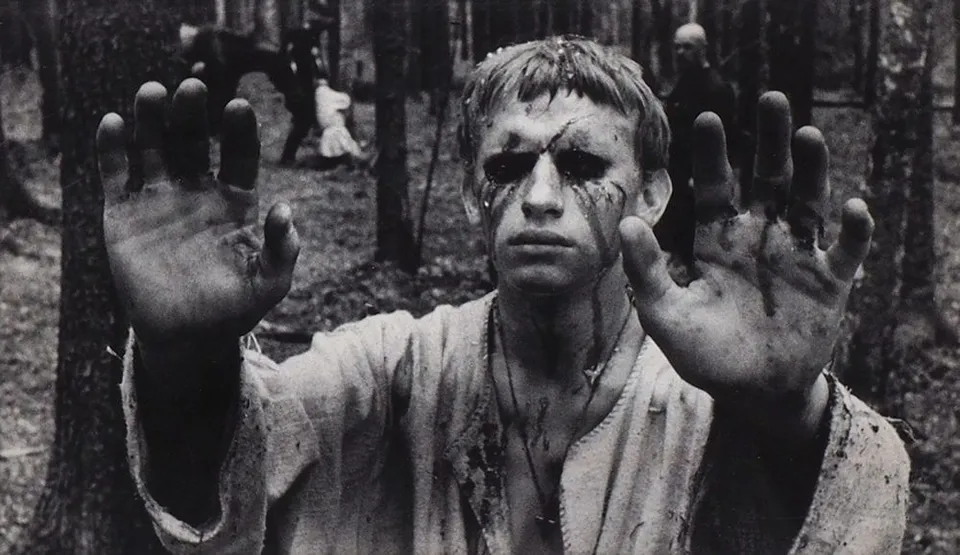
Completed in 1966 but suppressed by Soviet authorities for years, Andrei Rublev stands as a monumental statement on the role of the artist within a society defined by brutality, political power, and wavering faith. Its very production and subsequent censorship became an extension of its core themes. For a filmmaker working under the state-sponsored system of Mosfilm, to make a nearly three-and-a-half-hour black-and-white epic about a 15th-century icon painter was already an act of defiance. To structure it not as a biographical drama but as a series of harrowing, episodic meditations on history, violence, and creative silence was something else entirely. The film cemented Tarkovsky’s reputation as a director of uncompromising vision, but it also initiated the deep conflicts with Soviet officialdom that would shadow the rest of his career.
What it changed for Tarkovsky was scale and argument. After the focused, lyrical intensity of Ivan’s Childhood (1962), Andrei Rublev expanded his canvas to the national-historical. Co-written with Andrei Konchalovsky, the film discards conventional narrative causality for a structure of eight chapters, each a window into the unforgiving world that shapes and eventually silences the painter. We witness a pagan ritual, the sacking of Vladimir by Tartars, and the quiet desperation of a monastery. Rublev himself is often a passive observer, a vessel for the historical trauma he absorbs. This structure is a direct challenge to the heroic narratives favored by socialist realism. The film argues that art is not born from triumphant moments but forged in the crucible of suffering and doubt. Its watershed status comes from this collision of epic form with an anti-epic, interior perspective.
For working filmmakers, the film’s final major episode, “The Bell,” offers a masterclass in building a feature-length narrative climax around a technical process. The sequence follows a young man, Boriska, who claims to possess his late father’s secret for casting a giant bronze bell for the Grand Prince. The entire section is a film-within-a-film about creation under immense pressure. Failure means death. Tarkovsky and his cinematographer, Vadim Yusov, capture the physical reality of the work: the digging of the massive pit, the selection of the clay, the firing of the furnace, the terror and exhaustion of the laborers. The drama is not in dialogue but in logistics and raw effort. Will the clay hold? Is the metal at the right temperature?
The tension is almost entirely procedural. When the bell is finally hoisted and rung, its perfect tone is a moment of communal catharsis, a triumph of collective will and desperate faith. It is this sound that breaks Rublev’s own vow of silence, inspiring him to paint again. The film’s central thematic problem, the possibility of art in a fallen world, is resolved not through a speech but through the successful execution of another artistic-technical feat. The sequence demonstrates how to build suspense and emotional release from the mechanics of a craft, treating labor itself as a deep dramatic event.
One way to read the film’s famous final moments is as the ultimate justification for this entire approach. After more than three hours of stark monochrome imagery depicting a world of mud, wood, and stone, the film cuts abruptly to the vibrant, divine color of Rublev’s actual icons. The camera glides over the details of The Trinity and other works. This is not a simple coda. It is the film’s destination, the transcendent object produced by all the preceding suffering. The formal shift from black-and-white to color functions as an argument: this is what art is for. It is the conversion of historical pain into an image of grace.
Case Study: Stalker (1979)
!Image Anatoliy Solonitsyn in Stalker (1979)
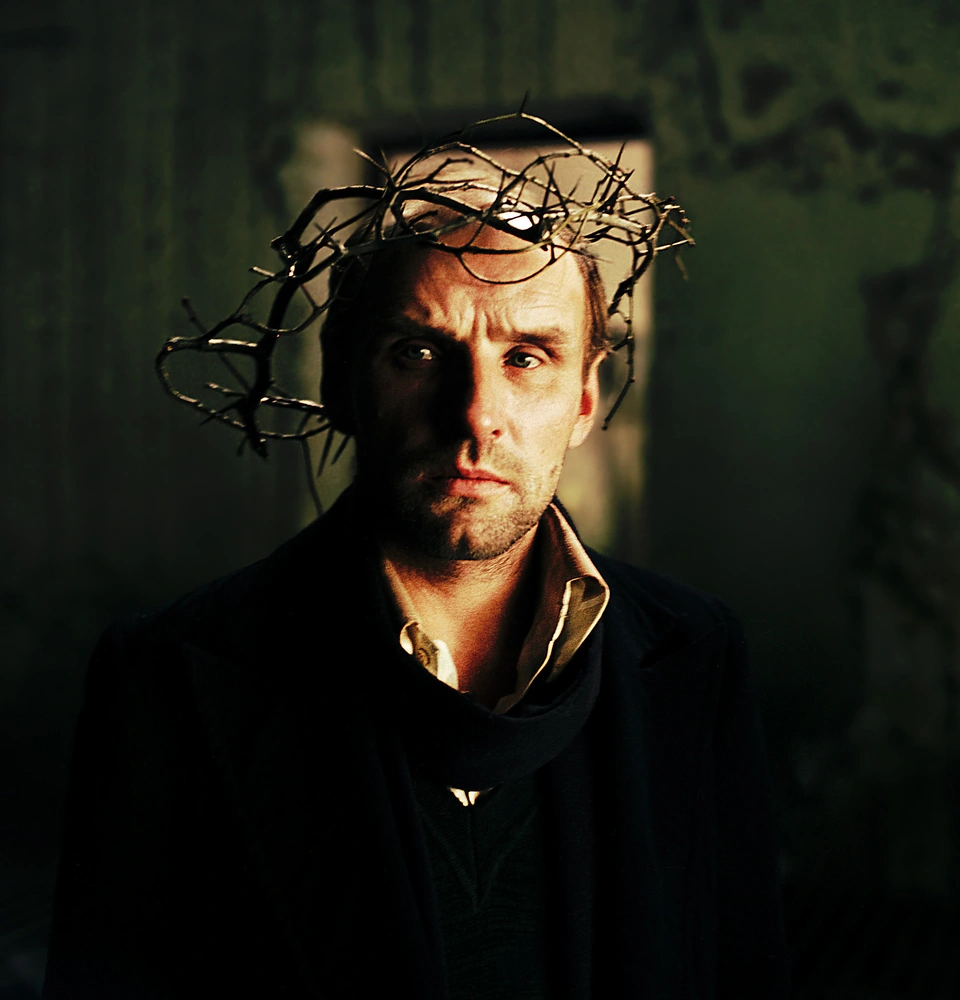
If Andrei Rublev explores the artist’s struggle with history, Stalker internalizes that struggle, transposing it onto metaphysical ground. The film is perhaps the purest distillation of Tarkovsky’s late-period concerns: faith, despair, and the search for meaning in a world stripped of certainty. It is a work of radical patience. Based loosely on the sci-fi novel Roadside Picnic by Arkady and Boris Strugatsky, the film pares the source material’s genre elements down to a skeletal premise. Three men, the Writer, the Professor, and their guide, the Stalker, venture into the Zone, a mysterious and overgrown territory containing a Room that supposedly grants one’s innermost wishes. The film is a journey inward, where the physical environment becomes a direct reflection of the characters’ psychological and spiritual states.
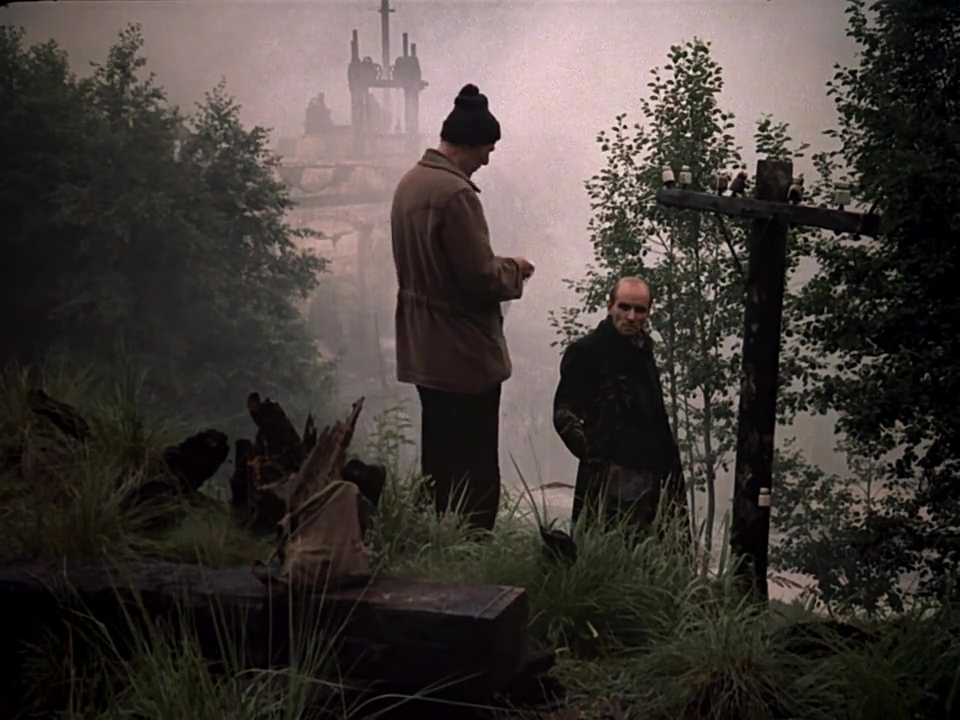
The craft of Stalker is a study in subtraction. The narrative is simple, the dialogue sparse and philosophical. Its power resides in its formal rigor, particularly its use of the long take and its atmospheric sound design. Tarkovsky’s camera movements are slow, deliberate, and hypnotic. Tracking shots glide over the damp, decaying surfaces of the Zone, lingering on running water, rusted metal, and submerged artifacts. What does this duration accomplish? It forces the viewer into a state of active contemplation. The Zone isn’t a place of action but of being. The long takes refuse to create conventional suspense, replacing it with a pervasive sense of dread and reverence. The camera’s patience invites us to look past the surface of the image and feel the weight of the space itself. On this reading, the Zone is less a location than a diagnostic tool for the soul, and the camera’s unhurried gaze is the mechanism of that diagnosis.
The film’s soundscape is as important as its visuals. Long passages unfold with only the sound of dripping water, the whisper of wind, or the distant, unidentifiable hum of the Zone. The score by Eduard Artemyev is used sparingly, often blending with ambient textures to create a sense of the uncanny. Dialogue scenes are frequently staged in reverberant, empty chambers, the actors’ voices echoing as if in a cathedral or a tomb. This sonic texture denies the audience any easy comfort. It reinforces the idea that the Zone is a place outside normal human experience, a space where the rules of the material world are suspended and every sound carries potential meaning.
For filmmakers, Stalker is an object lesson in world-building through atmosphere rather than exposition. Compare its approach to that of a contemporary like Ridley Scott in Alien (1979), another film about a small group in a hostile environment. Where Scott uses production design, fast cutting, and a physical antagonist to generate terror, Tarkovsky achieves a different kind of anxiety through stasis and ambiguity. The threat in the Zone is never visualized. It is an abstract pressure felt in the duration of a shot, the quality of the light, and the Stalker’s desperate warnings. The film teaches that a location’s power can be built from what is withheld from the audience. The Room itself is never entered, its power never demonstrated. The journey, not the destination, is the film’s true subject.
Ultimately, the film’s most contestable and compelling quality is its refusal of resolution. The characters’ debate about faith, cynicism, and desire is left unsettled. The final sequence, in which the Stalker’s daughter appears to move glasses with her mind, offers a hint of the miraculous but provides no definitive explanation. Is it a genuine miracle, a dream, or a symbol of a new kind of faith born from the Zone? The film poses the question and then falls silent, leaving the viewer in the same state of uncertain contemplation as its characters.
!Image Stalker (1979)
Collaborators
To speak of an Andrei Tarkovsky film is to speak of a small, tightly knit circle of creative trust, particularly during his Soviet period. His key collaborators were not merely technicians executing a vision but co-authors of a distinct cinematic language, tasked with translating metaphysical concerns into concrete sound and image. This reliance on a consistent team was a practical necessity within the state-run Soviet system and an artistic choice that allowed for a deepening of his formal preoccupations.
The most significant of his early partnerships was with cinematographer Vadim Yusov. Together, they defined the visual grammar that would bring Tarkovsky to world attention. Yusov’s high-contrast, graphically severe monochrome in Ivan’s Childhood (1962) established a template for subjective, dream-inflected warfare, while his work on Andrei Rublev (1966) achieved a painterly grandeur, rendering the medieval Russian countryside with the texture of a weathered fresco. On Solaris (1972), Yusov balanced the sterile functionality of the space station with the lush, hyper-real memories of Earth, creating a visual dialectic between technological alienation and organic nostalgia.
Tarkovsky’s co-writer on Andrei Rublev, Andrei Konchalovsky, was a fellow student at VGIK under Mikhail Romm. Their collaboration produced a screenplay of epic scope, braiding historical chronicle with philosophical inquiry into the role of the artist under a repressive state, a theme that resonated with their own professional circumstances. The script’s episodic structure, culminating in the visceral, process-heavy casting of the bell, is a proof to their shared ambition to break from the conventions of socialist realist biography.
The sound of Tarkovsky’s worlds, especially his science-fiction films, owes its character to composer Eduard Artemyev. A pioneer of electronic music in the Soviet Union, Artemyev used the rare ANS synthesizer to create the soundscapes of Solaris, Mirror (1975), and Stalker (1979). His contribution was not conventional scoring but a form of sonic architecture, blending ambient tones, distorted classical motifs (particularly Bach), and environmental noise to evoke the psychological and spiritual state of the characters and their surroundings.
From Ivan’s Childhood through Stalker, Tarkovsky’s films were cut by Lyudmila Feiginova. Her role in shaping the director’s signature durational rhythm cannot be overstated. The associative, non-linear structure of Mirror, which flows according to the logic of memory rather than plot, is as much a feat of editing as it is of writing or cinematography. Feiginova’s patient, contemplative cutting patterns are the mechanism that allows Tarkovsky’s long takes to accumulate their meditative power.
No actor is more synonymous with Tarkovsky’s cinema than Anatoly Solonitsyn. Initially cast as the lead in Andrei Rublev, Solonitsyn became the director’s on-screen vessel for tormented intellectual and spiritual inquiry, appearing as Dr. Sartorius in Solaris and the Writer in Stalker. His performances are marked by a weary, internalized intensity, embodying the crisis of faith and reason that sits at the heart of Tarkovsky’s work.
Upon his exile, Tarkovsky formed a new, key partnership with cinematographer Sven Nykvist for his final film, The Sacrifice (1986). Nykvist, Ingmar Bergman’s long-time collaborator, brought his mastery of natural light to Tarkovsky’s exacting compositional demands. The result is a visual palette of muted, northern European tones that feels both realistic and allegorical, culminating in the technically astounding and emotionally devastating single-take burning of the house, a sequence that merges Nykvist’s grounded naturalism with Tarkovsky’s apocalyptic vision.
Critical Reception and Counter-Readings
Andrei Tarkovsky’s work has been the subject of near-continuous critical contemplation since his emergence in the 1960s, generating a body of analysis that often mirrors the films themselves: dense, philosophical, and resistant to easy categorization. The dominant reading, advanced in his lifetime and consolidated after his death, frames him as a spiritual auteur, a cinematic mystic whose films are parables of faith, sacrifice, and transcendence. This view is heavily supported by his own theoretical writings in Sculpting in Time and finds its most ardent champions in critics who prioritize thematic and metaphysical interpretation. For them, the journey into the Zone in Stalker is a pilgrimage, the icon painter in Andrei Rublev is a national saint, and the final acts of Nostalghia (1983) and The Sacrifice are rituals of spiritual self-abnegation.
This hagiographic tendency has not gone unchallenged. One of the sharpest dissenting voices from the era belonged to Pauline Kael of The New Yorker. Famously allergic to what she perceived as the ponderous self-importance of European art cinema, Kael treated Solaris as slow-moving and self-serious, a film whose solemnity she read as pretension rather than depth. Her critique represents a pragmatic, audience-centered counterpoint, questioning whether the director’s glacial pacing and metaphysical ambiguity were deep or merely tedious. For Kael and critics of her persuasion, Tarkovsky’s films could fail a fundamental test of narrative engagement, sacrificing drama for solemnity.
A different kind of counter-reading comes from the school of film formalism, most closely associated with the work of David Bordwell. A formalist analysis of Tarkovsky tends to bracket grand thematic claims about spirituality to focus instead on the material properties of the films themselves. On this reading, the long take in Stalker is interesting not primarily as a metaphor for a spiritual journey, but as a specific stylistic choice with perceptible effects: it systematically subordinates character action to environmental detail, constructs a particular rhythm, and guides viewer attention in a highly controlled manner. This approach analyzes Tarkovsky’s style as a set of concrete formal strategies, examining camera movement, cutting patterns, and sound design as meaningful systems in their own right.
Political readings offer another corrective to the purely spiritual interpretation. While his conflicts with Soviet authorities are well-documented, critics like J. Hoberman have situated the films firmly within their historical context, arguing that they are as much about the struggle for artistic freedom in a totalitarian state as they are about God. From this perspective, Andrei Rublev is not just the story of a 15th-century painter but an allegory for the artist’s plight under any repressive regime, including Tarkovsky’s own. The film’s eventual release after years of suppression by censors becomes part of its text.
Finally, feminist film theory provides an ideological critique of the representational patterns in Tarkovsky’s work. While his films are celebrated for their psychological depth, that depth is almost exclusively afforded to his male protagonists. As scholars like Vida T. Johnson have noted, the female characters in films like Solaris, Stalker, and Nostalghia often function as idealized, mysterious, or sacrificial figures. They are mothers, wives, and phantoms who exist primarily to catalyze the spiritual crisis and self-realization of the central male figure. Even in Mirror, a film dedicated to the director’s mother, her presence is filtered entirely through the prism of a male narrator’s memory and desire. This reading doesn't necessarily negate the power of the films but calls attention to a persistent dynamic where female subjectivity is secondary to the grand drama of masculine angst.
What Working Filmmakers Should Steal
1. The Slow Push-In as Contemplative Tool Instead of using a dolly or zoom to emphasize a dramatic beat, Tarkovsky employs an almost imperceptibly slow forward camera movement that unfolds over the entire duration of a shot. The effect isn't punctuation but a gradual intensification of focus, drawing the viewer from a state of observation into one of intimate contemplation. In Stalker, the camera creeps toward the characters as they rest in the Zone, transforming the space around them into a psychic landscape. The mechanic is simple: mount the camera on a dolly and move it forward at the slowest possible speed for a minute or more. Rehearsing a move at that speed is its own discipline, as we cover in camera movement execution. It forces the audience to study the frame, to notice details, and to feel the passage of time.
2. Sound Design as Psychic Architecture Treat the soundtrack not as a supplement to the image but as a co-equal carrier of meaning. In Solaris, Eduard Artemyev’s score and the film’s sound design blend electronic tones, dripping water, distant rumbles, and the unsettling hum of the station into a continuous texture that externalizes the protagonist’s grief and disorientation. The practice here is to build dense, layered ambient tracks that define a location’s soul. Use Foley not just for realism but for effect, making the sound of a footstep or a closing door echo with the history and emotional weight of the space.
3. Elemental Events, Not Backdrops Integrate natural elements like water, fire, fog, and wind into the scene as active participants rather than passive atmosphere. The burning of the house in The Sacrifice is a masterclass in this principle: a single, complex take choreographed around the unpredictable behavior of real fire, with the actors and camera reacting to its organic, terrifying progression. The technique is to design shots around the element. Let a pool of water’s reflection become the primary visual subject, or let the wind moving through a field dictate the scene’s rhythm. This cedes a degree of control to the natural world, embedding a sense of life in the frame that cannot be faked.
4. Blocking for the Pro-Filmic Event Design scenes as self-contained dramatic units that can play out in a single, unbroken take. This requires choreographing actor movement, dialogue, and camera movement into one continuous action. The long, circular conversations in Nostalghia, where characters drift through decaying rooms, are blocked for duration, not for coverage. The approach demands precision from cast and crew on the day, but it yields a performance energy that coverage tends to sand away. Rehearse the whole unit on the floor before the camera is built, and accept that the take you print will contain small imperfections. Those imperfections are the evidence that something real happened in front of the lens.
5. Let the Weather Do the Acting Tarkovsky repeatedly scheduled around conditions rather than fighting them. Fog, rain, low sun, and wind are treated as production value rather than problems to be neutralized. On a low-budget schedule this is one of the few free upgrades available. Scout for locations that already carry texture (peeling paint, standing water, overgrowth) and build a contingency block into the day so you can move to an exterior when the sky turns. The corollary is patience in the edit: hold the shot two or three seconds past the point where a conventional cut would land, and let the environment finish the beat.
How to Watch It
Start with Ivan's Childhood (1962). It is the shortest, most conventionally structured film in the canon and it shows the aesthetic arriving fully formed inside a recognizable war-film frame. Move next to Andrei Rublev (1966) for the scale of the argument, and watch "The Bell" episode twice: once for the story, once purely for how the sequence is constructed out of process and labor.
Then take Stalker (1979). Watch it in one sitting, at night, with the volume high enough that the ambient layer reads as design rather than noise. Save Mirror (1975) for last. It rewards familiarity with the other films because its associative structure borrows images and rhythms from all of them. Solaris (1972), Nostalghia (1983), and The Sacrifice (1986) can be taken in any order after that.
Most of the features circulate in restored editions from arthouse distributors and specialty streaming services, and Mosfilm has made restored versions of several Soviet-period titles available on its official channels. If you are studying rather than simply watching, chapter through the long takes with a timer running. The shot lengths are frequently longer than they feel.
If you want more work in this register, our film studies on The Seventh Seal, Aguirre, the Wrath of God, and La Jetée sit adjacent to these concerns, as do the master studies on Ingmar Bergman and Akira Kurosawa.
Frequently Asked Questions
What did Tarkovsky mean by "sculpting in time"? He argued that the raw material of cinema is not the image or the edit but time itself, captured and shaped inside the shot. The filmmaker's job, on this view, is to find the correct duration for a piece of observed reality, then preserve it. The idea is laid out in his book Sculpting in Time (1986).
How many films did Andrei Tarkovsky direct? Seven features: Ivan's Childhood (1962), Andrei Rublev (1966), Solaris (1972), Mirror (1975), Stalker (1979), Nostalghia (1983), and The Sacrifice (1986). He also directed the graduation film The Steamroller and the Violin (1961) and a documentary, Voyage in Time (1983), made with Tonino Guerra.
Which Tarkovsky film should a filmmaker watch first? Ivan's Childhood. It is under 95 minutes, it has a legible narrative spine, and every element of the later style is already visible in it. Stalker is the deeper study but it asks far more of a first-time viewer.
Who were Tarkovsky's main cinematographers? Vadim Yusov shot Ivan's Childhood, Andrei Rublev, and Solaris. Georgi Rerberg shot Mirror and the lost first version of Stalker, which Alexander Knyazhinsky then reshot. Giuseppe Lanci photographed Nostalghia and Sven Nykvist photographed The Sacrifice.
Why did Tarkovsky leave the Soviet Union? Years of censorship, shelved projects, and restricted budgets made continued work in the state system untenable. After shooting Nostalghia in Italy he declined to return, and he spent his final years in exile in Italy, Sweden, and France. He died of cancer in Paris in December 1986.
Is Tarkovsky's slow pacing usable on a commercial schedule? The full method is not, but the individual tools are. A single held shot in an otherwise conventionally cut sequence, a sound bed that carries a scene without music, or an elemental event staged as a real occurrence rather than an effect all translate directly to modest budgets.
Sources and Further Reading
Recommended Books
- Tarkovsky, Andrei. Sculpting in Time. University of Texas Press, 1986.
Research References
1. Harvard Film Archive: Time Within Time, The Films of Andrei Tarkovsky
---
© 2026 BlockReel DAO. Master Studies series. Licensed under CC BY-NC-ND 4.0.