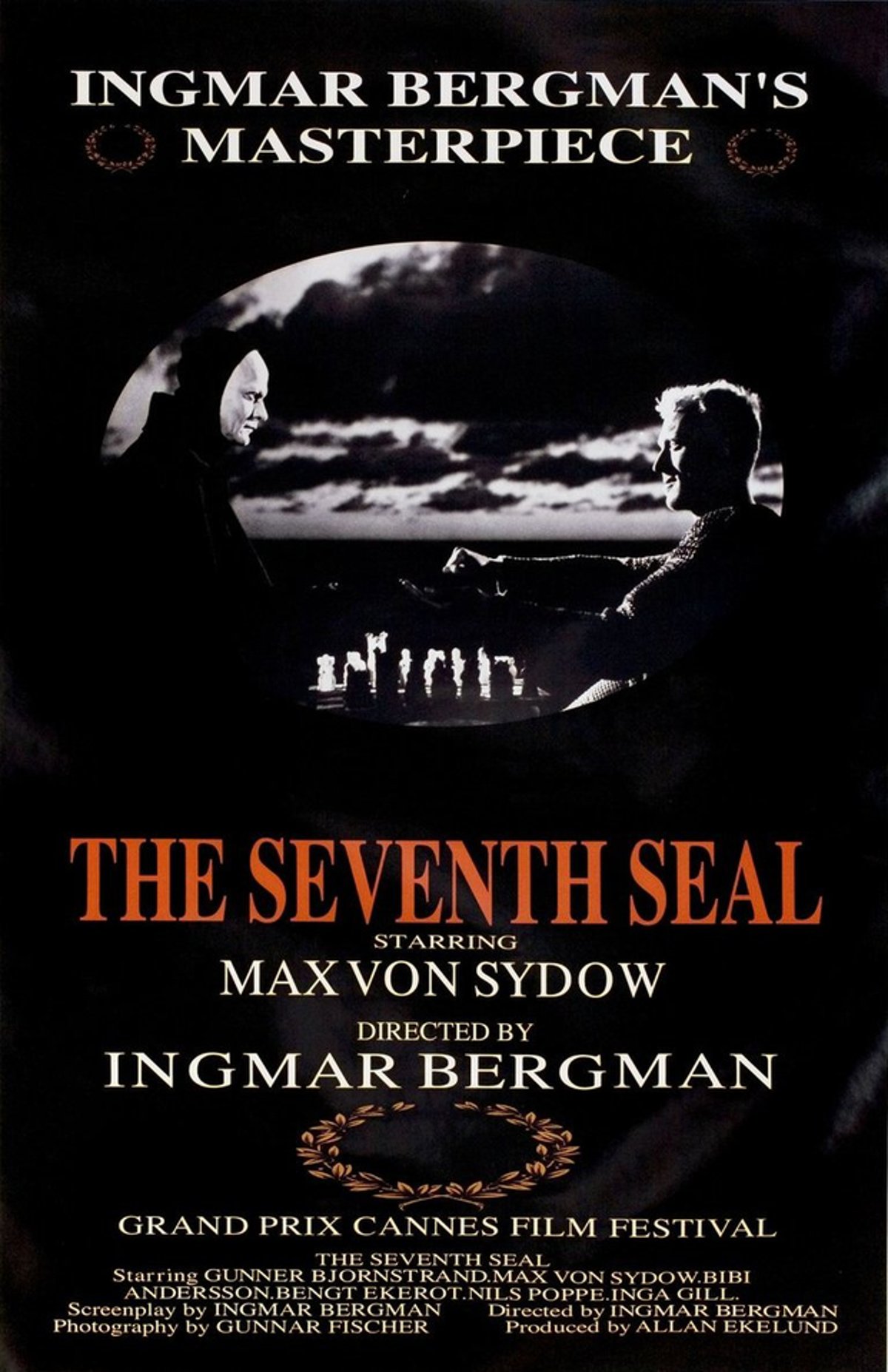
The Seventh Seal Film Study: Bergman’s Low-Budget Mastery
> This article contains affiliate links. BlockReel may earn a small commission on qualifying purchases at no extra cost to you. All commissions go directly toward funding our DAO Film Festival and supporting independent filmmakers.
A high sun bleaches the sky to a flat, unforgiving white. Below, waves crash against dark, jagged rocks, the sound a percussive roar with no discernible rhythm. The light is hard, carving deep shadows from every crevice in the stone and every fold of a knight’s coarse tunic. He lies on a bed of pebbles, his face turned to the empty expanse above. When he rises, the world is rendered in extremes: the black of his clothes, the white of the sea foam, the grey of the shore. There is no softness here, no gentle diffusion. Every texture is sharp, every outline absolute. A chess board, its squares a stark grid of black and white, mirrors the terrain’s brutal clarity.
This is a world stripped to its elements. The visual grammar denies comfort or ambiguity. When a figure cloaked in black appears, the confrontation feels less like an intrusion and more like an inevitability, a logical completion of the scene’s severe composition. The game that begins is not just a narrative device; it is a physical extension of the environment's own binary logic. One feels the cold of the stone and the damp spray of the sea not through immersive realism, but through a kind of sensory abstraction. The film presents not a place, but an idea of a place, a stage where the fundamental questions of existence can be posed without the distracting clutter of the mundane. The very construction of the image, its high-contrast severity, forces a mode of perception that is less observational and more contemplative. We are not watching a man on a beach so much as we are being confronted with a diagram of a soul at its limit.
At a Glance
| Film | The Seventh Seal (Det sjunde inseglet), 1957 |
| Director | Ingmar Bergman |
| Screenplay | Ingmar Bergman, adapted from his one-act play Wood Painting (Trämålning) |
| Cinematographer | Gunnar Fischer |
| Editor | Lennart Wallén |
| Production designer | P.A. Lundgren |
| Composer | Erik Nordgren |
| Sound | Aaby Wedin |
| Producer | Allan Ekelund, for Svensk Filmindustri |
| Principal cast | Max von Sydow (Antonius Block), Gunnar Björnstrand (Jöns), Bengt Ekerot (Death), Nils Poppe (Jof), Bibi Andersson (Mia) |
| Format | 35mm black-and-white, 1.37:1, mono |
| Running time | 96 minutes |
| Shoot | Roughly 35 days, July 2 to August 24, 1956 |
| Locations | Råsunda Film Studios, Stockholm, with exteriors at Hovs Hallar, Skåne |
| Budget | Reported at roughly $150,000 |
| Premiere | February 16, 1957, Sweden |
| Key award | Special Jury Prize, Cannes Film Festival, 1957 (shared with Kanal) |
Why This Film Still Gets Studied
The enduring lesson of The Seventh Seal is not about how to film an epic, but how to distill one. For a production team facing the perennial challenges of a tight schedule and a tighter budget, Bergman’s film offers a powerful, counterintuitive solution: embrace the artifice. Where a modern independent production might chase a documentary-style verisimilitude to mask its limitations, The Seventh Seal does the opposite. It leans into its own constructedness, turning the practical necessities of studio filmmaking into a coherent and potent aesthetic of theatrical allegory.
The film’s power is rooted in its controlled, almost painterly compositions. This is a direct consequence of its production method, but it provides a key lesson in visual storytelling. Consider the blocking. Characters are frequently arranged in stark, frontal tableaux, their bodies forming graphic shapes against minimalist backdrops. The confession scene, with the knight on one side of the grille and Death on the other, is staged with the geometric precision of a medieval woodcut. This isn't the fluid, overlapping action of realism. It is a deliberate, almost ritualistic presentation that forces the viewer to read the image for its symbolic content rather than its behavioral accuracy. For a director working with limited time for extensive coverage, this method is brutally efficient. It makes every frame count, concentrating meaning into a single, powerful setup.
Gunnar Fischer’s cinematography is the engine of this approach. The lighting is consistently hard, with high key-to-fill ratios that sculpt faces into masks of light and shadow. This isn’t simply “moody” lighting; it is a tool for abstracting the human form, for emphasizing the archetypal nature of the characters over their psychological particularities. The deep blacks and stark whites, a product of both lighting and the chosen black-and-white stock, create a world without greys, a visual corollary to the knight’s search for absolute certainty. A contemporary DP can learn from this how to create immense visual drama with a few well-placed hard sources and negative fill, proving that scale of effect is not always proportional to the scale of the lighting package. The subtractive half of that equation is worth studying on its own, since shaping a face with negative fill costs nothing but flags and time.
The sound design operates on a similar principle of stark economy. Erik Nordgren’s score is used sparingly, often entering to punctuate a moment of high drama or spiritual crisis and then receding into silence. The sound bed is not a rich, immersive weave of the 14th century. It is a spare collection of essential effects: the rattle of the plague cart, the crackle of a fire, the lonely sound of a flute. This minimalism makes each sonic event significant. In an era of dense, layered sound mixes, the film is a reminder of the power of silence and the impact of a single, well-placed sound. It demonstrates that what is omitted from the soundtrack can be as powerful as what is included, a distinction that begins in the divide between sound editing and sound mixing. The film’s most unsettling moments are often its quietest, evidence of a design philosophy that trusts the image and the performer to carry the weight of the scene.
!Image The Seventh Seal (1957) production
How It Got Made
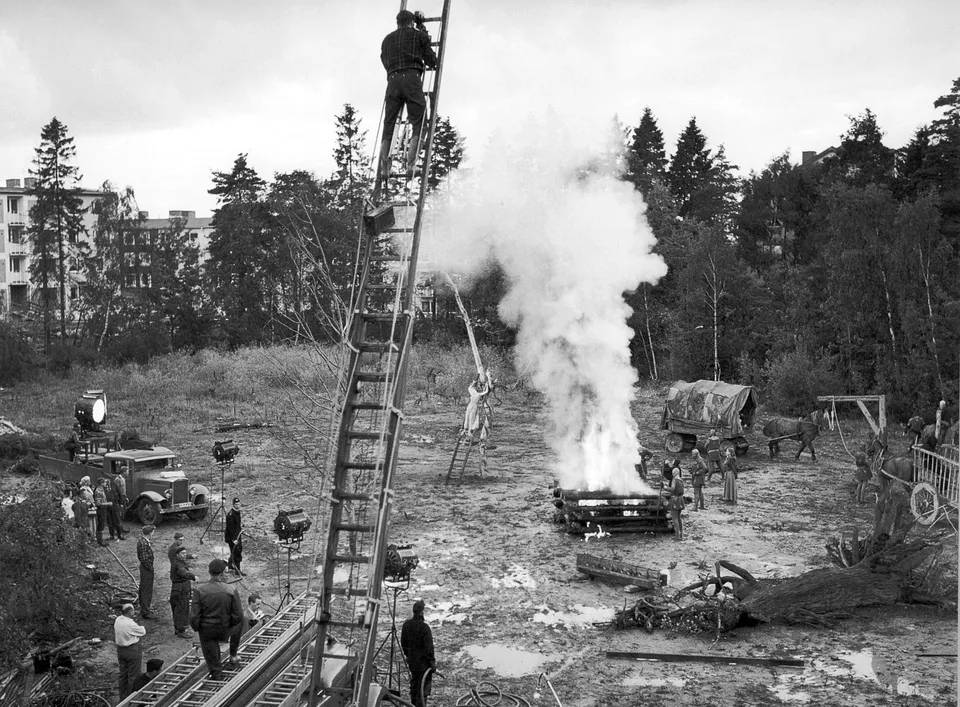
The stark, theatrical aesthetic of The Seventh Seal is inseparable from the severe constraints of its production. Ingmar Bergman had to fight to get the film made at all. His initial script, a version of his own stage play Wood Painting, was rejected by the studio Svensk Filmindustri. It was only after the international success of his comedy Smiles of a Summer Night, which won the Prix de l'humour poétique at Cannes in 1956 that the studio’s head, Carl-Anders Dymling, reluctantly agreed to finance the project. The terms were unforgiving. Bergman was granted a minimal budget, documented at around $150,000, and an extremely compressed shooting schedule of roughly 35 days.
These limitations were not incidental; they were formative. Bergman has been quoted as approaching Dymling with an ultimatum: “Now or never, Carl Anders!” He knew he had a small window of creative capital and had to use it. His own recollection captures the spirit of the production: “I mustn’t let myself get scared off any more. It’s better to do this than a bad comedy. I don’t give a damn about the money.” This was a film born of urgency, not luxury, and every choice reflects this reality. A schedule of about 35 shooting days, running from July 2 to August 24, 1956, necessitated a production model built for speed and control.
The solution was the studio. With the exception of a few key exteriors, the entirety of The Seventh Seal was shot on the soundstages of the Råsunda Film Studios. This decision, driven by budget and schedule, became the film's defining aesthetic choice. Production designer P.A. Lundgren was not tasked with recreating medieval Sweden, but with building a series of stark, functional spaces that could suggest it. The taverns, the church, the actor’s camp, these are not detailed, lived-in environments. Anyone who has tried working fast in a small space will recognise the discipline behind them. They are stages, deliberately sparse and enclosed, forcing the focus onto the actors and the dramatic geometry of their interactions. The film’s claustrophobia is a direct result of its manufactured environment.
This studio-bound production model created a powerful structural dichotomy. The film’s iconic opening and closing sequences, the knight’s first game with Death and the final Dance of Death against the skyline, were filmed on location at Hovs Hallar, a dramatic, rocky coastal reserve. These scenes feel elemental, vast, and exposed to the forces of nature and the divine, the same bargain Werner Herzog struck when he traded sets for a river in Aguirre, the Wrath of God. They bookend a story that otherwise unfolds in the cramped, artificial, and intensely human spaces of the Råsunda sets. The production’s logistical compromise thus becomes a potent metaphor. The great questions of God and mortality are posed in the open air, under a vast, indifferent sky. The petty, painful, and sometimes beautiful dramas of human life play out indoors, on a stage. The film’s very architecture, dictated by financial constraint, perfectly mirrors its thematic heart. It transmuted the limitations of mid-century Swedish studio production into a vision of faith and death whose power is inseparable from its manufactured precision.
A World Built from Fragments (Production Design)
!Image Maud Hansson in The Seventh Seal (1957)
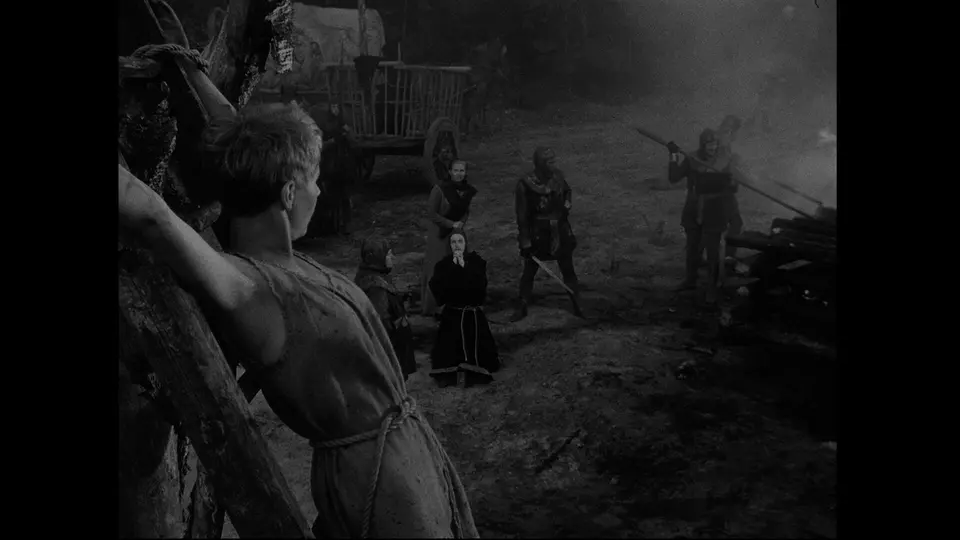
No other film of its era so completely abandons historical recreation for symbolic representation. Where contemporary epics like The Ten Commandments (1956) sought to overwhelm with scale and verisimilitude, The Seventh Seal’s production design, under P.A. Lundgren, constructs its 14th-century Sweden from a few archetypal, almost abstract, elements. This was not simply an aesthetic choice but a direct consequence of the production’s severe constraints: a 35-day schedule and a minimal budget that forced the majority of the shoot inside the Råsunda Film Studios. The film’s power comes from this limitation, turning what could have been a sparse and unconvincing world into a stark, theatrical stage for a morality play. The design philosophy is one of reduction. A church is not a cathedral; it’s a confessional grille suspended in darkness. A village is not a populated settlement; it’s a single tavern interior and a deserted, smoke-filled street. An actor’s travelling cart becomes the film’s sole moving refuge, a self-contained island of domesticity against a hostile terrain.
The contrast between the studio-bound scenes and the few exteriors shot at Hovs Hallar makes this strategy clear. The opening and closing sequences, with their real, elemental terrain of rock and sea, establish a natural world of sublime indifference. Against this vastness, the human drama unfolds in palpably artificial spaces. The lighting in the studio sets doesn't pretend to be natural sunlight filtering into a real space; it’s the hard, directional light of a theater. This manufactured quality prevents the viewer from ever sinking into a comfortable historical illusion. We are not watching a document of the past. We are watching an argument about faith and mortality, and Lundgren’s sets are the visual grammar of that argument. The confessional scene is the clearest distillation of this method. The set piece consists of little more than the grille, two faces, and a void. The architecture doesn't exist to establish a place but to create a specific moral geometry: a barrier through which a man confesses his deepest spiritual anxieties to the very entity he fears. The design is not a container for the action; it is the action, made manifest.
Light That Isolates, Not Illuminates (Cinematography)
!Image Max von Sydow and Bengt Ekerot in The Seventh Seal (1957)
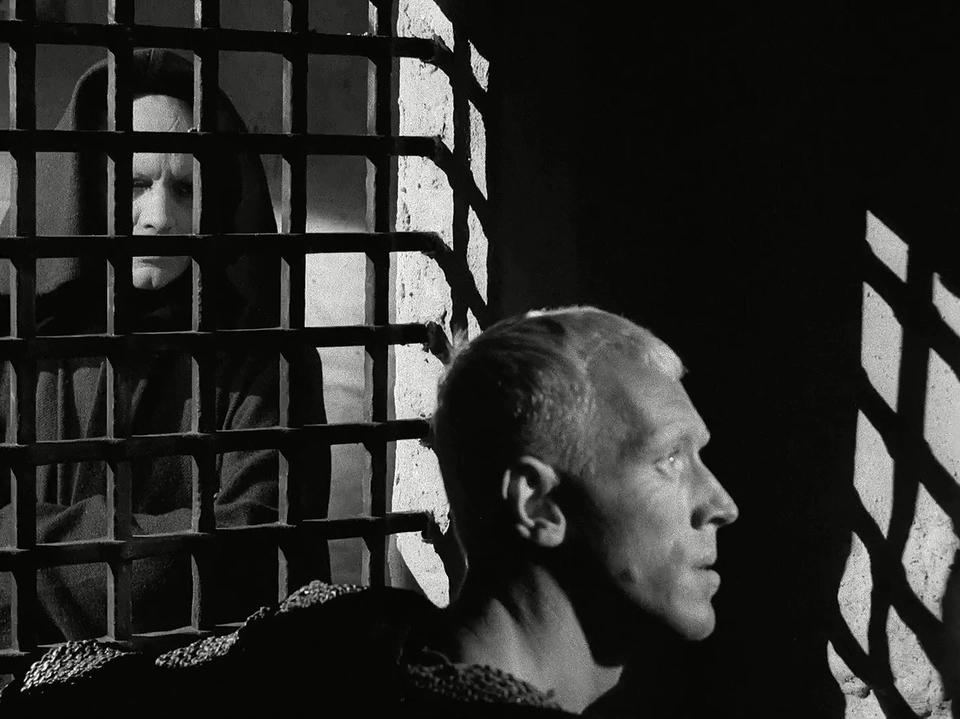
The cinematography of The Seventh Seal works in direct opposition to the conventions of narrative lighting. Gunnar Fischer’s camera does not seek to reveal a coherent, legible world for the audience. Instead, its high-contrast black-and-white photography carves figures out of an encroaching darkness, isolating them in pools of sculpted light. This is a visual language born of the studio, where total control over light is possible, and it perfectly serves the film’s existential dread. The lighting scheme consistently favors a hard key light with deep, often unfilled shadows. Faces are not softened but rendered as topographical maps of anguish and doubt. One feels the planes of Max von Sydow’s face as a terrain of bone and shadow, a technique that turns the human visage into the primary site of the film’s philosophical conflict. The effect is one of deep spiritual solitude. Characters are rarely integrated into their environment through soft, wrapping light. They are starkly defined against it, alone even when in a group.
This approach makes a claim about our state of being: that to be human is to be caught in a solitary circle of light, aware of a vast, unlit void just beyond its edge. The technique is most apparent in the intimate scenes of dialogue and confession. When the knight, Antonius Block, speaks to Death, the light models his face with a severity that externalizes his internal torment. There is no comforting ambience, no sense of a shared space. The deep blacks that surround him are not merely the absence of light but an active presence, the visual equivalent of God’s silence. This is a choice unavailable to a filmmaker committed to naturalism. It is a lighting strategy that embraces its own artifice to achieve a psychological truth. The opposite pole of the same argument runs through Jeanne Dielman and its weaponised natural light, where refusing to shape the light at all becomes the statement. Even the famous exterior shots at Hovs Hallar are composed for their graphic power, with figures silhouetted against a bright, overcast sky, rather than for their natural beauty. The light in The Seventh Seal never just illuminates; it judges, it dissects, and it isolates. It’s possible to read this not as a purely stylistic choice but as Fischer and Bergman finding the most efficient way to create dramatic images in a controlled setting, an economy that produced an unforgettable aesthetic.
The Theatrical Tableau as Moral Argument (Direction)
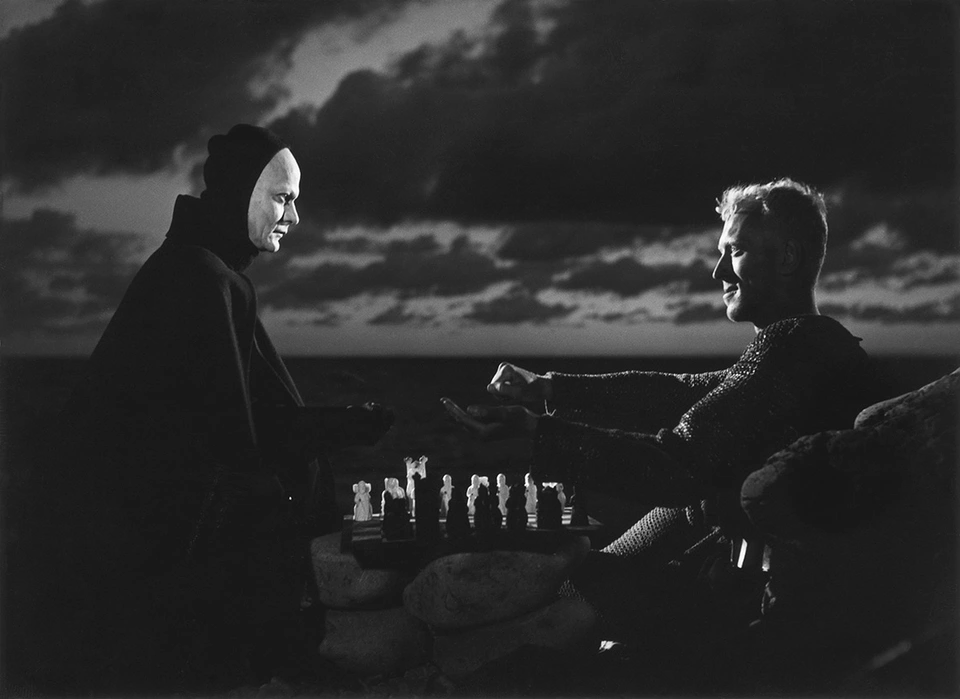
Ingmar Bergman’s direction treats the frame not as a window onto a world but as a proscenium arch for a series of moral tableaux. His blocking, honed by years of work in the theater, arranges characters in deliberate, often static compositions that function as visual arguments. This method, perfectly suited to the compressed shooting schedule, turns limitation into a potent stylistic signature. It is the oldest argument in favour of designing camera movement and blocking together rather than shooting coverage and solving the scene in the edit. Instead of relying on extensive coverage and complex camera moves to build a scene, Bergman often plants the camera and directs the drama within the fixed frame, like a stage play. Characters are positioned frontally or in sharp profile, their bodies forming geometric relationships that articulate their allegorical roles. The knight and Death face each other over the chessboard in a composition of pure opposition. The family of actors, Jof, Mia, and their child, are frequently framed in triangular harmony, an image of grace amidst the surrounding horror.
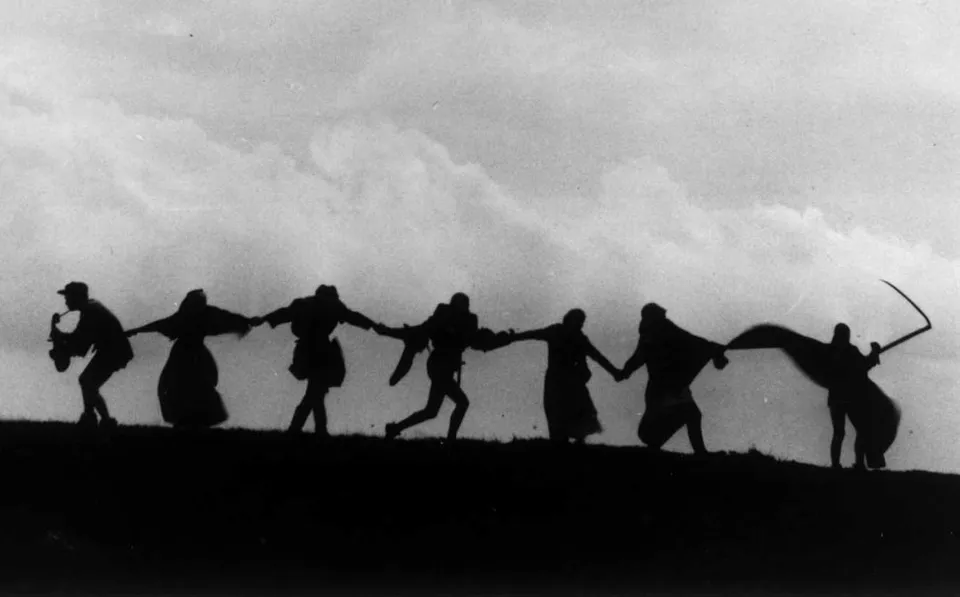
This presentational style has a distinct perceptual effect. It denies the audience the illusion of spontaneous, unfolding reality. One is always aware of the composition, of the director’s hand arranging his human figures to make a point. The flagellants’ procession is a prime example. They move across the screen in a horrifying, rhythmic frieze, a collective body of suffering that enters and exits the frame as a single, staged event. Bergman doesn't cut into the crowd to give us individual perspectives; he presents the phenomenon in its terrifying totality. The blocking makes a claim about the nature of the world these characters inhabit: it is not a place of psychological nuance and fluid social interaction, but a rigid stage where beings representing fixed ideas (Doubt, Death, Innocence, Zealotry) collide. The film’s most iconic image, the final "Dance of Death" against the horizon at Hovs Hallar, is the ultimate expression of this method: a silent, silhouetted tableau that summarizes the entire film’s thesis in a single, starkly composed shot. It is the work of a director using the static frame to ask the most dynamic of questions.
A Rhythm of Inquiry, Not Action (Editing)
The editing in The Seventh Seal, credited to Lennart Wallén, establishes a rhythm of contemplation rather than propulsion. In an era where classical Hollywood cutting was designed to create an unbroken flow of action and information, Wallén’s work consistently prioritizes psychological duration over narrative velocity. The film’s structure is episodic, a journey punctuated by encounters, and the cutting reinforces this feeling of a pilgrimage through a series of spiritual tests. The edit does not rush to get from one plot point to the next. Instead, it lingers. Scenes are often built from a few carefully chosen camera positions, and the cuts between them are deliberate and measured. The edit frequently holds on a face after a line has landed, letting the reaction, not the information, set the length of the shot.
That patience produces the film's two-track structure. The cutting alternates between the knight's metaphysical inquiry and the plain, sensory life of the travelling players, and the transitions between those registers are rarely smoothed over. A scene of theological argument gives way, without a bridging device, to wild strawberries and milk in a summer field. The abruptness is the point: the edit refuses to rank the two experiences, and it lets the audience feel the gap between a question about God and a bowl of fruit. Wallén also resists cutting on movement in the way classical continuity would demand. Shots often begin slightly before a character acts and end slightly after, so the frame retains a residue of stillness on either side of the drama. For a production shooting a handful of setups per scene, this is also practical: fewer angles, held longer, cut on thought rather than on action. The rhythm reads as contemplation, but it was built from economy.
Scene Study: The Knight, Death, and the Shore
!Image The Seventh Seal (1957)
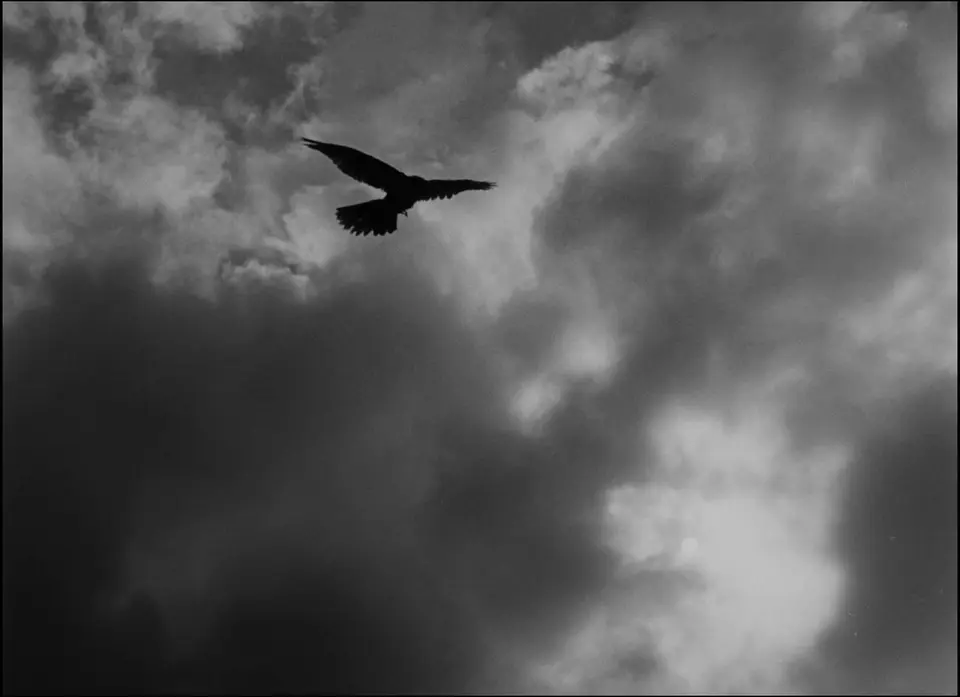
The opening sequence of The Seventh Seal, shot on location at Hovs Hallar, solves a fundamental problem of allegorical filmmaking: how to ground a mythic confrontation in a tangible, elemental world. On a compressed 35-day schedule and a minimal budget, Ingmar Bergman and his cinematographer Gunnar Fischer could not afford to construct a fantasy world from whole cloth. Instead, they used the stark, windswept coast of southern Sweden as a found set, a natural stage whose textures and scale do much of the production design’s work. The sequence demonstrates how a production’s limitations, when met with compositional rigor, can produce an aesthetic of potent simplicity.
The scene begins not with the human characters but with a shot of a bird of prey against a bleached, overexposed sky. The image is immediate, high-contrast, and symbolic, establishing the visual key for the entire film: life and death rendered in stark black and white. From there, the cutting introduces the knight, Antonius Block (Max von Sydow), asleep on a stone-strewn shore. The camera holds a wide shot, placing his small, armored form against the immense, indifferent backdrop of the sea and sky. The choice of a real, rugged terrain provides a production value far exceeding what the budget could have built. The craggy rocks and restless water are not dressing; they are active participants, their raw texture captured in deep focus. The lighting here is the sun, a single, hard key light that casts deep shadows and models the terrain with severe clarity.
Block’s morning ritual, washing his face in the saltwater, is covered in a medium shot that brings the viewer closer, connecting us to the man before the myth. His subsequent prayer is framed in a static, reverent composition, resembling a medieval woodcut. The camera does not move. The power of these shots derives from their stillness and from von Sydow’s contained performance. This is economical filmmaking, relying on composition and acting rather than elaborate coverage or camera mechanics. It trusts the audience to read the image.
The arrival of Death (Bengt Ekerot) is a lesson in understated blocking and framing. There is no grand entrance, no special effect. He simply appears in the frame, a figure in black whose form absorbs the light, creating a void against the bright sky. Fischer’s cinematography exploits the high-contrast potential of black-and-white film to its fullest. With the sun as a hard backlight on Death, his face is often thrown into shadow, making him a silhouette, an absence. When he turns, the light catches the white makeup of his face, a stark reversal. The key/fill ratio appears extreme, with little attempt to soften the shadows. This is not the soft, glamorous lighting of many contemporary studio pictures but a harsh, expressive choice that suits the subject.
The introduction of the chessboard is the scene’s central symbolic act. Block retrieves it, a perfect, man-made grid of order, and places it between himself and Death on the chaotic, natural shoreline. The camera frames them in a series of clean, balanced two-shots, often in profile, as they begin their game. The cutting, by Lennart Wallén, is deliberate and paced to the dialogue’s liturgical rhythm. It does not rush. The sound design, credited to Aaby Wedin and Wallén, prioritizes the diegetic soundscape: the crash of waves, the cry of gulls, the wind. Erik Nordgren’s score is absent, allowing the natural world to provide the scene’s unnerving sound bed. This choice reinforces the sense of a confrontation happening outside of human society, at the edge of the world.
One might argue that the theatricality of the dialogue and performance sits uneasily with the naturalism of the location. Yet the tension is productive. The formal, stylized language of faith and existential dread feels all the more stark and fragile when spoken against the unfeeling reality of the sea. The sequence suggests that our deepest spiritual questions are not abstract but are posed in and against a physical world that offers no answers.
What the sequence teaches. A powerful natural location can provide immense production value, serving as both a backdrop and a thematic counterpoint. By embracing a single, hard light source and composing in static, deliberate frames, a filmmaker can achieve a mythic scale without complex equipment. The most significant entrances can be achieved through simple blocking and framing, allowing a character to simply appear in a well-composed shot rather than relying on an elaborate reveal.
Scene Study: The Confession and the Grille
If the opening on the shore establishes the film’s elemental scale, the confession sequence demonstrates its capacity for psychological claustrophobia. Shot on a set at Råsunda Film Studios, this scene is an exercise in manufactured precision, transmuting the limitations of a studio interior into a crucible of spiritual terror. Where the opening used the vastness of nature, this sequence uses the artifice of P.A. Lundgren’s production design and the total control of Gunnar Fischer’s lighting to create its power. The technical problem here is not how to capture a mythic terrain, but how to generate deep dread from two faces, a wall, and a grille.
The scene finds Antonius Block in a village church, seeking to confess his spiritual emptiness. The set itself is a key actor. The stone walls feel heavy and cold, and the air is thick with shadow. The central prop is the confessional grille, a wrought-iron lattice that separates Block from the hooded figure of the priest. This single piece of production design becomes the scene’s organizing principle, dictating the blocking, framing, and theme. It is a physical barrier that visualizes the separation between man and God, and, as we discover, between man and his own mortality.
Fischer’s lighting is the scene’s most potent tool. This is not the broad, hard sunlight of Hovs Hallar but a highly controlled, low-key studio setup. The light source is motivated, presumably, by a high church window outside the frame, but its function is purely expressive. It is a hard, directional light that carves Block’s face out of the darkness, emphasizing the sharp planes of his cheeks and the torment in his eyes. The shadows are not filled; they are embraced. The aggressive use of negative fill plunges the background into near-total blackness, isolating the characters in pools of light and creating a space that feels both cavernous and suffocating.
The coverage consists largely of a shot-reverse shot pattern, but it is made deeply unsettling by the grille. When the camera is on Block’s side, it shoots past his head, looking through the lattice at the shadowed priest. When it reverses, it often shoots directly through the grille, which fragments the image and cages the speaker. The eyelines are tight and direct. The camera’s proximity to the actors creates an uncomfortable intimacy, forcing the viewer into the position of an eavesdropper on a soul’s final accounting. Block confesses his plan to defeat Death at chess, a strategy of pure intellect. The camera remains fixed, holding on his desperate hope.
The sequence’s climax is a purely cinematic gesture. After Block reveals his strategy, the hooded figure turns his head. The camera, which has been largely static, executes a slow, deliberate pan or dolly movement. It travels from its position on Block’s side of the grille around to the other side, revealing the confessor’s face in the same hard, revealing light. It is Death. The move is not complex, but its impact is devastating. It breaks the established pattern of the shot-reverse shot and violates the spatial logic of the confessional. In that single, fluid motion, the sacred space is profaned, and Block’s hope is revealed as folly.
The sound design reinforces the oppressive atmosphere. The dialogue is paramount, delivered in the resonant, echo-filled acoustic of the church set. The silence between the lines is as important as the words themselves, filled with a palpable weight. The scene shows that the most terrifying voids are not the silent heavens but the intimate spaces where we bare our souls, only to find our deepest fears listening. The scene’s power comes not from what is shown, but from the interplay of light and its absolute absence.
What the sequence teaches. A single, well-designed prop or architectural element can organize an entire scene’s visual grammar, providing a powerful tool for blocking and composition. In a studio environment, controlled, low-key lighting and deep, unfilled shadows can create a stronger sense of scale and dread than a fully illuminated set. A simple, motivated camera movement that breaks an established cutting pattern can deliver a narrative reveal with more force than any line of dialogue.
Technical Firsts and What Was Actually New
!Image Bengt Ekerot in The Seventh Seal (1957)
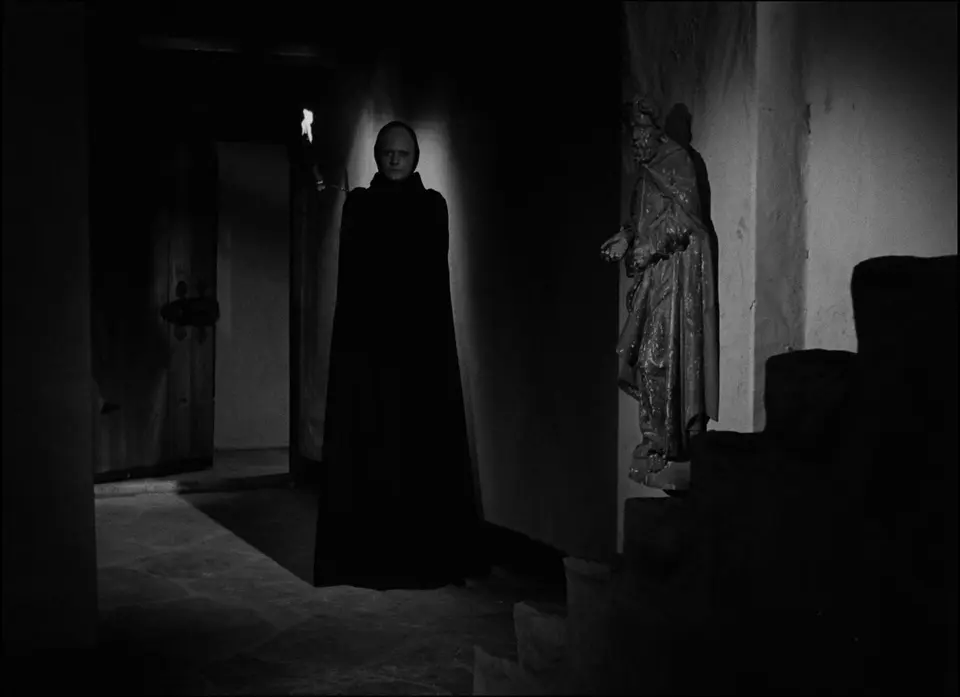
The iconography of The Seventh Seal is so foundational that its technical methods are often mistaken for invention. Received wisdom holds that Bergman and his cinematographer Gunnar Fischer created a new visual language for existential dread. The reality is more specific. The film’s true innovation was not in developing new tools but in its radical, strategic deployment of existing ones, turning the severe limitations of a 35-day studio shoot into a primary aesthetic principle.
Its most famous images, particularly the silhouetted figure of Death, were not technically novel. High-contrast, low-key lighting was a staple of German Expressionism in the 1920s and film noir in the 1940s. The innovation was conceptual: abstracting a character into a pure graphic element and sustaining that abstraction as a narrative presence. The film’s genuine technical contribution lies in its rigorous division between studio artifice and raw nature. With the exception of the opening and closing sequences shot on the rocky coast of Hovs Hallar, the entirety of the film was produced at the Råsunda Film Studios. This was a budgetary necessity, born from a scant $150,000 budget, but Bergman and his team leaned into the constraint.
Unlike the neorealist movements of the preceding decade, which sought to dissolve the barrier between the studio and the street, The Seventh Seal erects it as a formal wall. The world of the film is deliberately flattened, theatrical, and contained. Sets designed by P.A. Lundgren feel like stages, with action often blocked in proscenium-like arrangements that favor the tableau over immersive depth. The film’s newness, then, was one of degree and of philosophical commitment. It took the standard mid-century studio production model and, rather than trying to disguise its limitations, weaponized them. The claustrophobia of the studio becomes the spiritual claustrophobia of a world abandoned by God. The artifice of the sets mirrors the artifice of the rituals (religious and otherwise) that the characters use to ward off chaos. The film’s power comes not from inventing a new way to shoot, but from insisting that the old way could be used to say something profound by embracing its inherent unreality.
Influence and Inheritance
The DNA of The Seventh Seal is most visible not in its broad philosophical themes, which are perennial, but in specific, transferable formal devices. Its influence is less a matter of direct homage and more a case of filmmakers inheriting its solutions to narrative and visual problems.
The most direct and frequently cited inheritance is the personification of Death as a conversational, game-playing antagonist. This concept was parodied with affection by Woody Allen in Love and Death (1975) and repurposed for comedy in Bill & Ted's Bogus Journey (1991), where Death becomes a hapless board game enthusiast. In these cases, the inheritance is purely iconographic. A more substantive influence is visible in films that adopt its stark, high-contrast black-and-white palette to signify a state of moral or existential extremity. The desolate, texture-rich monochrome of Béla Tarr’s Sátántangó (1994) or the funereal, statuesque compositions of Pawel Pawlikowski’s Ida (2013) owe a debt to the way Gunnar Fischer’s cinematography divorces the image from simple realism. Nuri Bilge Ceylan's Winter Sleep inherits the other half of Bergman's method, the long theological argument staged in a single room. In each case the image stops describing a world and starts diagramming a moral position.
The film’s staging, which often presents characters arranged in a shallow plane against a stark backdrop, has also been influential. While a director like Wes Anderson uses a similar proscenium framing for comedic effect, others have used it to explore isolation. The way characters are positioned as lonely figures in a forbidding terrain (or soundstage) finds an echo in the work of Theo Angelopoulos, whose films like Landscape in the Mist (1988) use choreographed blocking in deep space to articulate a sense of historical and personal searching.
Finally, the film’s climactic Danse Macabre, a simple shot of silhouetted figures against a skyline, provided a powerful, low-cost template for suggesting the supernatural. The decision to render the film’s ultimate supernatural event as a simple, graphic image, devoid of special effects, demonstrated that the most resonant metaphysical moments often require the least technical embellishment. This principle, the power of the unseen or the merely suggested, is a cornerstone of atmospheric horror and can be felt in films from The Blair Witch Project (1999) to A Ghost Story (2017).
!Image Max von Sydow, Gunnar Björnstrand, Bengt Ekerot, Åke Fridell, Inga Gill, and Gunnel Lindblom in The Seventh Seal (1957)
Critical Reception and Counter-Readings
Upon its premiere in 1957, The Seventh Seal was not a guaranteed canonical work. Its success at the Cannes Film Festival, where it won the Special Prize, cemented its status as a significant piece of international art cinema, but its reputation has evolved from a celebrated allegorical drama to a monolithic cultural artifact. The consensus reading, solidified over decades, treats the film as a deep meditation on faith, doubt, and mortality, an interpretation Bergman himself encouraged. In this view, the knight Antonius Block’s chess game with Death is the central metaphor for a modern, existential crisis played out against a medieval backdrop. Critics operating in a humanist tradition, from Roger Ebert onward, have focused on the film’s emotional core: the simple joys of the acting family Jof and Mia, who represent a kind of secular grace that ultimately escapes Death’s grasp.
A necessary counter-reading, however, emerges from the film’s production history. This industrial-formalist critique does not seek to diminish the film’s philosophical weight but to ground it in the material realities of its creation. As the production records confirm, The Seventh Seal was a low-budget, tightly scheduled picture made possible only by the commercial success of Bergman’s previous film, Smiles of a Summer Night (1955), which took the Prix de l'humour poétique at Cannes in 1956. On this reading, the film’s austere, theatrical aesthetic is not just a high-minded choice but a direct consequence of constraint. The reliance on studio sets, the spare compositions, and the focus on small-cast dialogue scenes were economical necessities. The film’s allegorical power, therefore, is inseparable from its manufactured precision. It feels like a fable precisely because it was built like one: on a stage, with limited resources, where every element must be deliberate.
Read alongside our master study of Ingmar Bergman, this reading complicates the notion of Bergman as a lone auteur conjuring visions from a purely internal, spiritual space. It re-situates him as a pragmatic studio director, albeit a brilliant one, working within the Swedish film industry. The film’s starkness is as much a product of Svensk Filmindustri’s ledger as it is of post-war Lutheran angst. To see the film this way is to appreciate it not as a disembodied philosophical text but as a expert piece of problem-solving, where every aesthetic choice serves a dual purpose of thematic resonance and production efficiency. The question of whether the meaning produces the form, or the form produces the meaning, remains fruitfully unresolved.
What Working Filmmakers Should Steal
!Image Max von Sydow and Bengt Ekerot in The Seventh Seal
The Overture/Coda Location Strategy. The film was shot almost entirely in-studio, except for the opening and closing scenes at Hovs Hallar. This anchors the artificial journey in a tangible, elemental reality. On a tight budget, save your expensive location days for the first and last five minutes of your film to establish and resolve its world.
Antagonist as Graphic Shape. Death is introduced as a black silhouette against a grey sky, a form before a character. This is a purely visual statement of intent, costing nothing more than a cloak and careful backlighting. Introduce a threat through its silhouette or graphic form before revealing its human details to build immediate dread.
World-Building Through Off-Screen Sound. The plague-ravaged Sweden is often heard more than seen. The sound design, credited to Aaby Wedin and Lennart Wallén, uses distant chants, cries, and an unnerving quiet to suggest a society collapsing just beyond the frame. Build the scale of your world with a carefully designed sound bed rather than expensive wide shots or crowd scenes.
The Tableau as Coverage. Many scenes, like the actors’ meal with the knight, are blocked as a single, painterly composition. Bergman and Fischer trust the tableau, minimizing the need for extensive shot-reverse-shot coverage. Block your scenes to work powerfully in a single wide or medium master shot, which can save immense time on set.
Embrace Hard Light and Negative Fill. Fischer’s cinematography uses hard key lights with minimal fill, carving faces out of deep shadow. This is faster to set up than complex soft lighting and creates immediate dramatic texture. Instead of fighting shadows on a low-budget shoot, use them as a primary visual tool by embracing hard sources and negative fill.
The Narrative Prop. The chess set is not mere set dressing; it is the film’s structural engine, externalizing the knight’s internal battle and driving the plot. Find a single, potent prop that can provide narrative structure and make an abstract conflict tangible for the audience.
The Power of the Simple Effect. The final Danse Macabre is one of cinema’s most enduring images of death, yet it is just actors in costume silhouetted against a ridge. The effect is entirely photographic, requiring no post-production wizardry. For supernatural or symbolic moments, exhaust simple, in-camera solutions before turning to digital effects.
How to Watch It
The film exists in several editions, but the restoration available through the Criterion Collection is the definitive presentation for home viewing. Its visual and sonic clarity is essential to appreciating the craft. The Seventh Seal makes demands on its audience. It is not a film to be watched casually or with distractions. The power of its quietest moments, the subtle shifts in Erik Nordgren’s score, and the weight of its silences require an uninterrupted viewing in a darkened room. The stark black-and-white cinematography is designed for total immersion; the presence of ambient light or a second screen dissolves its carefully constructed atmosphere.
On a first pass, allow the allegory and the performances to guide you. Follow the parallel journeys of the knight and the family of actors. On a second viewing, watch the film with the sound off. Pay attention to Gunnar Fischer’s lighting and P.A. Lundgren’s art direction. Note the visual contrast between the craggy, elemental textures of the Hovs Hallar exteriors and the smooth, theatrical planes of the Råsunda studio sets. Notice how often characters are framed against the sky or a blank wall, isolating them within the 1.37:1 frame, the inverse of the strategy Truffaut and Decaë pursue in The 400 Blows, where a widescreen format is turned against its own spectacle.
Then, experience the film with the picture off, focusing solely on the soundtrack. The sonic world is just as constructed as the visual one. Listen for the interplay between dialogue, Nordgren's score, and the long stretches of near-silence that the film uses as its default state. The plague world is largely a sonic invention: distant chants, a cart wheel, wind across open rock. Once you hear how little is actually there, the density of the film's atmosphere reads as a lesson in restraint rather than in resources.
Pair the viewing with Wild Strawberries (1957), shot the same year with the same cinematographer, to see how differently Bergman and Fischer handle light when the subject is memory rather than dread. The Criterion Collection edition of The Seventh Seal remains the reference transfer.
Sources and Further Reading
Critical Texts and Scholarship
- Bergman, Ingmar. Images: My Life in Film. Arcade, 1994.
Primary and Archival Sources
1. Ingmar Bergman Foundation: production record for The Seventh Seal
---
© 2026 BlockReel DAO. Film Studies series. Licensed under CC BY-NC-ND 4.0.