Christopher Doyle: Mixed-colour Handheld and wide-lens cinematography
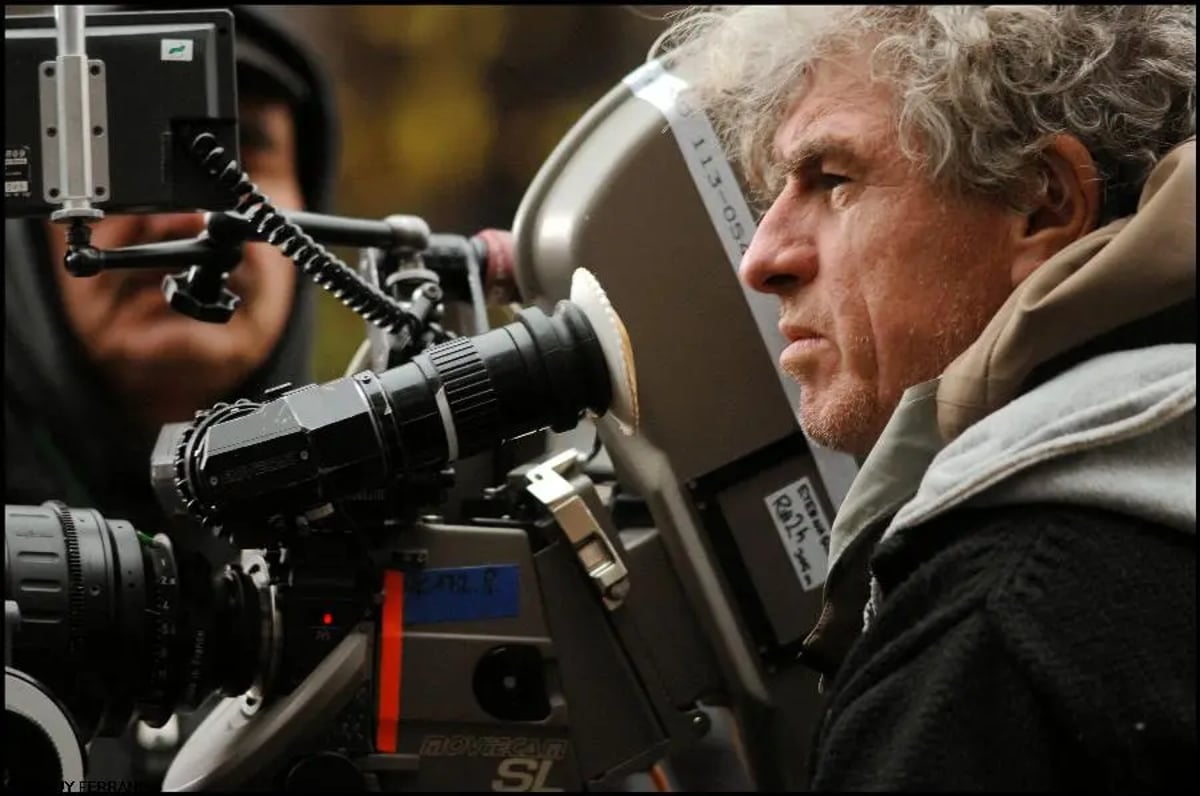
> This study contains affiliate links. BlockReel may earn a small commission on qualifying purchases at no extra cost to you. All commissions go directly toward funding our DAO Film Festival and supporting independent filmmakers.
A smear of light drags across the frame, the tail-light of a bus bleeding into the rain-slicked Hong Kong asphalt. The camera is not on sticks. It is a nervous system, a participant, shouldering its way through a crowded noodle stall or stumbling alongside a character in flight. This is the immediate sensory data of a Christopher Doyle picture. His images are not merely captured; they feel excavated from the moment, thick with the humidity and neon of the city, saturated with a longing that clings to the air like smoke. One thinks of the step-printing in Chungking Express (1994), where the world rushes past a pensive character in a liquid blur. The technique, a simple optical process of re-photographing frames to manipulate motion, becomes a perfect visual analog for a specific kind of urban loneliness: the feeling of standing still while life accelerates around you.
What is the texture of memory? For Doyle, particularly in his work with Wong Kar-wai, it is often a collision of kinetic, handheld immediacy and a deep, almost suffocating melancholy. The camera peers from behind a doorway, catching a fleeting glance between two people who will never connect. It glides slowly, hypnotically, past a character framed in a sliver of space, their face obscured by a curtain or a reflection in a dirty window. The result is a deeply subjective grammar. We are not watching a story from a safe distance. We are inside the character’s perceptual field, experiencing their world as a barrage of sensual information, fragmented and achingly beautiful. It is a cinema of heightened sensation, where the color of a dress or the quality of light in a hallway carries the entire emotional weight of a scene.
The Arc
Christopher Doyle’s path to becoming one of the world’s most distinctive cinematographers was not a straight one. He did not emerge from a film school, nor did he apprentice in a traditional camera department. His early life, as retold in profiles over the decades and rarely with matching details, was a nomadic run of jobs: time at sea in the merchant marine, drilling work in Asia, a stretch studying Chinese medicine. The specifics shift from interview to interview, which is itself part of the Doyle persona. This itinerant, outsider perspective is not incidental to his work; it is foundational. Arriving in Taiwan in the late 1970s, he fell into the orbit of the burgeoning New Wave, finding his first major credit on Edward Yang’s directorial debut, That Day, on the Beach (1983). His fluency in Mandarin and later Cantonese gave him an access and collaborative intimacy that would have been impossible for most expatriates. He was not a visiting technician but a resident artist, absorbing the cultural frequencies of a place that would become his primary canvas.
The collaboration that would define his career, and in many ways redefine the aesthetics of global art cinema, began with Wong Kar-wai’s Days of Being Wild (1990). Here, the Doyle-Wong method was forged. It was a process built on intuition, not rigid planning. Working from sparse outlines rather than finished scripts, they discovered the film during production. Doyle’s role was far more than a director of photography executing a plan; he was a co-conspirator, a sparring partner, his camera an active participant in the search for the film’s soul. This approach reached a fever pitch with Chungking Express. Shot quickly in the breaks of editing the sprawling wuxia epic Ashes of Time, the film has a restless, improvisational energy. Its handheld camerawork, use of available light, and experiments with frame rates were born of necessity, but they cohered into a style that perfectly captured the fleeting connections and disconnections of modern urban life. In its immediacy and formal freedom, it echoes the spirit of Raoul Coutard’s work with Jean-Luc Godard, another instance of a cinematographer and director inventing a new language in the streets.
If Chungking Express was punk rock, In the Mood for Love (2000) was a mournful torch song. The collaboration with Wong evolved dramatically. The frenetic energy was now contained, sublimated into a mood of intense restraint and longing. Doyle’s camera, shared on this film with Mark Lee Ping-bing and, on 2046, with Kwan Pun-leung, became more formal, its movements deliberate and hypnotic. The tight, claustrophobic framing traps Tony Leung and Maggie Cheung in the hallways, offices, and cramped apartments of 1960s Hong Kong. We observe them through doorways, over shoulders, and in reflective surfaces, the compositions emphasizing their isolation and the social barriers that keep them apart. The color palette is controlled and expressive, with deep reds and melancholic greens dominating the visual field. Slow motion is used not for spectacle but to suspend time, to stretch a fleeting glance into an eternity of unspoken desire. It is a study in visual tension, where the strongest emotions are carried in the space between two people. The work was recognised at the time: In the Mood for Love took the Technical Grand Prize at Cannes in 2000, the festival's craft award, and Hero went on to an Academy Award nomination for Best Foreign Language Film.
The film 2046 (2004) acts as a fractured retrospective of the entire Wong-Doyle aesthetic, blending the formal elegance of In the Mood for Love with the chaotic energy of their earlier work, all filtered through a science-fiction conceit that is really about the prison of memory. The visual world is a labyrinth of recurring colors, textures, and compositions, a direct representation of a mind lost in its own past.
His work outside of Hong Kong demonstrates a remarkable adaptability. For Zhang Yimou’s Hero (2002), Doyle exchanged the intimacy of handheld for the grand scale of an epic. The film’s visual structure is rigorously organized around color, with each narrative section assigned a distinct chromatic identity (a red chapter, a blue chapter, a white chapter, and a green flashback). The compositions are painterly and precise, proof of his ability to serve a completely different directorial vision on a massive state-backed production. The result is as far from the run-and-gun ethos of Chungking Express as one could imagine, yet the images possess the same confidence and expressive power. His collaborations with Western directors like Gus Van Sant, particularly on Paranoid Park (2007), show another facet. There, mixing 35mm and Super 8, Doyle’s camera finds a grainy, lyrical intimacy that connects directly to the subjective world of its teenage protagonist, proving his eye is not tied to one city or one director, but to a way of seeing.
Doyle’s career arc is not one of linear refinement toward a single, perfected style. It is a spiral, constantly returning to core principles of spontaneity and presence while applying them to new contexts. He has consistently described his ideal working state as one that leaves room for accident, comparing his own on-set temperament to a rock musician who can only sustain choreography for a few minutes before instinct takes over. This philosophy places him in contrast to cinematographers known for their careful preparation, like Roger Deakins or the late Gordon Willis. For Doyle, the image is not an endpoint to be achieved but a discovery to be made in the dynamic space between the camera, the actor, and the environment. His greatest contribution may be this very idea: that the cinematographer is not merely a technician who records, but an artist who responds, intuits, and feels their way through the film, one frame at a time. Set him beside Roger Deakins, whose authority comes from the opposite instinct, and the two studies together cover most of the range available to a working cinematographer.
Temporal Manipulation: The Step-Printed Image
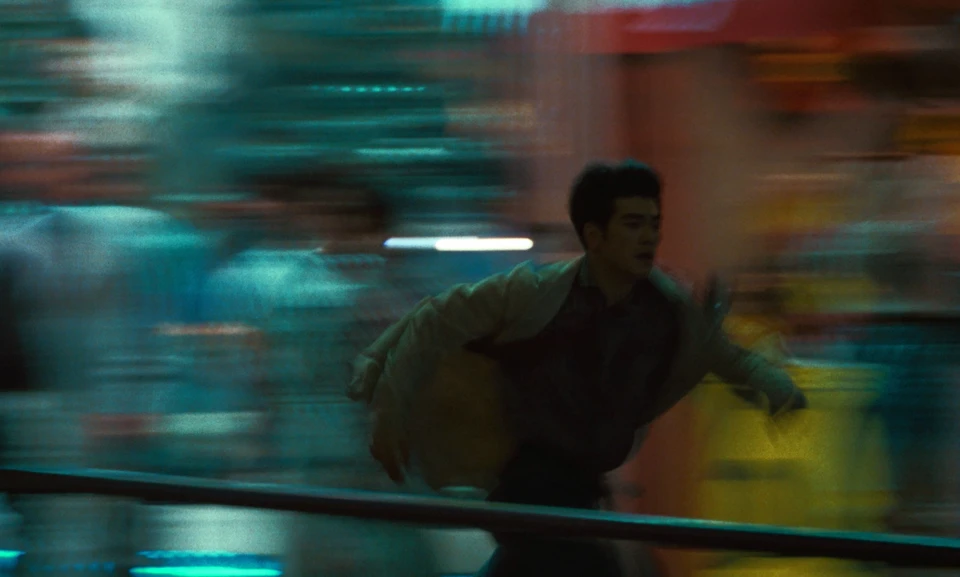
Nocturnal Velocity: Cop 223 sprinting through the midnight streets of Hong Kong. Doyle uses step-printing to turn the fluorescent city into a streak of liquid neon, physically visualizing a mind completely isolated by urban melancholy.
The kinetic, smeared-motion effect in Wong Kar-wai’s films, particularly Chungking Express (1994), is not a post-production afterthought but a foundational in-camera technique that redefines cinematic time. This is achieved through step-printing. The mechanical process involves shooting at a lower-than-standard frame rate, well below the standard 24, and then optically printing or digitally duplicating those frames to stretch the action to the standard 24 fps playback speed. The result is a disorienting temporal distortion: stationary or slow-moving objects appear relatively sharp, while faster-moving elements within the frame, especially in the background, blur into streaks of light and color.
In Chungking Express, this technique visualizes the internal dislocation of its characters against the ceaseless motion of Hong Kong. When Cop 223 (Takeshi Kaneshiro) stands still amidst a crowd, the world rushes past him in a staccato blur. The technique isolates him, suggesting a man frozen in his own heartache while the city’s metabolism continues unabated. It’s a powerful externalization of a subjective state. The world doesn’t just feel like it’s moving too fast; for the viewer, it literally is.
This contrasts sharply with the more conventional use of overcranking (slow motion) to heighten emotion, a tool Doyle and Wong also employ with precision in films like In the Mood for Love (2000). Where slow motion elongates a moment for romantic or melancholic emphasis, step-printing chops it up, creating a sense of anxiety and temporal fragmentation. It’s the visual equivalent of a skipping record, a glitch in the fabric of the diegesis that forces the viewer to experience time not as a smooth continuum, but as a series of discrete, jarring instants.
Framing as Obstruction
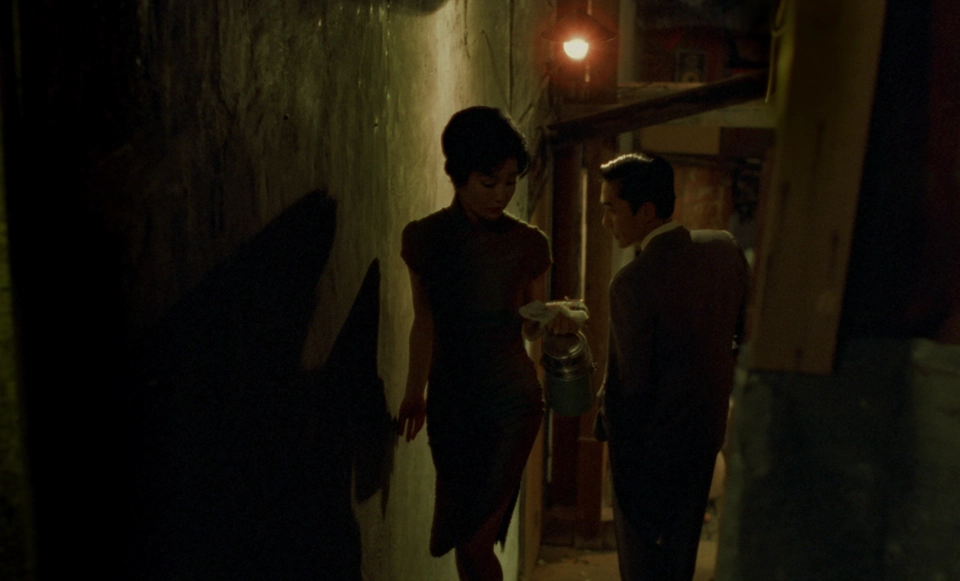
The Architecture of Confinement: Compositional obstruction as a narrative keyhole. The narrow, repeating geometric lines of the corridor frame the characters not in a shared space, but in individual cells of societal repression.
A recurring visual signature in Doyle’s work with Wong Kar-wai is the denial of a clean, unobstructed view of the action. Characters are constantly glimpsed through doorways, past out-of-focus foreground objects, around corners, and in the reflection of rain-slicked surfaces. The compositions in In the Mood for Love are the fullest expression of it. We rarely see Su Li-zhen (Maggie Cheung) and Chow Mo-wan (Tony Leung) in a simple, direct two-shot. Instead, the camera is placed down a hallway, outside a window, or behind a latticed screen, forcing the audience into the position of a voyeur.
This is more than a stylistic flourish. The framing functions as a narrative and psychological barrier. The cramped Hong Kong corridors and cluttered apartment interiors become physical manifestations of the social and emotional confinement the characters endure. Their affair, which exists only in stolen moments and shared glances, is visually represented by a camera that can only steal glimpses itself. The frame is not a window but a keyhole. By consistently obscuring our view, the film makes their isolation and the impossibility of their connection palpable. We long for a clear shot of them together, just as they long for a life they cannot have. Composing this way inside real apartments is a scheduling problem before it is an aesthetic one, which is the subject of our guide to blocking and lighting in small spaces.
One way to read this technique is as a direct challenge to the grammar of classical continuity editing, which prioritizes spatial clarity and ideal vantage points. Where a director like Alfred Hitchcock might use a point-of-view shot to create suspense by aligning the audience with a character’s gaze, Doyle’s obstructed frames often create a more ambiguous subjectivity. Whose gaze are we sharing? Is it a neighbor’s? Is it the camera’s own disembodied presence? Or is it a projection of the characters’ own self-consciousness, their feeling of being watched? The technique refuses a simple answer, implicating the viewer in the act of looking while simultaneously holding the film's central relationship at a frustrating, beautiful distance.
Color Temperature as Psychology
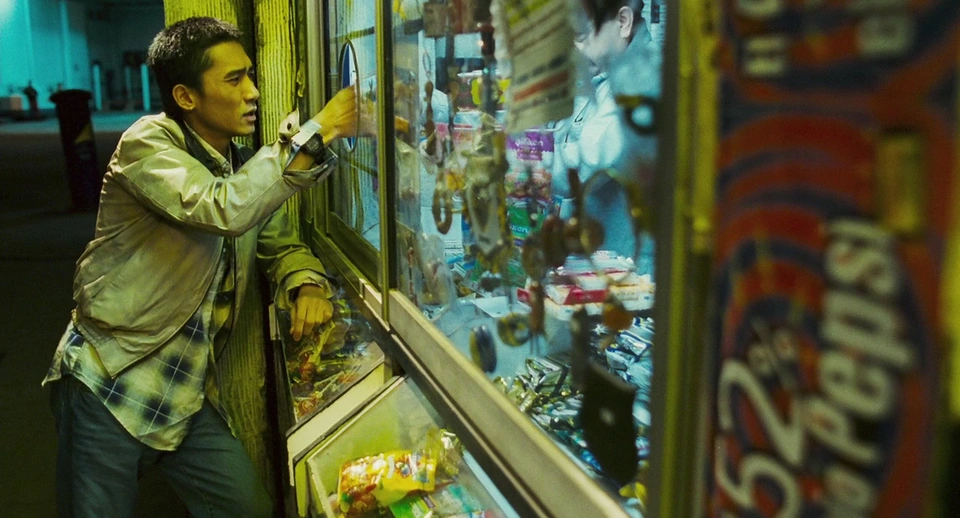
Chromatic Dissonance: Rather than correcting environmental sources, Doyle embraces raw, conflicting color temperatures to paint a dirty, fragmented palette that actively visualizes internal emotional friction.
Doyle’s palettes are rarely naturalistic; they are expressive. He is known for embracing, rather than correcting, the mixed color temperatures of urban environments. The sickly green cast of fluorescent lights in a subway station is allowed to clash with the warm, amber glow of a tungsten practical lamp or the sodium-vapor orange of a street light. This creates a world saturated with competing hues, a visual strategy that links color directly to a character's psychological state. In films like Fallen Angels (1995) and Happy Together (1997), the uncorrected, often jarring colors contribute to a sense of alienation and emotional dissonance. The world looks and feels off-kilter because the characters are. Doing this on purpose rather than by accident means knowing what your sources actually put out, which our guide to practical lighting, dimming, and CRI pitfalls covers fixture by fixture.
The approach reaches its most disciplined form in In the Mood for Love, where the palette is more controlled but no less subjective. The deep, enveloping reds of curtains, dresses, and wallpaper suggest a world of repressed passion and simmering desire. The cool greens and blues that often frame the characters in their lonelier moments provide a stark counterpoint. The color isn't simply decorative; it’s a key component of the film’s emotional architecture. The temperature of a scene, in a literal and figurative sense, tells us as much about the characters’ inner lives as the dialogue does.
This method stands in revealing contrast to his work with Zhang Yimou on Hero (2002). There, color is not a messy byproduct of mixed lighting but a rigid, monolithic structuring principle. Entire sequences are coded with a single dominant color, and each color carries a competing account of the same events: the red version Nameless tells the king, the blue version the king imagines in reply, the white version that comes closest to what happened, and a green flashback to the earlier history between Broken Sword and Flying Snow. This demonstrates Doyle’s versatility. He can move from the chaotic, street-level color-mixing of the Wong Kar-wai collaborations to a highly formalized, almost abstract use of color in a different directorial context. In both modes, however, the principle remains the same: color is not used to replicate reality, but to interpret it.
The Intimate Wide
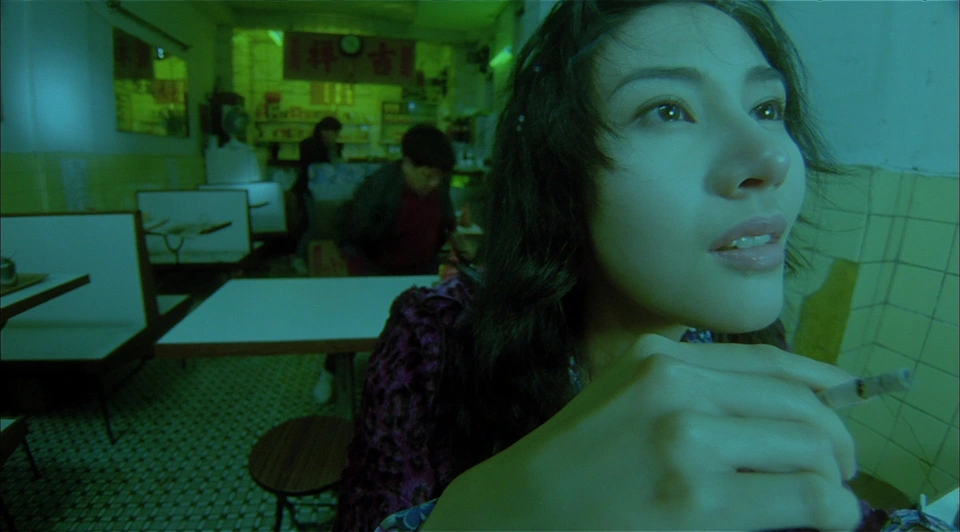
Forced Proximity: Subverting classical telephoto portraiture. Utilizing a wide-angle lens (under 25mm) in extreme close-up forces a confrontational, slightly warped physical intimacy while maintaining a sharply present, immersive environment.
Conventional cinematography dictates that a close-up is best achieved with a longer focal length (85mm, 100mm, or more) to flatten the actor’s features and isolate them from the background. Doyle frequently subverts this convention, opting instead for what could be called the "intimate wide." He places a wide-angle lens (for instance, a 25mm or wider) extremely close to the actor, a choice with two consequences.
First, it creates a subtle but palpable distortion. The proximity of the wide lens exaggerates features, making faces feel more expressive, almost grotesque. It generates a feeling of forced intimacy, as if the camera has violated the actor’s personal space. This is not the flattering portraiture of classic Hollywood; it is raw, immediate, and sometimes uncomfortable. In Fallen Angels, the faces of the hitman (Leon Lai) and his anarchic partner (Michelle Reis) are often rendered through this distorted proximity, amplifying their disconnection from normative society.
Second, unlike a telephoto lens that obliterates the background into a soft bokeh, the wide-angle close-up maintains a deep field of focus, keeping the environment sharply present. The character is never divorced from their context. We see the frenetic street scene or the cluttered room wrapping around them. This creates a paradoxical sensation of claustrophobia and immersion. The character is simultaneously the overwhelming focus of the shot and just another element in a chaotic world. This visual tension is central to the urban anxieties explored in films like Chungking Express, where individuals struggle to carve out a space for themselves within the overwhelming density of the city. The intimate wide makes that struggle visible in the very construction of the frame. The distortion is a property of the glass rather than a defect to hide, an argument we develop in Beyond Perfection: Harnessing Lens Breathing, Distortion, and Falloff.
Case Study: Chungking Express
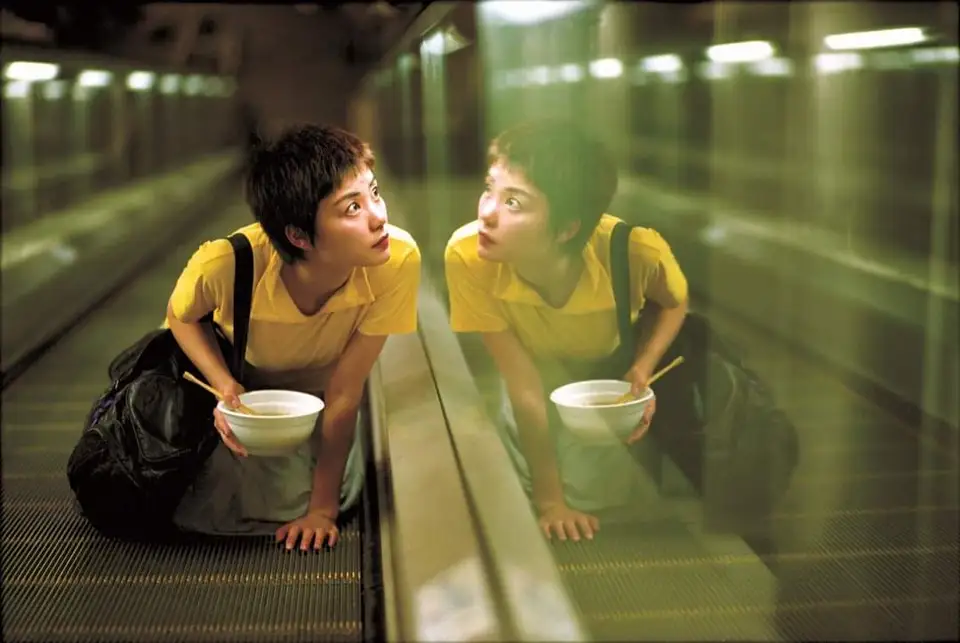
Faye Wong in Chungking Express (1994)
For many filmmakers, Chungking Express (1994) was not just a film but an event. It arrived as a bolt of raw, kinetic energy, its aesthetic seemingly born of pure impulse. The collaboration between Wong Kar-wai and Christopher Doyle codified a visual language that would define a certain strain of independent cinema for the next decade. Its influence is difficult to overstate, but its methods, born of constraint and opportunity, offer a specific set of lessons in capturing spontaneity.
The film’s signature effect, the smeared, dreamlike motion of bodies against a static background, is a product of step-printing. By shooting at a reduced frame rate and then printing each frame multiple times to reach the standard 24 fps, the filmmakers create a peculiar temporal distortion. Action is blurred, stretched, and stuttering, while any elements moving at a "normal" speed relative to the camera appear sharp. In the film's first story, this technique visualizes the frantic, almost desperate energy of the city and its inhabitants. Cop 223 (Takeshi Kaneshiro) runs through crowds that become painterly streaks of color. His physical exertion is palpable, yet the world’s velocity renders him both part of the chaos and strangely separate from it. The technique isn't merely decorative; it’s a direct visual analog for a character’s internal state of anxiety and dislocation.
This approach stands in stark contrast to a more classical handling of motion, such as the crisp tracking shots of Stanley Kubrick or the elegant dolly moves of Max Ophüls, which seek to clarify spatial relationships. Here, space is intentionally confused. Doyle’s camera, often handheld and equipped with a wide lens, plunges into the real, claustrophobic environments of Hong Kong’s Chungking Mansions and the Midnight Express food stall. The wide lenses don't create epic vistas; they distort and bend the already tight spaces, pushing the viewer uncomfortably close to the characters. Walls seem to curve in, and faces at the edge of the frame elongate. This isn't the clean, architectural wide-angle of a John Ford terrain. It's the perspective of a participant, jostled and overwhelmed. Handheld that reads as intention rather than fatigue has its own rules, collected in our guide to cinematic handheld operating.
One way to see this is as a form of photographic impressionism. The goal isn't to render a photorealistic account of a location but to capture the feeling of being there. The mixed color temperatures, with sickly greens from fluorescent lights clashing with the warmth of a street vendor's stall, are not "corrected" in the traditional sense. They are embraced as part of the city's authentic texture. This embrace of found light and environmental color became a hallmark of Doyle’s work. Where a cinematographer like Roger Deakins might carefully control the color and quality of every source to build a cohesive palette, Doyle often appears to be conducting a chaotic orchestra of existing practicals.
The production’s legendary speed and lack of a finished script were not limitations to be overcome but were central to the film’s aesthetic. The camera had to be responsive, ready to capture a fleeting moment or an actor’s improvisation. This method prioritizes presence over precision. It asks a fundamental question: can a film’s visual grammar be discovered on the day, in the moment, rather than being predetermined by a storyboard? For Chungking Express, the answer is an emphatic yes. The result is a film that feels alive and unpredictable, as if it could veer off in a new direction at any moment. It teaches that sometimes the most potent visual strategy is to relinquish absolute control and allow the energy of the location and the performers to dictate the frame.
Case Study: In the Mood for Love
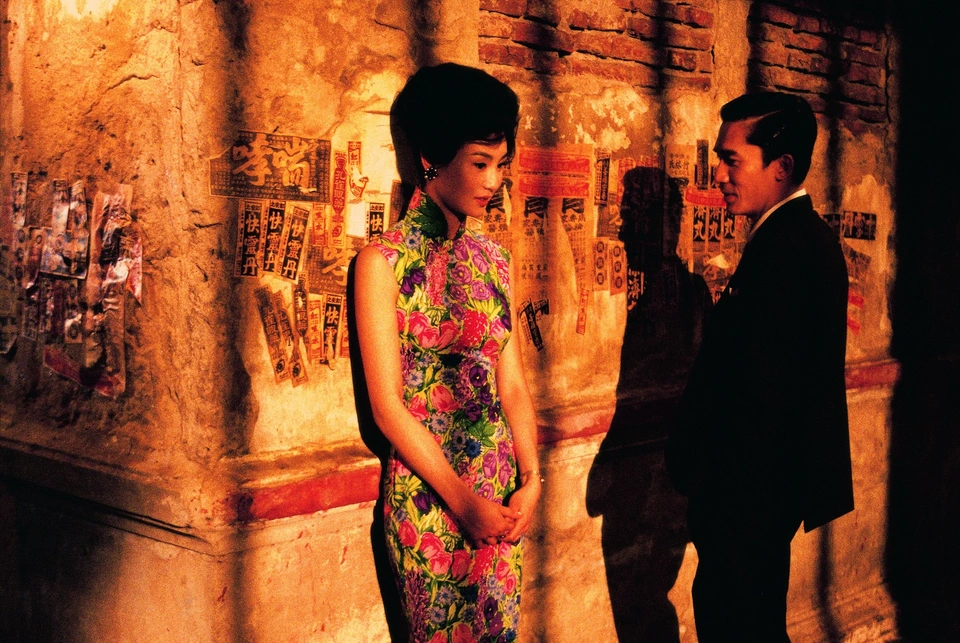
In the Mood for Love (2000)
If Chungking Express was a declaration of kinetic freedom, In the Mood for Love (2000) is a study in confinement and restraint. The same core team of Wong and Doyle, working again with editor and frequent collaborator William Chang, turned their aesthetic inward. The frenetic energy is gone, replaced by a suffocating, melancholic beauty. The film is a study in what is withheld, both emotionally and visually, and its power comes from the tension created by this obstruction.
The camera's posture changes completely. Gone are the jostling, handheld wide-angle shots. In their place is a precise, often static, and voyeuristic frame. Doyle and Wong compose shots through doorways, past out-of-focus foreground objects, around corners, and in the reflections of mirrors and windows. Mrs. Chan (Maggie Cheung) and Mr. Chow (Tony Leung) are rarely seen in a clean two-shot. They are separated by the architecture of their cramped apartment building, their figures bisected by door frames or obscured by billowing curtains. This compositional strategy does more than just create pretty pictures. It externalizes the characters' central conflict: their deep attraction is constantly thwarted by social convention and their own sense of propriety. The camera's inability to get a clear view of them together mirrors their own inability to connect freely.
This approach to framing has precedents, in the work of Yasujirō Ozu, whose low-angle "tatami shots" often use household objects and shōji screens to create complex, layered compositions. But where Ozu's frames often suggest a stable, harmonious social order, Doyle's framing in this film suggests imprisonment. The spaces feel tight, the ceilings low. The repeating patterns of wallpaper and the narrowness of the noodle bar where the characters meet create a sense of inescapable routine.
Color becomes a primary narrative tool. The palette is dominated by deep, resonant reds, shadowed greens, and warm, almost amber tones. Mrs. Chan’s succession of stunning cheongsams are not merely costumes; they are emotional signifiers, their patterns and colors shifting with her unspoken feelings. The lighting scheme moves away from the chaotic mix of practicals found in Chungking Express toward a more controlled, almost painterly chiaroscuro. Light sources are often singular and soft, carving the characters out of deep pools of shadow. This is the lighting of memory, of moments isolated and burnished by time. It evokes the work of an artist like Vermeer, where domestic scenes are imbued with a deep interiority. We approach the same film from another angle in Apertures of Unbelonging, which reads its framing against Parasite.
The step-printing technique reappears, but its function is transformed. Instead of conveying frantic energy, the slow-motion sequences here are languorous and hypnotic. Accompanied by Shigeru Umebayashi’s recurring waltz, the sight of Mrs. Chan walking to the noodle stand becomes a ritual of longing. The slow, graceful motion, with its subtle temporal blur, elevates a mundane act into a poetic expression of desire and loneliness. It’s no longer about the rush of the city; it's about the slowing of time that occurs in moments of intense emotional significance.
One could argue whether this level of careful stylization creates an emotional distance, encasing the characters in a beautiful but impenetrable aesthetic. On this reading, the film is more about the idea of repressed love than the feeling of it. But a different interpretation sees the style as the only way to access the characters' inner lives. Because they say so little of what they truly feel, the film's mood, carried by Doyle's camera and Chang's cutting, must speak for them. The claustrophobic frames, the charged colors, and the hypnotic slow-motion are not observing their story. They are their story.
Collaborators
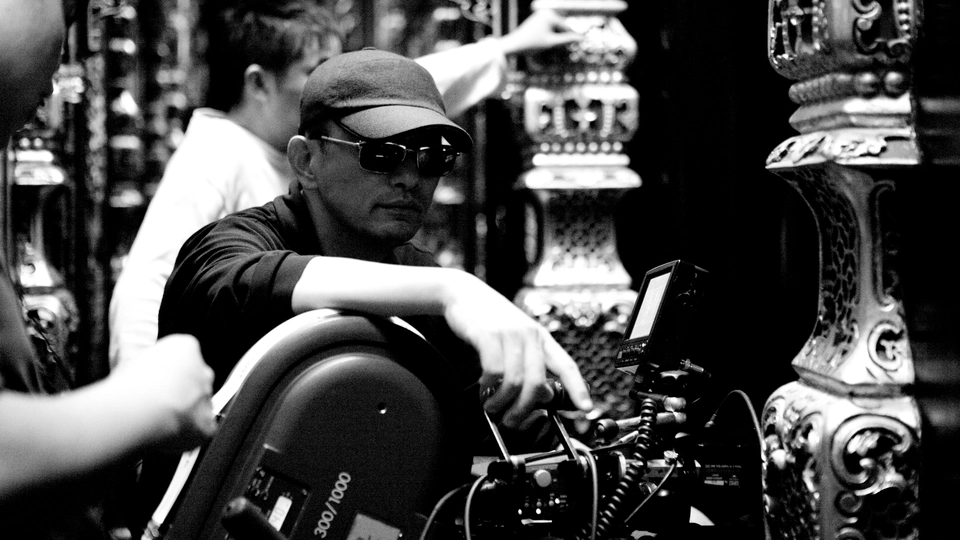
Wong Kar-Wai in The Grandmaster (2013)
To speak of Christopher Doyle is to speak of Wong Kar-wai. The director-cinematographer relationship is one of the most symbiotic in modern cinema, a partnership so intertwined that assigning authorship for the final image feels like a pointless exercise. Their process, famously improvisational and script-averse, relied on a shared intuition developed over seven features, beginning with Days of Being Wild (1990). Wong provided the emotional thesis and the location; Doyle, in practice, was the one who had to convert that into something photographable, translating abstract feelings about time, memory, and longing into light, color, and motion. This was not a conventional collaboration of pre-planned shot lists but a responsive, often chaotic discovery of the film on set, with Doyle’s handheld camera acting as a nerve ending for Wong’s thematic preoccupations.
The third point in this creative triangle was William Chang Suk Ping, who served as both production designer and editor on nearly all of Wong's films. Chang’s contribution is inseparable from Doyle’s. The confined, textured spaces of In the Mood for Love (2000), with their repeating floral wallpapers and narrow corridors, were the canvasses Chang provided for Doyle to paint on with shadow and suffocated light. In the edit, Chang’s elliptical cutting, which often favors graphic matches and emotional continuity over spatial logic, took Doyle’s restless, searching camerawork and sculpted it into the fragmented, rhythmic poetry that defines the films. One cannot fully appreciate Doyle’s kinetic step-printing in Chungking Express (1994) without also crediting Chang’s staccato editing, which gives the technique its narrative pulse.
The faces in front of the lens were just as foundational. Tony Leung Chiu-wai, a constant presence, developed a mode of performance built on stillness and minute gestures, a quiet center around which Doyle’s often frantic camera could orbit. His capacity to convey deep interiority with a mere glance or the angle of his head allowed Doyle to shoot him in extreme close-up or through layers of obstruction without losing the character’s emotional state. Similarly, Maggie Cheung’s collaboration on In the Mood for Love saw her performance and the cinematography merge; the film’s visual grammar is built around the qipaos Chang designed for her, with Doyle’s camera following the line of her neck or the pattern on the fabric as a primary narrative device.
Outside the Wong Kar-wai nexus, Doyle’s work with Zhang Yimou on Hero (2002) demonstrates a different collaborative mode. Here, the improvisational freedom was replaced by a rigorous, almost diagrammatic formalism. Zhang, a former cinematographer himself, conceived of the film’s narrative through distinct color chapters (red, blue, white, green). Doyle’s task was to execute this vision with absolute discipline, creating vast, monochromatic compositions that stand in stark contrast to the messy, intimate vitality of his Hong Kong films. The collaboration proves Doyle is not merely an instinctual artist but a craftsman capable of subsuming his personal style into a director’s highly structured aesthetic. A system that rigid only survives contact with a shooting day if every department is briefed in prep, the process laid out in our guide to color palette planning between art, wardrobe, and the DP.
Critical Reception and Counter-Readings
The critical consensus surrounding Christopher Doyle’s cinematography, particularly his work with Wong Kar-wai, has long celebrated it as a high point of cinematic expressionism. Critics lauded the films for creating a visual language that felt entirely new, a "free-camera" style that was both viscerally present and dreamily detached. In his influential book Planet Hong Kong, scholar David Bordwell performs a deep formalist analysis of the techniques Doyle and Wong popularized, such as step-printing and the use of extremely wide-angle lenses for close-ups. Bordwell frames these not as mere stylistic tics but as a coherent system for representing a specific modern urban consciousness, one defined by fleeting encounters and temporal dislocation. For Bordwell and many others, the "Doyle look" was the definitive visual signature of Hong Kong's cinematic golden age.
The work was often positioned as a corrective to the perceived sterility of mainstream Hollywood cinematography. Where Hollywood favored invisible technique and classical continuity, Doyle’s camera was a felt presence, its movements and imperfections part of the film's texture. Amy Taubin, reviewing the film for Sight & Sound, celebrated the way In the Mood for Love used its visuals to articulate what remains unsaid, with the camera's patient, obstructed gaze conveying the characters' repressed desire more powerfully than any dialogue could. The aesthetic was seen as deeply romantic, capturing the ache of missed connections in a hyper-modern world.
However, this dominant reading is not without its challengers. One way to see the work, particularly through a feminist lens, is to question the line between aesthetic appreciation and objectification. In Primitive Passions (1995), her study of visuality, sexuality, and ethnography in contemporary Chinese cinema, Rey Chow discusses the ways in which the female figure can become a "spectacle," an object for visual consumption. Applying this framework, one could argue that the relentless focus on Maggie Cheung’s body in In the Mood for Love, the camera trailing her hips, the slow-motion shots emphasizing the sway of her qipao, risks reducing her character, Su Li-zhen, to a beautiful surface. Is the camera articulating her inner torment, or is it fetishizing her melancholy? The film’s beauty is undeniable, but this counter-reading poses a genuine question about whose pleasure is being prioritized in these compositions.
A different critique comes from a more purely formalist or narrative-focused perspective, which sometimes accused the films of being exercises in "style over substance." This position holds that the overwhelming sensory experience of a film like Fallen Angels (1995) or 2046 (2004) can obscure, rather than enhance, character and story. The argument suggests that the constant visual invention, the smeared light, the disorienting angles, the fragmented editing, creates an emotional distance, keeping the viewer in a state of aesthetic admiration rather than narrative immersion. It surfaces in dissenting pieces such as PopMatters' "Against the Consensus" reading of Chungking Express, and it persists as a minority report, a caution that a style so potent can sometimes overwhelm the human drama it purports to serve.
What Working Filmmakers Should Steal
Step-Printing for Temporal Distortion The blurred, stuttering motion in Chungking Express is achieved by shooting scenes at a lower-than-normal frame rate and then optically printing each frame two or three times to stretch the footage to the standard 24 fps playback speed. The result is that stationary or slow-moving subjects (like Tony Leung’s Cop 663) appear relatively sharp, while fast-moving background elements dissolve into kinetic streaks of light and color. It’s a powerful, in-camera method for visually separating a character from the flow of time, externalizing a state of introspection or grief amidst a chaotic world.
Obstructed Framing and Voyeurism Throughout In the Mood for Love, Doyle and Wong consistently place the camera outside the immediate action, shooting through doorways, over shoulders, around corners, or past foreground objects. This technique denies the viewer a clean, privileged view of the characters. The mechanic is simple: find a natural obstruction in the location and compose the frame so it partially obscures the main subject. This creates a powerful sense of intimacy and stolen glances, positioning the audience as a voyeur. It externalizes the characters' own feelings of being trapped and their fear of being seen, making their private moments feel both intensely personal and dangerously public.
Embrace Mixed Color Temperatures Doyle’s work is a masterclass in using conflicting color temperatures within a single frame to create psychological texture. Instead of correcting location lighting to a single, uniform temperature, he leans into the clash between the cool green/cyan of fluorescent streetlights and the warm yellow/orange of interior tungsten practicals. In films like Happy Together (1997), a character can be lit with a warm key from a table lamp while the fill light spilling in from a window is a sickly green. This "dirty" color palette feels authentic to urban environments and can be used to suggest a character's internal conflict or emotional dissonance.
Wide Lenses for Extreme Close-Ups Conventional wisdom dictates using longer lenses for close-ups to flatter the subject and compress the background. Doyle frequently does the opposite, using very wide-angle lenses (often in the 14mm to 25mm range) for his tightest shots, as seen throughout Fallen Angels. This forces the camera physically close to the actor, creating a distorted, almost confrontational intimacy. The background warps and stretches, enhancing the sense of a character’s alienation from their environment. It’s an aggressive, subjective choice that sacrifices classical beauty for raw psychological impact.
Lighting from the Edit This is more of a philosophy than a single technique. In many of Doyle’s collaborations with Wong and Chang, the coverage is not designed for traditional scene construction. A scene might be built from a shot of a clock, a close-up of a hand, a reflection in a puddle, and only a fleeting glimpse of an actor’s face. This requires lighting and shooting for moments and textures, not just for masters and reverses. A filmmaker can "steal" this by liberating their shot list from the tyranny of continuity, instead collecting evocative fragments, a detail, a color, a movement, with the confidence that they can be assembled rhythmically in the edit to create an emotional, rather than literal, representation of a scene. That freedom still needs a floor under it, which is what our guide to directing coverage without overshooting supplies.
Color as Narrative Pillar In Zhang Yimou’s Hero, color is not merely decorative; it is the primary structuring device of the entire film. Each conflicting account of the same events gets its own strictly controlled palette: red for the version first told, blue for the version told back in contradiction, white for the account closest to the truth, and green for the earlier flashback. Doyle’s cinematography executes this by having all elements within the frame, costumes, set dressing, and even the quality of light, adhere to the chosen color. This provides a clear, transferable model for how cinematography can provide the fundamental architecture for a complex, non-linear narrative.
Further Study
Chungking Express* (1994): The essential text for Doyle’s kinetic, improvisational Hong Kong style. Happy Together* (1997): A key work for its use of different film stocks and color processing to delineate shifts in geography and emotional states. In the Mood for Love* (2000): The high point of the Wong collaboration, and the clearest example of controlled, patient, emotionally exact camerawork. Hero* (2002): Demonstrates Doyle’s range and his ability to execute a highly formal, pre-determined aesthetic. 2046 (2004): A maximalist evolution of the techniques developed in In the Mood for Love*, pushing the expressionistic style to its limits.
Critical texts and books
- A Cloud in Trousers (Christopher Doyle, Smart Art Press, 1998) - one of several photo-books by Doyle himself. Not a technical manual but a diaristic collection of images and text, and the closest thing to a first-person account of how he looks at a location.
If you want the same treatment applied to a cinematographer who reaches comparable emotional force through system rather than instinct, our Vittorio Storaro master study covers colour designed in prep rather than found on the night.
Sources and Further Reading
1. Christopher Doyle on shooting Chungking Express for Wong Kar-wai - BFI
---
© 2026 BlockReel DAO. Master Studies series. Licensed under CC BY-NC-ND 4.0.