Winter Sleep Film Study: Dialogue & Space Composition
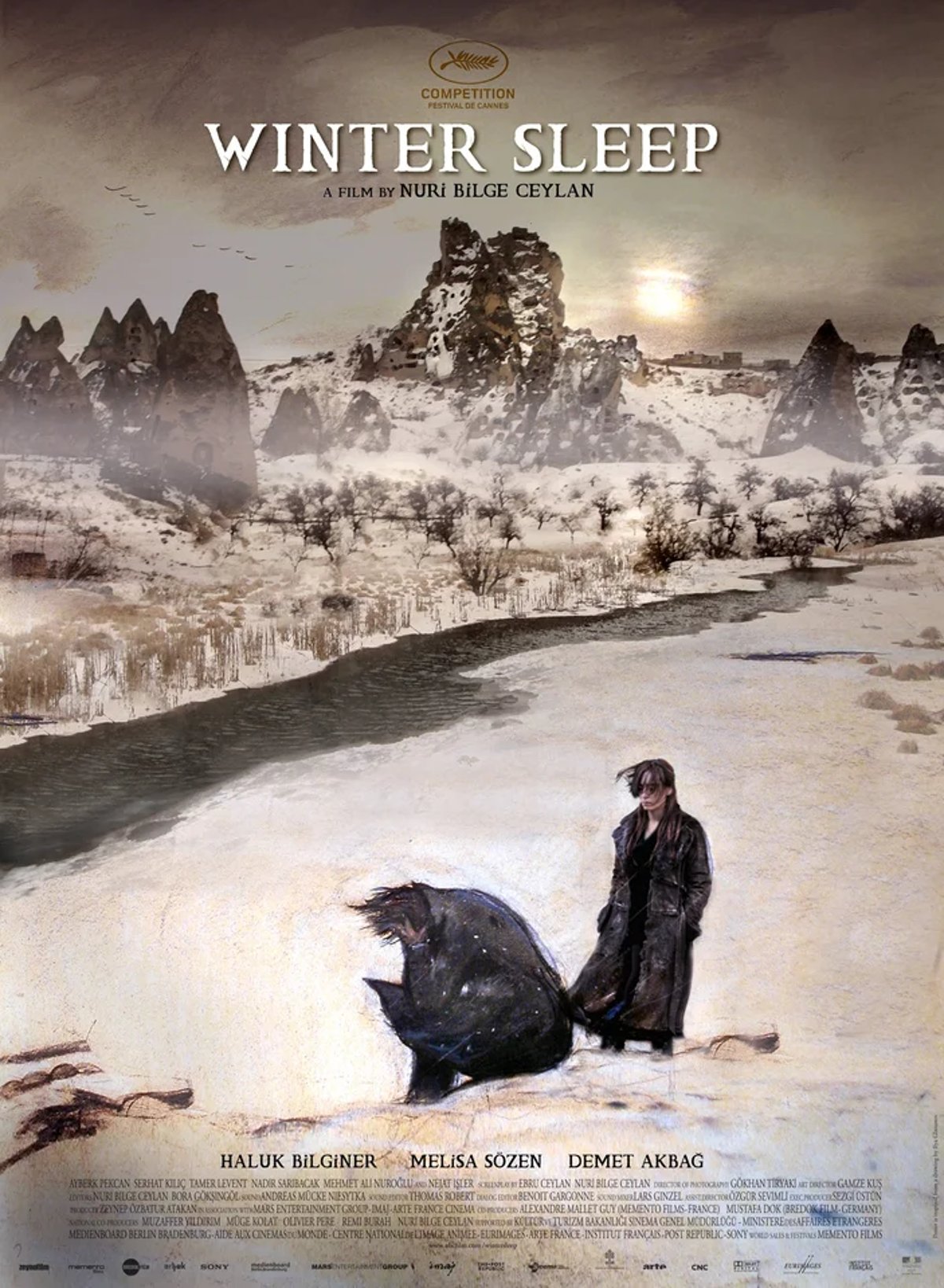
> This article contains affiliate links. BlockReel may earn a small commission on qualifying purchases at no extra cost to you. All commissions go directly toward funding our DAO Film Festival and supporting independent filmmakers.
A fire crackles in a hearth, the only source of warmth in a room carved from stone and lined with books. Two people sit across from one another, separated by a desk cluttered with papers. Outside, the Anatolian winter has buried the terrain in snow. Inside, the air is thick with words. The conversation is a siege. It is not an exchange of information but a battle of position, a slow, grinding effort by one person to dismantle the other's entire moral and intellectual life. There are no raised voices. The violence is in the syntax, in the patient, exquisitely cruel turning of a phrase. To watch is to be held hostage alongside the characters, to feel the walls of the room contract with each new paragraph of dialogue.
The sensation is one of extreme duration. Time inside these conversations does not pass as it does in other films. It stretches, eddies, and sometimes seems to stop altogether, forcing a confrontation not just with the characters' arguments but with one's own capacity for attention. This is not the passive viewing of plot mechanics. It is the active, often uncomfortable work of listening to people think aloud, with all their self-deceptions, petty grievances, and flashes of genuine insight laid bare. The effect is suffocating, exhilarating, and clarifying.
Nuri Bilge Ceylan's Winter Sleep (2014) turns that feeling into an argument. Drawing on Chekhov, the film uses its 196 minutes to conduct a forensic examination of one man's soul. The protagonist, Aydın, a retired actor who now runs a cave hotel in Cappadocia, has built a life insulated by intellectual vanity and inherited property. The long, talk-heavy scenes are the instruments that peel back those layers without anesthetic. The film's length and verbal density are not features of the story. They are the substance of its argument. They convert a domestic drama into a rigorous, almost punitive experience of what it feels like to be trapped inside a fortress of one's own making.
At a Glance
| Film | Winter Sleep (Kış Uykusu), 2014 |
| Director | Nuri Bilge Ceylan |
| Screenplay | Ebru Ceylan and Nuri Bilge Ceylan, inspired by stories of Anton Chekhov, with quotations from Chekhov, Shakespeare, Dostoevsky, Voltaire and Jack London |
| Cinematographer | Gökhan Tiryaki |
| Editors | Nuri Bilge Ceylan and Bora Gökşingöl |
| Production design | Gamze Kuş |
| Sound | Andreas Mücke Niesytka |
| Producer | Zeynep Özbatur Atakan, with co-producers Mustafa Dok and Alexandre Mallet-Guy |
| Format | Digital capture on the Sony F65 |
| Running time | 196 minutes |
| Shoot | Roughly two months on location in Cappadocia, plus four weeks on a studio build in Istanbul |
| Awards | Palme d'Or and the FIPRESCI Prize, Cannes 2014 |
| Cast | Haluk Bilginer (Aydın), Melisa Sözen (Nihal), Demet Akbağ (Necla), Ayberk Pekcan (Hidayet), Serhat Kılıç (Hamdi), Nejat İşler (İsmail), Tamer Levent (Suavi) |
| Where to watch | MUBI for streaming, or a Blu-ray edition for the full-length presentation |
Why This Film Still Gets Studied
The craft problem Winter Sleep takes on is how to make sustained, philosophical dialogue cinematic. The default solution in narrative filmmaking is to break long conversations up with action, cut away to illustrative flashbacks, or simply shorten the scene. Ceylan offers a harder model. He argues that a conversation staged with enough psychological precision can carry more pressure than physical conflict. For anyone wrestling with a talky script, the film is a working demonstration rather than a theory.
It treats dialogue as a form of blocking. Characters do not just speak. They deploy words to control space, pin an opponent down, or build a defensive perimeter. In the long argument between Aydın and his sister Necla, the physical space between them becomes a charged void. Her refusal to meet his eyeline, his habit of turning toward the fire as if addressing an audience, her eventual retreat from the room: these are the scene's primary events, not incidental gestures. The camera's patience forces the viewer to read body language with heightened acuity. Tension comes not from what might happen next but from the weight of what is being said right now. The cut, when it finally arrives, lands like a physical blow, and usually on a silent reaction rather than on the speaker. If your script has a scene like this, the groundwork happens in prep: see the definitive guide to camera movement and blocking and the subtext writing method for the two halves of the problem.
This approach depends entirely on duration. The length of the scenes recalibrates audience expectation. A five-minute two-hander in another film feels substantial. In Winter Sleep, it is an overture. By refusing the relief of a conventional edit, Ceylan cultivates a state of deep immersion, and that duration is a thematic necessity rather than an indulgence. It mirrors the circular, inescapable nature of the conflicts. The characters are stuck with each other, and for three hours and sixteen minutes the audience is stuck with them. Runtime becomes a narrative tool, producing an affective state in the viewer, entrapment or exhaustion or contemplation, that aligns with the film's concerns. Whether every scene sustains that intensity, or whether the method occasionally curdles into an exercise in endurance, is a fair question and the film does not settle it.
The production design works as an active agent in the drama rather than a container for it. Aydın's hotel is a physical correlative for his mind: a labyrinth of stone passages, comfortable but airless, filled with the artifacts of a culture he curates and no longer contributes to. The Cappadocian terrain glimpsed through the windows is a silent rebuke to the pettiness unfolding indoors. Every room reinforces the tension between intellectual retreat and the demanding reality outside it. The principle scales down to almost any budget: see production design on micro-budgets.
How It Got Made
Winter Sleep is a Turkish production mounted with French and German partners, produced by Zeynep Özbatur Atakan with co-producers Mustafa Dok and Alexandre Mallet-Guy. That structure matters more than any single line item. European co-production financing is designed to support work that a purely market-driven system would reject on length alone, and it is the reason a 196-minute chamber drama in Turkish could be made, finished, and distributed internationally without being cut down. Filmmakers working across borders can study the mechanics of that arrangement in our guide to cross-border structures and tax credits.
The schedule tells you as much as the financing. The production shot for roughly two months on location in Cappadocia, then moved to a studio build in Istanbul for another four weeks. That second block is the detail most viewers miss. The hotel's interiors, the rooms where the film's real violence happens, were not simply found. Substantial portions were constructed, which is precisely what allowed the long conversations to be covered from many angles without the compromises a real cave hotel would have forced on lighting and sound. The film looks like observed reality and was built to look that way.
After the shoot, Ceylan had roughly 200 hours of material. He cut it first to about four and a half hours, then fought it down to the final three hours and sixteen minutes. That ratio is documentary territory applied to a scripted drama, and it explains the film's rhythm better than any stylistic label. The unbroken stretches and the precisely timed cuts in the dialogue scenes are not on-set improvisation. They are the product of a long, unhurried process of discovery in the edit, where each argument could be rebuilt from a deep bench of performance variations and the emotional temperature adjusted degree by degree. The cost of that method is measured in months, not equipment, which is one of the few genuinely transferable luxuries in low-budget filmmaking: see the complete guide to film editing workflows.
For capture, Ceylan and cinematographer Gökhan Tiryaki tested several systems and settled on the Sony F65. Ceylan has shot digitally since Climates (2006), and his stated reason is control rather than convenience. He describes film as the use of artificial elements to arrive at something true, and digital capture as the tool that lets him adjust every one of those artificial elements until the truth comes through. That preference is legible in the finished image, which is far more shaped than its documentary surface suggests.
The Craft Breakdown
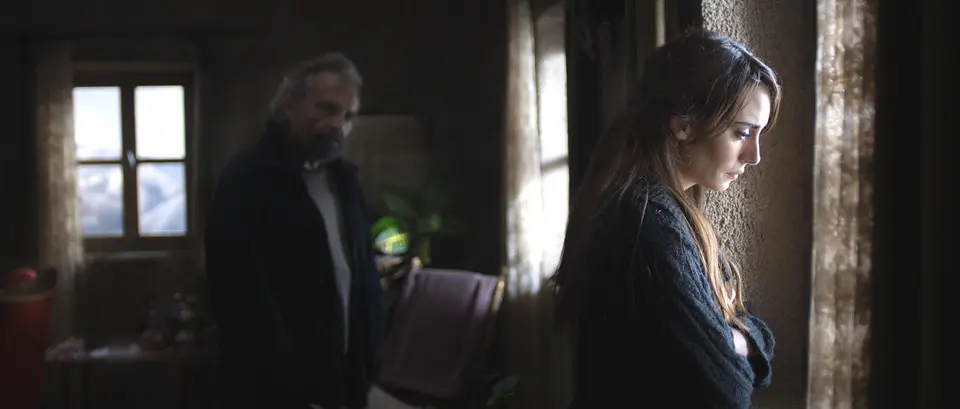
!Image Haluk Bilginer and Melisa Sözen in Winter Sleep (2014)
Conversations as Static Sieges (Direction and Blocking)
Few contemporary films commit to the static two-person dialogue scene with this much intensity. Where another director would use movement to energize a talk-heavy script, Ceylan makes physical stasis the visual grammar of moral and intellectual confinement. The major confrontations are blocked as tableaux of exhaustion. Characters stay seated for immense stretches, rooted to chairs and couches in the cavernous rooms of the hotel. Conversations become endurance contests in which remaining in your seat is a form of passive aggression. The blocking denies the release that movement provides and forces everyone, characters and audience alike, to sit inside the inertia that defines these relationships.
The method is clearest in the marathon argument between Aydın and his recently divorced sister Necla. They occupy opposite ends of a sofa and a nearby chair, locked into a composition that barely changes. Ceylan stages their debate about morality and resistance to evil not as a duel but as a siege of competing monologues. The camera holds them in tight two-shots or singles that emphasize isolation within shared space, and their eyelines often slide past one another, as though each were addressing an internal argument rather than a person. The performances turn on the strain of maintaining a posture of detached intellectualism while absorbing personal attacks. Aydın's small, self-satisfied gestures and Necla's simmering stillness carry weight that another film would hand to an actor pacing a room. It is closer to photographed theatre than to conventional cinematic realism, and whether that theatricality serves the psychology or holds us at a distance from the pain is genuinely arguable. What is not arguable is the effect: the staging makes you watch the performance of intellectualism itself. Getting this kind of stillness out of actors is rehearsal work, not coverage work: see directing actors and rehearsals on a budget.
Light That Entombs, Not Illuminates (Cinematography)
!Image Haluk Bilginer and Melisa Sözen in Winter Sleep (2014)
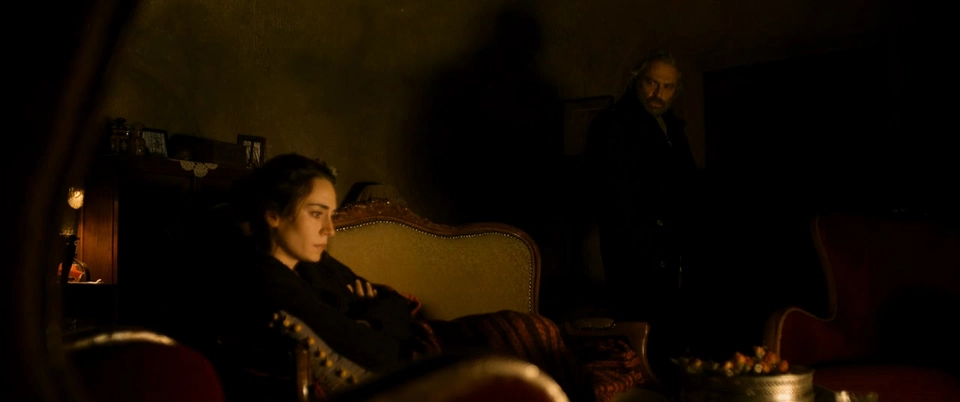
Tiryaki rejects the high-key clarity that usually accompanies prestige drama and works instead in a painterly chiaroscuro that traps its characters in pools of shadow. Interiors read as lit almost exclusively by motivated sources: the glow from a fireplace, the spill from a desk lamp, the weak winter sun through a window. The result is a world of deep blacks and soft mid-tones in which the opulent clutter of the hotel registers less as wealth than as a dense, light-swallowing mass. Faces are carved out of darkness while their surroundings stay in gloom. Light does not reveal here. It conceals. Characters retreat into shadow, half-eclipsed, even while delivering their most articulate speeches, which is exactly the point: they are together in a room and each inhabits a separate, dimly lit psychological space.
The strategy peaks in the argument between Aydın and his much younger wife, Nihal. Seated near a fire, their faces are modeled by unstable flame. The hard side light shapes their features while the rapid falloff drops the rest of the frame, and often the far side of each face, into near-total darkness. The camera's patience turns an intimate conversation into a gothic portrait of a marriage coming apart in real time. Fire, the conventional shorthand for warmth and domesticity, becomes an interrogating source that offers no comfort, enough illumination to see the pain and not enough to suggest a way out of it. Outside, the snow-covered terrain is shot with a contrasting flatness, its desaturated whites and grays indifferent to any of it. One could argue the sheer beauty of these compositions risks aestheticizing misery, but the consistency of the scheme suggests a harder purpose: to build a world whose physical atmosphere is as airless as its emotional one. The technique is cheap to imitate and hard to control. Start with practical lighting and negative fill.
The Punitive Rhythm of Real Time (Editing)
Two hundred hours of footage, an intermediate cut of about four and a half hours, and a final 196 minutes. Those three numbers are the film's editorial philosophy in shorthand. The cutting, which Ceylan did himself with Bora Gökşingöl, rejects the economy that normally governs narrative film. Instead of condensing time and eliding the mundane, the cut logic makes the audience experience circular arguments and painful silences at something close to their natural length. Scenes are allowed to sprawl, to lose momentum, and to double back. The effect is fatigue, and it mirrors the fatigue of the characters. By refusing to cut away, the film makes the viewer a participant in the work of enduring these people.
Shot/reverse-shot appears constantly, but its function is inverted. Rather than building a rhythm of call and response, the pattern presents a sequence of isolated monologues. Cutting to a reaction does not advance the dialogue. It transfers the burden of speech. We watch Aydın for two minutes, then Nihal for two minutes. The coverage exists to emphasize the chasm between speakers, not to knit them into shared space. Nowhere is this clearer than in the excruciating sequence in which Nihal tries to hand a large sum of money to the family of a tenant. The editing protracts every beat of social awkwardness: the silence after a line, the fumbling with the envelope, the shame in the room. No cutaway, no temporal jump, no relief. Some read that as indulgence. It is closer to the film's central claim, which is that the substance of these lives sits in the evasions between the declarations. For a study of the opposite temperament, read our piece on elliptical editing in Kieślowski and Weerasethakul.
A Fortress of Decaying Culture (Production Design)
Gamze Kuş's hotel is the film's central metaphor rather than its setting, a physical manifestation of the protagonist's psyche. It is simultaneously a fortress against the outside world and a prison for the people inside it. Carved into Cappadocian rock, the walls read as ancient and impregnable. The dressing, meanwhile, insists on genteel decay. Aydın's study, the nerve center of his intellectual kingdom, is a piece of character-driven design: towering stacks of books, disorganized notes for his local newspaper column, and a scatter of historical objects belonging to a man who values the idea of culture more than its practice. The room is a barricade of paper standing between him and any genuine human engagement.
That space is set against the areas his wife and sister occupy. Nihal's workspace for her charity committee is comparatively spartan, and its emptiness speaks to the futility she feels. The shared rooms carry heavy dark furniture and thick textiles that seem to absorb both sound and light, feeding the film's inertia. History registers as a weight rather than a guide. Every object looks like it has collected the dust of an old argument. The hotel is physically isolated inside an indifferent winter terrain, mirroring Aydın's detachment from the community he writes about with such condescension, and it enables his worst instincts by letting him play enlightened country squire without ever facing a consequence. The density of the dressing could in theory swamp the human drama. Here the environment and the characters are inseparable. Small rooms, dense dressing, and long lenses are a demanding combination on a real schedule: see working fast in small spaces.
Scene Study: The Study Argument
!Image Demet Akbağ and Haluk Bilginer in Winter Sleep (2014)
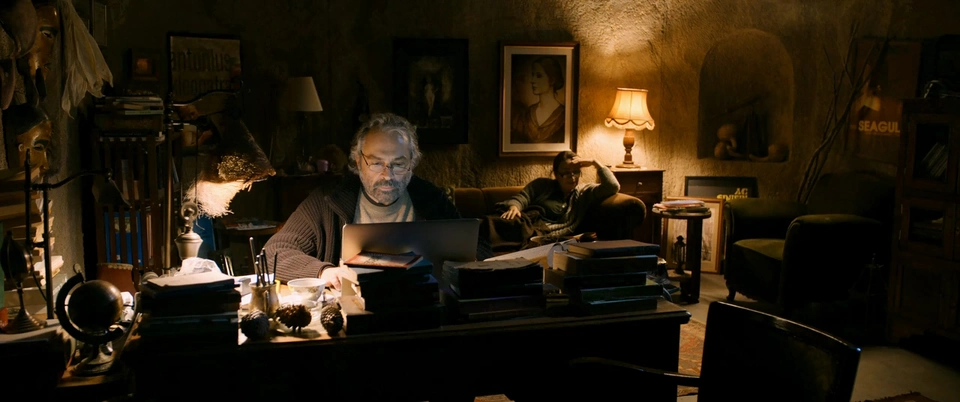
The long central confrontations are the film's defining feature, and none is more representative than the argument between Aydın and Necla in his study. The sequence carries the Chekhovian inheritance most openly, but its treatment pushes past theatricality into something forensic. It is an autopsy of an intellectual relationship, conducted through camera placement, performance, and editorial patience, and it supports the film's thesis by making duration the instrument, forcing us into the same room as two people who use language to dismantle rather than connect.
The study is established as Aydın's fortress: books, the tools of his writing, warm practical sources, a fire, soft window light. When Necla enters, she is an intruder in a kingdom of self-regard. The initial blocking puts Aydın behind his large desk, a barrier that doubles as a statement of authority. Coverage begins conventionally, with clean over-the-shoulders and singles that respect the line. Eyelines are direct. The battle is joined on fair terms.
What distinguishes the sequence is the execution across its length. As Necla's critique of his character, disguised as a critique of his writing, intensifies, the cutting pattern shifts. The film stops cutting on dialogue cues. It holds on Aydın's face for long, uncomfortable stretches while Necla speaks, and we watch his mask of detached amusement crack in increments. The reactions are minute, a tightening of the jaw, a flicker at the eye, and the camera's stillness makes them enormous. When the camera is on Necla, it catches the rawness of someone releasing resentment she has held for years. The lighting stays soft, with gentle modeling that keeps the scene from becoming a hard-lit interrogation. The intimacy is real, but it is the intimacy of a surgeon rather than a lover.
The sound is austere. There is no score to guide the emotion. The bed is the crackling fire, the faint ambience of the hotel, and the dialogue. That refusal of musical sweetening is the critical choice, because it denies any release from the conversation itself. We are trapped with the words and obliged to weigh the accusations and the deflections ourselves. The L-cuts and J-cuts are subtle, often letting one character's words hang over the other's silent reaction to widen the gap between speaking and hearing. Building a sound bed that carries a scene without music starts at the scout: see how to scout locations for sound.
At bottom the sequence is a study in how people construct and defend an ego. Aydın's intellectualism is a shield and his calm condescension a tactic to reclassify Necla's critique as emotional and therefore irrational. Necla uses her pain as a cudgel, attacking his whole being because she feels unseen. The filmmaking takes no side. It presents the evidence with punishing clarity, and the camera's patience suggests that for people like this, intellectual debate is a more sophisticated form of domestic violence.
The power is cumulative. A five-minute version of this argument is effective drama. An extended version becomes a statement about how people live. The duration is the point. It mirrors the circular, inescapable nature of the conflict and the stasis of these lives, and it refuses to let either the characters or the audience off with a resolution or a cathartic outburst. There is a real question about whether the film's attention to Necla's eventual collapse grants her a grace it denies Aydın. On one reading her breakdown is authenticity breaking through a world of performance. On another it is a different flavor of self-absorption, as paralyzing as his arrogance. The film leaves the judgment open.
What the sequence teaches. To make long dialogue scenes cinematic, use the camera to scrutinize the act of listening rather than to cover the lines. Holding a reaction past the point of comfort can reveal more than the dialogue does. Austere sound design, stripped of score, forces an audience to engage directly with text and subtext, which produces a more analytical and more intense experience.
Scene Study: The Rent Collection
!Image Emirhan Doruktutan in Winter Sleep (2014)
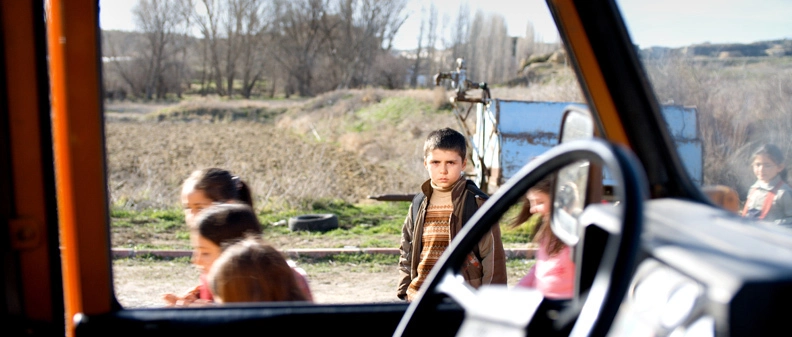
Against the static interior war of words, the sequence in which Aydın and his caretaker Hidayet drive out to collect rent from the tenant İsmail's family is a collision of class, terrain, and sudden violence. It moves the film from the psychological to the social and shows how Aydın's fortifications collapse when he meets a reality he cannot manage through rhetoric. Where the study scene uses duration to dissect a character, this one uses physical space and abrupt action to expose the power relations that underwrite his comfort.
It opens with a journey. The camera observes the vehicle moving through the alien topography of Cappadocia, and the compositions insist on the smallness of human figures against ancient terrain. The motif does double duty, establishing the hotel's isolation and suggesting an indifference to every drama playing out inside it. The movement is fluid, tracking the truck along dirt roads. The natural light is harsh and flat, a world away from the curated warmth of the study.
The confrontation is initiated by an act rather than a word. İsmail's young son throws a rock that shatters the truck's window. The abruptness is the shock. Sound carries it: placid engine noise and ambient wind punctured by a sharp crack and breaking glass. The cutting, languid until now, turns momentarily sharp to catch the reaction in the cab. One act of rebellion from a child tears a hole in the film's talkative fabric, a physical expression of a resentment the adults can only reach through bitter argument or silence.
The scene then moves to the tenant's home, and the transition from expansive exterior to cramped interior is jarring. The camera works tighter in a space defined by poverty. The lighting reads as a single weak overhead source and a small window, producing a contrast the study never has. The blocking tells the story of the imbalance. Aydın, the landlord, is an awkward, towering presence in a room not built for him. İsmail is brought low, literally and socially, by his brother Hamdi, the local imam who tries to mediate.
The sequence exposes the inadequacy of Aydın's worldview. His attempts at detached, benevolent paternalism are useless. He is not an intellectual sparring partner here. He is the man with money and power. Moral debate of the kind he conducts with Necla and Nihal turns out to be a luxury afforded by position, and when he meets the visceral shame and anger of this family his eloquence deserts him. He is reduced to platitudes and uncomfortable silence.
The climax, in which İsmail forces his son to kiss Aydın's hand in apology, is staged at an unflinching observational distance. The camera does not push in for the dramatic close-up. It stays at a medium and frames the group, denying us a simple emotional reaction. Rather than directing our outrage, the film makes us witness the web of humiliation, pride, and obligation that produced the moment. Is the gesture genuine submission to appease a landlord, or a performance of abjection so extreme that it becomes aggression, a way to shame Aydın with the full spectacle of his own power? The refusal to editorialize keeps both readings live.
What the sequence teaches. Contrast is a tool for character revelation. Move a character from a controlled environment where they dominate into an uncontrolled one where their status is challenged, and their nature surfaces without a line of expository dialogue. A single well-staged physical action can be more thematically potent than pages of talk, puncturing an established tone and exposing what has been simmering underneath. For the underlying structural logic, see scene design: objective, obstacle, turn.
Technical Firsts and What Was Actually New
The innovations of Winter Sleep are not in hardware. The film arrived in 2014 without pioneering a camera system, a lens family, or a sound format. Its novelty lies in applying a maximalist, almost exhaustive method to the intimate scale of chamber drama. Two hundred hours of material for a scripted, dialogue-driven narrative is not unheard of in documentary. In this context it represents an extreme commitment to finding the film after the shoot rather than before it.
That approach separates Ceylan from a lineage of slow cinema built on pre-planned extended single takes. Where Tarkovsky or Angelopoulos construct meaning through the unblinking gaze of one complex shot, Ceylan builds durational effects through an accretion of coverage. The long conversations are not presented as theatrical masters. They are assembled from a vast repository of angles, reactions, and subtle reframings, and the effect is one of completeness rather than restraint. No conversational dead end goes unexplored, no bitter pause is trimmed, no argument is granted a clean rhetorical victory. For the wider tradition this sits inside, see our essay on landscape theory and the politics of slow cinema.
The innovation, then, is one of degree and of transposition. Ceylan takes the editorial latitude of a vérité documentarian and applies it to a Chekhovian structure. The result is a film whose slowness is a matter of psychological and conversational density rather than shot length. Time functions as a dramatic weapon, and the audience is placed inside the same temporal trap as the characters. The newness is in the insistence that every moment of self-deception, cruelty, and vulnerability be available to the edit, so that the finished arguments feel as exhausting and inescapable as they do in life.
Influence and Inheritance
Tracing a direct influence from Winter Sleep onto later films is premature. Its aesthetic is singular and demanding enough that the DNA does not replicate easily. The more useful move is to examine what it inherits. The film's most explicit debt is to Anton Chekhov, whose stories supplied its characters and preoccupations, and whose lines appear alongside quotations from Shakespeare, Dostoevsky, Voltaire, and Jack London. Like the plays, the film observes a provincial intelligentsia trapped by ennui, vanity, and an awareness of its own obsolescence. Aydın is a classic Chekhovian figure: a man of letters who produces nothing, critiquing the world from a position of comfortable isolation while his own household comes apart.
Cinematically the lineage runs through Ingmar Bergman, and particularly the television version of Scenes from a Marriage (1973). Bergman's multi-hour dissection of a collapsing relationship, built on articulate and cruel dialogue, is the clearest precedent. Both directors understand that the most violent confrontations are verbal and that patient observation can turn a living room into a crucible. Both use extended runtime for immersion rather than spectacle. Our Bergman master study traces that technique across his career.
Winter Sleep also belongs to a European tradition concerned with terrain and alienation, one that recalls Antonioni. Ceylan's characters are far more verbose, but the visual strategy is comparable. The Cappadocian terrain is not picturesque backdrop. It is an objective correlative for the internal states of the people living in it: ancient, eroded, isolating. The rock-hewn hotel is both refuge and tomb. By placing Bergman's psychological intensity inside an Antonioni terrain and filtering both through Chekhov, Ceylan builds a hybrid that inherits the theatricality of intense dialogue and stages it with a patience that makes physical and emotional space feel equally, bleakly real.
Critical Reception and Counter-Readings
Winter Sleep premiered to considerable reverence, taking both the Palme d'Or and the FIPRESCI Prize at Cannes in 2014. That immediate canonization fixed its status as a major work of international art cinema. Peter Bradshaw, writing in The Guardian, called it a sharply observed tragicomedy. Reviewing it for RogerEbert.com, Glenn Kenny judged it Ceylan's plainest and perhaps his finest film, which is a more interesting compliment than it first appears: the praise is for restraint, not ambition. Sight & Sound made it their film of the week. The dominant interpretive frame, advanced from festival coverage through to academic work in journals such as Offscreen, was Chekhovian, reading the film as a translation of the playwright's concerns with class, intellectual impotence, and moral compromise into contemporary Turkey.
A compelling counter-reading questions whether the film's form escapes the stasis it depicts. This critique, formalist in nature, argues that the length and the aesthetic austerity risk becoming a self-congratulatory exercise in difficult cinema. On this view the 196 minutes do not illuminate the characters' paralysis so much as replicate it, holding the viewer in the same privileged, inactive observation that Aydın occupies. The critique of his detachment, the argument goes, is mounted from an equally detached and highly controlled aesthetic position. The beauty, the painterly compositions and the modulated gloom, can read as an aestheticization of suffering rather than an engagement with it, producing an artifact for festival and repertory audiences that flatters their endurance instead of testing their complacency.
That objection is not easily dismissed. The film does demand a specific mode of viewing, one that treats contemplation and duration as virtues in themselves. The counter-argument is that this is the design. Ceylan's method is experiential, and the exhaustion you feel in the third hour is a thematic outcome rather than a pacing flaw. We are made to feel the deadening weight of a life spent in circular argument and unresolved grievance. The film withholds the release of a tidy resolution because these characters have none available to them. The discomfort is the message. Whether you experience that duration as immersive critique or as a beautiful but inert reflection of the problem is the honest fault line in the film's reception.
What Working Filmmakers Should Steal
!Image Haluk Bilginer in Winter Sleep (2014)
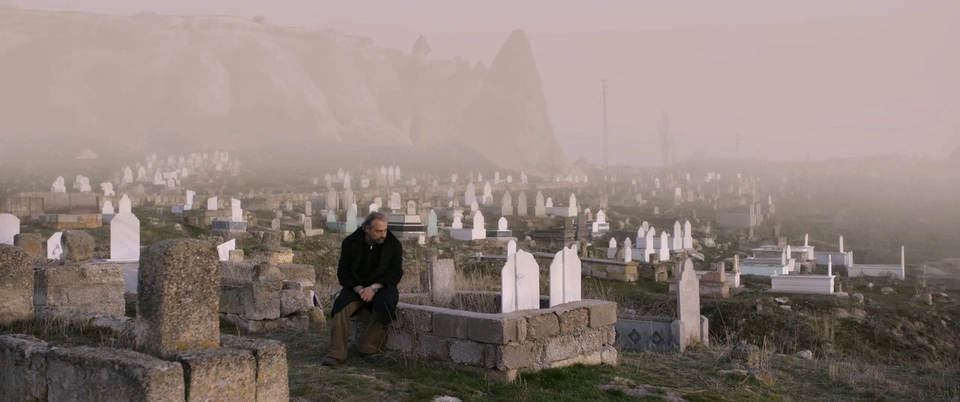
1. Let the location argue with the character Mechanic: Long, critical conversations are staged in wide or medium shots where the environment dwarfs the speakers. In the study, the clutter of books and artifacts comments on Aydın's vanity and makes his pronouncements sound small. Application: On a contained production, cast your primary location as a third character in every dialogue scene and let the dressing carry subtext the dialogue never states. See production design on micro-budgets.
2. Give the listener the take Mechanic: During Aydın's self-justifying monologues, the camera often stays on Necla or Nihal. Their weary or contemptuous reactions become the scene's primary text. Application: Instead of defaulting to shot/reverse-shot, dedicate a full take to the listener alone. Denying the audience the speaker's face is what makes the words land. That is a coverage decision made in prep: see directing coverage without overshooting.
3. Build the scene around one motivated source Mechanic: Interiors are lit from a fireplace, a desk lamp, or a window. The low-key, high-contrast result carves faces out of darkness and lets shadow conceal as much as light reveals. Application: Light with a single inexpensive practical and shape the darkness around it with subtraction rather than adding units. See practical lighting and negative fill mastery.
4. Lock the camera off and let it become a cage Mechanic: During the most intense arguments the camera sits on sticks and refuses to pan or reframe as characters shift and gesture. The rigid frame traps them. Application: Resist the impulse to follow every movement. A locked frame builds tension precisely because it will not accommodate the actor. Rehearse the blocking to the frame instead of the frame to the blocking: see camera movement and blocking.
5. Score the room, not the emotion Mechanic: Beneath the dialogue sits the Anatolian wind, the creak of floorboards, and the echo in stone hallways. There is effectively no non-diegetic music in the film's key confrontations. Application: Record extensive wild tracks and room tone at every location, then build a dense bed that communicates emotional climate without a cue. See sound design for film.
6. Stay past the climax Mechanic: Scenes continue well past their dramatic peak. An argument does not end on the sharpest retort. It trails into bitter silence, awkward gestures, and the mundane business of clearing a table. Application: When cutting a confrontation, try holding the shot after the action resolves. The aftermath is usually where the character actually shows. See the complete guide to film editing workflows.
The Film in the Canon
Winter Sleep sits inside a longer argument about duration, terrain, and the seriousness of ordinary talk. Read it against The 400 Blows, which reaches an equally interior result through movement and compression rather than stillness and length, and against Aguirre, the Wrath of God, where an indifferent terrain does comparable work to Cappadocia while the production method could hardly be more different. For the use of real time as a moral instrument, Jeanne Dielman is the closest relative. Among directors, Ingmar Bergman is the direct ancestor, and Tarkovsky and Godard on the image of a dying world marks out the terrain tradition Ceylan inherits. Filmmakers planning a festival run for work in this register should read our festival strategy guide.
How to Watch It
Watch it in one sitting. The 196 minutes are the argument, and splitting the film across two evenings dismantles the cumulative pressure that makes the third hour work. Stream it on MUBI or find a Blu-ray edition that carries the full length. Anything markedly shorter than 196 minutes is a cut or a mistimed transfer. Watch in a dark room with the phone out of reach, because the image lives in shadow detail that ambient light destroys and the sound design works at a level a television speaker will flatten.
On a first pass, let the performances carry you and resist the urge to anticipate where an argument is going. Ceylan's scenes rarely arrive where their opening beat suggests, and the pleasure of the film depends on being wrong about people in the same way the characters are.
On a second pass, run a long conversation with the picture off and listen only. You will hear how completely the film refuses music, and how much emotional information is carried by fire, wind, and the space between lines. Then run the same scene muted and watch the listener rather than the speaker. Count how often the cut lands on a reaction instead of on a line, and note how rarely anyone gets up.
For comparison, watch Bergman's Scenes from a Marriage (1973) for the precedent in extended verbal combat, Antonioni's L'Avventura (1960) for terrain as psychology, and Ceylan's own Once Upon a Time in Anatolia (2011), which solves a related durational problem with an entirely different structure.
Sources and Further Reading
Books and Scholarship
- Chekhov, Anton. The Wife and Other Stories. Translated by Constance Garnett. The collection containing the source material Ceylan drew on most directly. Find it
Book links above are Amazon affiliate links. BlockReel may earn a small commission on purchases at no extra cost to you.
Primary and Archival Sources
1. Festival de Cannes, official film record for Winter Sleep
---
© 2026 BlockReel DAO. Film Studies series. Licensed under CC BY-NC-ND 4.0. No AI training use permitted: this work may not be used to train, fine-tune, or evaluate machine learning models without written permission.