Emmanuel Lubezki: Natural Light, Long Takes & Cinematography
> This study contains affiliate links. BlockReel may earn a small commission on qualifying purchases at no extra cost to you. All commissions go directly toward funding our DAO Film Festival and supporting independent filmmakers.
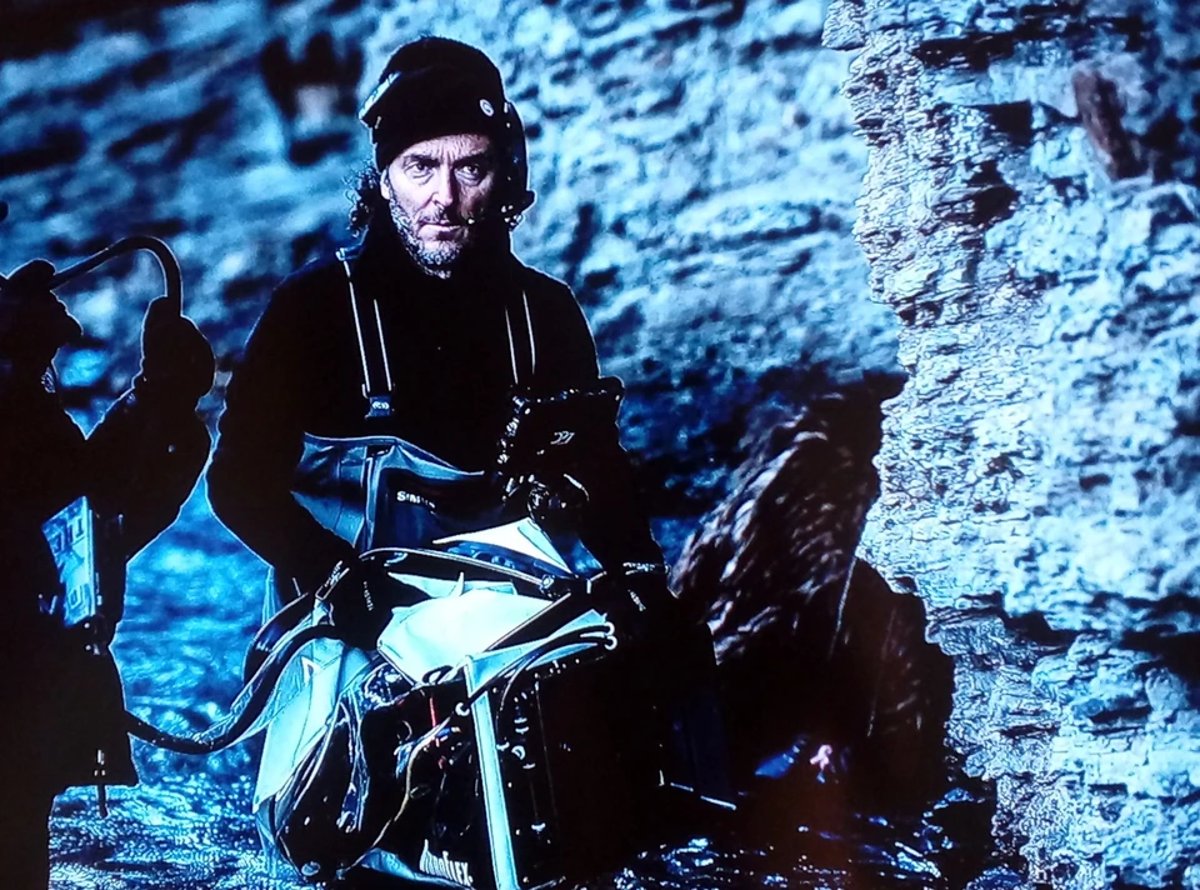
The lens is cold. It registers the sting of frozen air, the wet splatter of mud, the condensing fog of a human gasp. This is the sensory grammar of Emmanuel Lubezki's late-period work, a cinematography that trades the observer's safe distance for the participant's vulnerable proximity. Watching the Bexhill battle in Children of Men (2006), you feel less like a spectator than like a war correspondent whose camera has been commandeered by the event itself. Blood hits the glass and nobody wipes it. In The Revenant (2015), the camera is not documenting Hugh Glass's ordeal so much as shivering alongside him, its front element catching the low winter sun and the panicked breath of a man past the end of his endurance.
Lubezki, in his collaborations with Alfonso Cuarón, Terrence Malick, and Alejandro G. Iñárritu, uses wide-angle lenses not for establishing shots but for radical intimacy. He puts a lens in the 12mm to 21mm range inside an actor's personal space, a choice that classical portraiture treats as a violation, distorting features and stretching the background. The effect is not caricature. It is immersion. The proximity places the viewer inches from a character's consciousness while keeping the hostile world in full, terrifying view. The camera stops being a window. It becomes a nerve ending.
The Arc
Emmanuel Lubezki Morgenstern, ASC, AMC, known throughout the industry as Chivo, was born in Mexico City in 1964. His formation in the Mexican film scene of the late 1980s, particularly his early work with Alfonso Cuarón on the comedy Sólo con tu pareja (1991), already carried a dynamic, character-centric instinct. Arriving in Hollywood, that sensibility was first adapted to more classical modes. His American debut with Cuarón, A Little Princess (1995), is a work of rich magical realism, its controlled studio elegance a world away from the raw naturalism to come. The film shows a mastery of the traditional kit: soft sources, careful compositions, a storybook palette. His work on Tim Burton's Sleepy Hollow (1999) proved his range again, delivering a calibrated gothic atmosphere out of desaturated color, hard contrast, and manufactured fog, an exercise in total environmental control.
The decisive break arrives with his first Terrence Malick collaboration, The New World (2005). The rigid architecture of studio cinematography is deliberately dismantled. Lubezki and Malick pursued a fluid, improvisational method built around available light, a preference for back and side light, and a camera that rarely settles. This was not the choreographed ballet of a locked-off Steadicam move but a searching, questioning motion, often handheld, that seemed to find moments at the same instant the characters did. The approach was pushed further on The Tree of Life (2011), where the crew worked almost entirely with daylight and practical sources, blocking scenes around the sun rather than the other way around. Malick gave Lubezki a new set of questions and a license to prioritize sensory experience over narrative efficiency.
That method, forged inside Malick's philosophical filmmaking, found its most muscular expression in a run of films with Cuarón and Iñárritu. Children of Men is the pivot. Its long takes, including the roadside ambush, are not feats of bravado for their own sake. They are a narrative strategy. By refusing to cut, Lubezki and Cuarón deny the audience the psychological relief of a new angle. We are stuck in the car, experiencing the chaos in an unbroken present tense. The camera is a witness rather than an omniscient narrator, its movement dictated by the frantic logic of survival.
If Children of Men locked the viewer into a terrestrial nightmare, Gravity (2013) pushed them into an orbital one. The technical problem was how to put believable, constantly moving light on actors who were supposed to be spinning above a rotating Earth. The answer was the Light Box, a cube of LED panels built with visual effects supervisor Tim Webber and the team at Framestore, which surrounded the performer with projected imagery of Earth, sun, and starfield so the light on a face came from the environment itself. Robotic camera arms supplied by Bot & Dolly executed repeatable moves inside that box. Here the long take does something different from Children of Men. The seamless shots create a sense of perpetual, weightless motion that mirrors Dr. Stone's disorientation, detaching from her point of view to float in the void and then reattaching, blurring the line between a character's experience and the indifference of space.
The single-shot conceit of Iñárritu's Birdman or (The Unexpected Virtue of Ignorance) (2014) is the most theatrical use of the technique. The film, assembled from a series of extended takes joined by hidden transitions, creates the illusion of one unbroken shot moving through the backstage corridors of Broadway's St. James Theatre, which plays itself. The unrelenting forward momentum of the camera becomes a reading of the character: a desperate, recursive quest for relevance with no exit and no pause for reflection. The coordination between camera, blocking, and practical lighting cues was by all accounts punishing, but the aesthetic result is what lasts. The film becomes a durational performance piece.
The run culminates with The Revenant (2015), which fuses the naturalism of the Malick films with the physical intensity of the Iñárritu and Cuarón work. Shooting in remote locations in Alberta and later in Argentina, the production committed to daylight and firelight only. Lubezki's choice to hold extremely wide lenses close to faces became the film's signature. That proximity, catching every pained breath and fleck of snow on Leonardo DiCaprio's face, coexists with a panoramic awareness of the terrain. The camera is intimate and epic at once, inside the suffering and dwarfed by the wilderness.
The Oscars followed in an unprecedented sequence: Gravity at the 2014 ceremony, Birdman in 2015, The Revenant in 2016, making him the first cinematographer to win three consecutive Academy Awards for Best Cinematography out of eight career nominations. His output since has been more selective. He returned to Malick for Song to Song (2017), and in 2024 he reunited with Cuarón on the Apple TV+ limited series Disclaimer, sharing the cinematography credit with Bruno Delbonnel, ASC, AFC, in an unusual structural arrangement where each cinematographer photographed a different narrative timeline. (Bardo, False Chronicle of a Handful of Truths, Iñárritu's 2022 feature, was photographed by Darius Khondji, not Lubezki, a credit that is frequently misattributed.)
Signature Techniques
Lubezki's work is defined by a set of choices that reinforce one another rather than standing as separate tricks. The desire for a long unbroken take demands a mobile camera. A mobile camera on wide lenses creates a particular relationship between character and environment. And a reliance on available light grounds the whole elaborate apparatus in something tangible.
The Immersive Long Take
!Image Children of Men (2006)
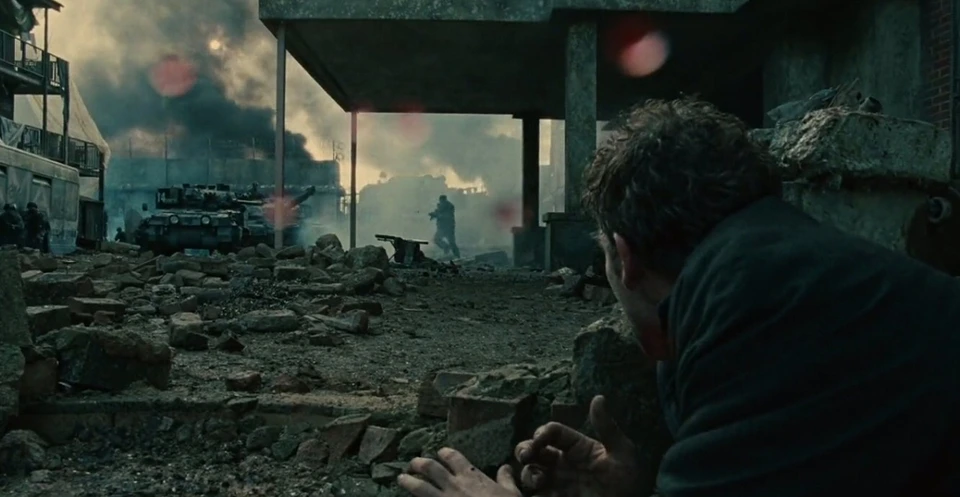
No contemporary cinematographer is more associated with the extended take. But reading his work as technical virtuosity misses the point. His long takes are instruments for generating sustained subjective presence. The goal is to collapse the distance between viewer and event, forcing a real-time experience of duration and pressure.
In Children of Men, the ambush places the camera as a fellow passenger, unable to look away. The shot is a blend of in-camera choreography and digitally joined plates, but its effect is one of horrifying continuity. The camera pivots frantically, catching attackers and reactions, and the lens is fouled in the process. A similar logic governs the Bexhill sequence, where the camera follows Clive Owen through a war zone for minutes at a stretch. We are not watching a battle. We are getting through it with him.
Birdman takes the principle to its conclusion. The camera's constant gliding motion through tight corridors becomes a physical manifestation of Riggan Thomson's trapped state of mind. The hidden cuts, masked by whip pans and moments of darkness, matter less than the feeling of uninterrupted time. This is worth setting against the contemplative long takes of a filmmaker like Tarkovsky, covered in our Andrei Tarkovsky master study, which ask for reflection on time itself. Lubezki, particularly with Iñárritu, uses duration to generate anxiety. Both approaches live or die on floor rehearsal, which is its own craft discipline and one we break down in camera movement execution.
Wide-Angle Proximity
!Image Leonardo DiCaprio in The Revenant (2015)
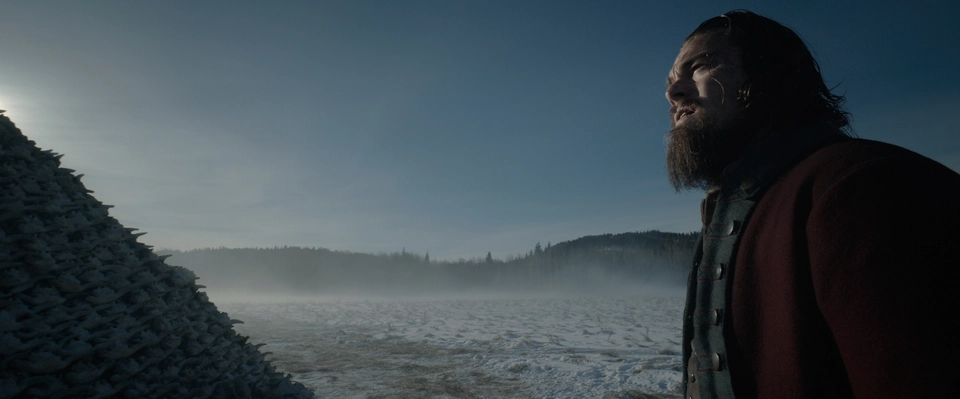
His camera consistently favors extremely wide lenses positioned startlingly close to actors, creating a spatial distortion that reads as both intimate and overwhelming. Where a cinematographer working in a more classical register might reach for a 35mm or 50mm to build a naturalistic portrait, as we discuss in Lens Selection Mastery, Lubezki's wide approach pulls the viewer into the character's personal space and keeps the world in the same frame.
The proximity captures every flicker of expression while the field of view guarantees the surrounding environment stays present, usually looming. In The Revenant, this is fundamental to the film's physicality. During the bear attack, the wide lens keeps Glass and the animal in the same frame, denying the audience the comfort of analytical cutting. The proximity is so extreme that his breath fogs the glass, a recurring motif that functions as a raw assertion of presence. The optical side effects that a rental house would normally treat as flaws, the stretched edges and the falloff, become expressive material here, a subject we go deeper on in harnessing lens breathing, distortion, and falloff.
Read philosophically, the character is never separate from their environment. They are engulfed by it. In Children of Men, as Theo runs through the besieged building, the lens holds the chaos, the soldiers, and the crumbling architecture while staying on his face. Subject and context become one visual unit.
The Doctrine of Natural Light
A defining characteristic of the Malick and Iñárritu work is a commitment to natural and motivated light that shapes the entire production, not just the lighting plan. On The Tree of Life, the scheme feels discovered rather than imposed. Scenes were blocked and shot according to the sun, with the crew chasing the last usable hour of the day to lend the domestic material a sense of grace. The light behaves like a participant, pouring through windows and picking out dust.
The Revenant is the most extreme application. The production committed to daylight and firelight, which restricted the crew to a narrow usable window each day in punishing winter conditions. The reward was a texture nobody could have built with units. Low winter sun, diffused through overcast or large silks, wraps the characters in something soft, cold, and unforgiving. The ARRI Alexa XT, Alexa M, and Alexa 65 package, run with fast glass, made images possible at levels that would have been out of reach on stock.
This inverts the studio model. Instead of bringing lights to the actors, the actors and the camera move to the light. It demands flexibility from every department and a willingness to abandon the plan for a momentary opportunity. If you want the underlying theory rather than the anecdote, our piece on what we are really chasing with light and lens covers the reasoning, and A Tyranny of Windows shows the same principle running through Jeanne Dielman on a fraction of the budget.
The Disembodied Camera
His camera is rarely static. It glides, floats, and weaves with a fluid, almost spectral grace. This is not the nervous handheld of the Dardenne brothers or the verité shake of Paul Greengrass, a distinction we get into in cinematic handheld. It is a controlled, disembodied perspective built on Steadicam, cranes, and later lightweight gimbals, and it often reads as its own character.
In The Tree of Life, the camera detaches from any single point of view, drifting through the rooms of the family house and across the lawns. It moves with the logic of memory, catching fragments of conversation and gesture. On Gravity the quality reaches its apex. For long stretches the camera is entirely virtual, a product of previsualization and computer graphics, executing moves no physical rig could perform. In one moment it is locked inside Dr. Stone's helmet, in the next it pulls back to an impossibly wide shot against the Earth. That ability to attach to and detach from a body inside one continuous movement is the engine of the film's visual grammar.
Case Study: Children of Men
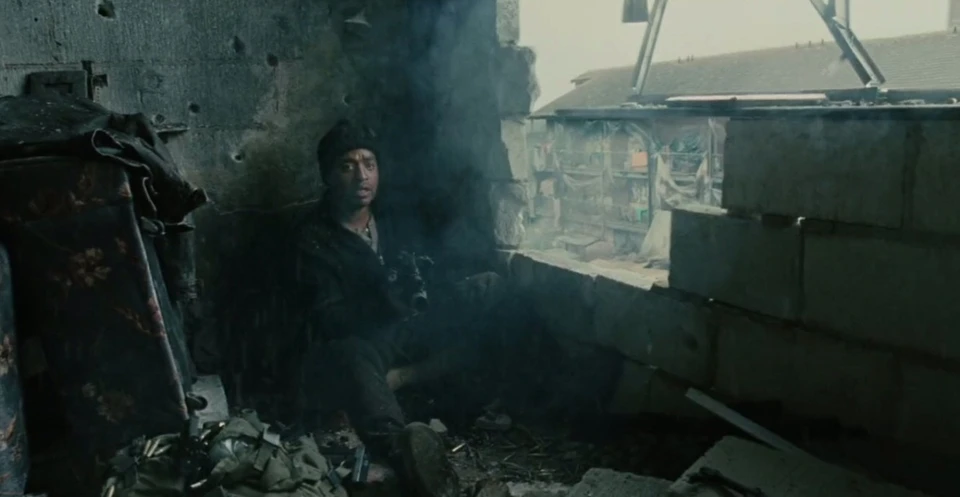
Cuarón's Children of Men did not invent the long take, but it put it to work for a generation of popular filmmaking. The formal project was to weld the camera to the protagonist's subjective experience with a ferocity few thrillers had attempted. Filmmakers still reference it, not for bravado but for the completeness with which form and function fuse. The camera's perspective is not a stylistic layer on top of the story. It is the narrative engine.
Two sequences carry the influence: the roadside ambush and the Bexhill battle. For the ambush, the production worked inside a modified Fiat Multipla, running roughly twelve script pages as an apparent continuous take. Doggicam Systems built the specialized rig that let the camera travel the length of the car and rotate between actors with no operator in frame. As documented in detail by fxguide, the finished shot is composited from multiple takes, which is itself the lesson for practitioners. The goal was never dogmatic purity in achieving one unbroken pass. It was the construction of a sustained, unbreakable subjective experience. When Julian (Julianne Moore) is shot, the camera does not cut to a reaction from Theo (Clive Owen). It stays, whipping around in the same panicked confusion he feels.
That methodology changes performance and blocking. Actors cannot rely on an editor to assemble a performance out of coverage. They have to sustain intention through long, physically demanding choreography, which puts real weight on the rehearsal process covered in our guide to camera movement and blocking. The camera becomes a scene partner. It flinches, it ducks, it moves on the same survival instinct as the characters.
The Bexhill sequence scales the principle up. As Theo works through the war-torn building, the camera is an exhausted participant. It follows him up stairs, takes cover, and gets splattered. That blood on the lens was an accident on the day, and Lubezki and Cuarón chose to keep it. It is the film's philosophy stated in one frame: the apparatus is not invisible or clean, its limitations become part of the texture, and there is no objective view of this world. Every perspective is obscured by the violence it witnesses.
What can a working filmmaker take? Mostly the power of restricted point of view to generate suspense and empathy. By refusing to grant a wider, more objective perspective, the film traps the audience in the immediate sensory reality of its protagonist. Every piece of information arrives as Theo gathers it. The wide lenses are used for claustrophobia rather than vistas, keeping the hostile environment sharp and pressing in. The background is never passive. It is a field of active threats.
Case Study: The Tree of Life
!Image Jessica Chastain in The Tree of Life (2011)
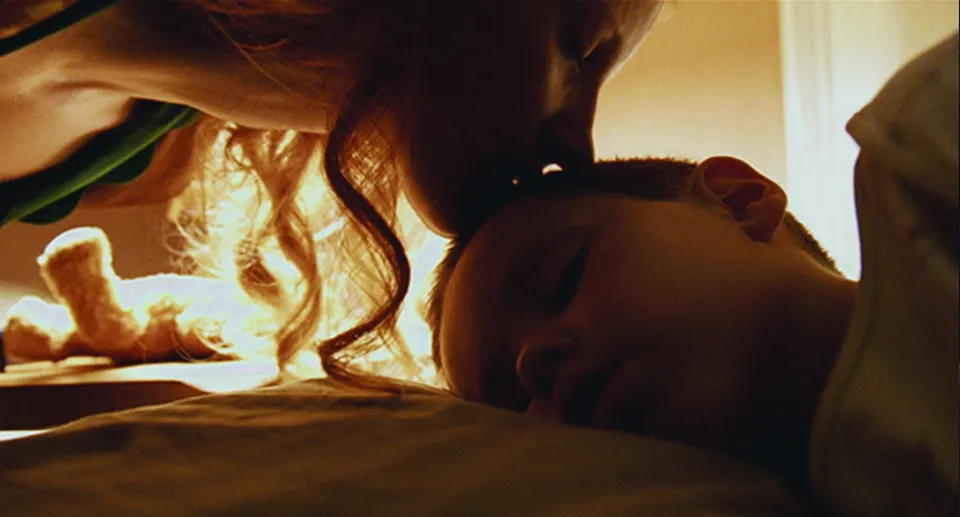
If Children of Men is choreographed chaos, Lubezki's work on Malick's The Tree of Life is an embrace of the unplannable kind. The film required a shift from master of execution to seeker of found moments, and it offers a radically different model for visual storytelling.
The collaboration was governed by principles designed to strip away artifice. The crew worked with available light, shooting on 35mm with Jörg Widmer operating Steadicam. If a room was dark it was played dark, or characters were blocked toward a window. That restriction changed the process at its root. Rather than designing shots and lighting them, the small mobile crew followed the light and the actors through the space. Anyone who has tried to work this way in a real location will recognize the trade-offs, which we cover from the practical side in working fast in small spaces.
You see it in every scene with the O'Brien family. The camera drifts through the house with the fluidity of a memory, not holding static compositions but discovering things: light on a curtain, the texture of a dress, a child's expression before it resolves. The wide lenses serve an intimate, psychological function rather than a grand one. Rooms feel vast, adults tower, and the distortion at the edges suggests the way memory bends a room out of true.
The process on set was one of organized discovery. Malick gave the actors, particularly the children, freedom to move and interact inside the emotional parameters of a scene while the camera searched for something true. It is closer to documentary practice than to conventional narrative production. The goal was not to execute a storyboard but to build conditions where authentic moments could occur and be caught, trading the security of coverage for the possibility of serendipity.
Studying the film is less about a lighting diagram and more about absorbing a position. Does a scene have to be built from shot and reverse shot to be understood? Can a visual language be constructed from light, movement, and gesture rather than plot-driven compositions? The aesthetic does not suit every story, and the method is hard to replicate without a director willing to shoot at that ratio. But its influence runs through a whole school of naturalistic cinematography that followed.
Collaborators
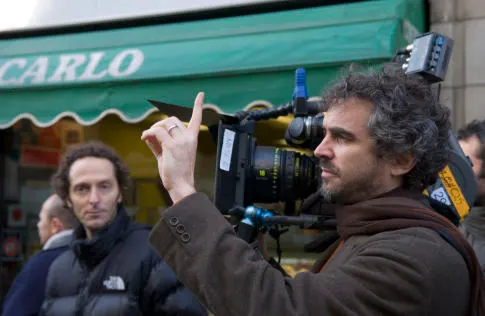
A cinematographer's work is inseparable from their key relationships. For Lubezki these partnerships are the conditions under which the aesthetic gets made.
The most defining is with Alfonso Cuarón. Their shared history, beginning in Mexico, matured into a technical and artistic dialogue conducted over three decades. On Children of Men, their joint commitment to the immersive take redefined what an action sequence could feel like. On Gravity, the ambition required inventing tools, and the Light Box developed with Tim Webber and Framestore solved the problem of how to put moving, environmentally accurate light on a face in a vacuum. On Disclaimer (2024) the two split the show with Bruno Delbonnel, each cinematographer taking a separate timeline so that the shift in perspective would be legible as a shift in image.
The Iñárritu partnership produced two of the three consecutive Oscars. On Birdman, the continuous-shot conceit was a formal dare, and the execution turned a technical constraint into a narrative device. Editor Stephen Mirrione was central to it, since the rhythm had to be constructed in previsualization and on the floor rather than found later. On The Revenant, the challenge moved from temporal continuity to environmental authenticity. Production designer Jack Fisk, a long-standing Malick collaborator, built period-accurate forts and settlements in remote country, giving Lubezki a tangible world. The mandate to shoot with natural light forced the whole production to bend to the sun.
The Malick work is the third pillar and the most contemplative. From The New World through The Tree of Life and Song to Song, Lubezki moved away from conventional scene lighting entirely. Guided by Malick's curiosity and by Fisk's sets, built to function from any angle, the camera became a free-roaming consciousness looking for ephemeral moments rather than narrative beats.
Earlier, Tim Burton on Sleepy Hollow (1999) drew out the opposite instinct: a high-contrast, desaturated, controlled look that proved Lubezki was not a stylist with a single mode but an interpreter of a director's intent.
Critical Reception and Counter-Readings
The consensus around Lubezki borders on reverence. For many he is the preeminent cinematographer of his generation, a technician whose innovations measurably shifted the visual language of contemporary film. Three consecutive Academy Awards served as the industry's coronation. Critics from American Cinematographer to Sight & Sound have praised his ability to merge technical ambition with sensory experience.
No artist at that level escapes friction. The virtuosity that draws praise is also the target. David Bordwell's account of intensified continuity, the modern Hollywood system of fast cutting, tight framing, and restless camera built for maximum visceral impact, offers the sharpest frame for the argument. Lubezki's long takes in Children of Men and Birdman read as a direct challenge to that paradigm, an attempt to restore spatial and temporal integrity to a scene. But a counter-reading from the same formalist position asks whether the self-announcing complexity of these shots performs a similar function. Does the spectacle of the unbroken take, in its demand for admiration, become its own kind of intensification?
That leads to a broader question about technology and humanism in the Cuarón and Iñárritu films. The problems solved on Gravity and The Revenant were genuinely hard, but the public discourse around both films skewed heavily toward how the shots were achieved rather than what they meant. The risk is that the apparatus becomes the main event. When a viewer's first response is a question about the rig rather than about the character, the technology has stopped being a tool.
A more specific line of inquiry surrounds the imagery in Gravity, particularly the shot of Dr. Ryan Stone (Sandra Bullock) floating in a fetal curl inside the airlock. On one reading, that is a legible symbol of rebirth and survival. On another, taken up in Wai Chee Dimock's essay "Umbilical Cords" for the Los Angeles Review of Books and in reviews across the American press, the image risks reducing a highly specialized scientist to a primal biological state at the exact moment of reprieve, re-inscribing an association of the female with the maternal that sits awkwardly against a portrait of professional competence. The image is doing several things at once, and the disagreement about which of them dominates is genuine rather than manufactured.
Finally, the naturalism of the Malick and Iñárritu films invites its own skepticism. Is the pursuit of authentic light and real conditions on The Revenant a window into reality, or a highly controlled performance of authenticity? The sunsets and flares of The Tree of Life are undeniably beautiful, though for some critics that beauty floats free of its subject. At what point does the rigorous rejection of artifice become its own mannerism? These questions do not shrink the achievement. They suggest the relationship between his images and the reality they claim is more contested than the awards record implies.
What Working Filmmakers Should Steal
1. Wide lenses, close subjects Lubezki routinely breaks the textbook rule that wide lenses establish and long lenses flatter. He brings glass in the 12mm to 21mm range into intimate proximity with actors. The technique embeds a character in their environment, because the background is not soft scenery but a sharp, active presence sharing the frame. In The Revenant, Glass's suffering is permanently framed by the wilderness that is about to kill him. On a small production this costs nothing beyond the courage to put the lens closer than feels polite, and it demands that your background be dressed and blocked, because everything in it will read.
2. Light with one justification This is motivated lighting pushed to its endpoint. Rather than building a key, fill, and back light, design the blocking and the location around a single defensible source: a window, a fire, a monitor, a streetlamp. The Children of Men ambush leans on real exterior ambience and small hidden practicals inside the car. The result feels less like a lit scene than a captured event.
3. Make the camera hand off A Lubezki long take is rarely just a proficient Steadicam move. Inside one shot the camera may adopt a character's subjective view, pull back to observe them, then detach to follow someone else or reveal information. The Bexhill battle is the canonical example: it finds Theo, loses him, attaches to soldiers, drifts up to discover Kee, and descends again. It behaves like a reporter whose allegiance shifts with the action.
4. Use digital for sensitivity, not polish An early adopter of the digital intermediate, he tends to use digital tools against the grain of clean imagery. Modern sensors let him work at light levels that were impossible on stock, and the grade then finds and shapes what was captured in near-darkness rather than brightening it into safety. The firelight scenes in The Revenant are the reference. If you want to work this way, the grade has to be planned before the shoot, not discovered after, which is the argument behind building a LUT pipeline and behind talking to your colorist early.
5. Invent the tool when the tool does not exist When no conventional rig achieves the shot, build one rather than compromising the shot. The Light Box on Gravity and the Doggicam car rig on Children of Men are both the same instinct at different budgets. On a small production this scales down honestly: a custom bracket, a shop-built diffusion frame, a modified filter, a practical wired to a dimmer board.
6. Block for the focal plane, not for coverage In a continuous take there is no editor to fix a missed mark, so depth becomes the cutting mechanism. Staging in Birdman repeatedly moves characters toward and away from the lens to change who dominates the frame, which is functionally a cut performed with blocking. Rehearse the depth changes with the focus puller present, and treat each shift in the focal plane as an edit you have chosen to make in camera.
7. Let the day dictate the schedule Chasing the sun is a scheduling decision before it is an aesthetic one. It means shorter shooting windows, a smaller and faster crew, exteriors held in reserve for the moment the sky turns, and a first assistant director who will defend the plan. Any production can adopt the discipline. Very few are willing to give up the certainty of a lighting truck to do it.
How to Watch It
Watch in this order rather than by reputation. The sequence tracks how he moved from photographing stories to inhabiting them.
1. A Little Princess (1995) for the classical foundation. Note how much control there is here, so you can measure what he later gave up on purpose.
If you want the same treatment applied to cinematographers with different temperaments, our Roger Deakins master study covers restraint and motivation, and our Vittorio Storaro master study covers color as an authored system.
Sources and Further Reading
Recommended Books
- Schaefer, Dennis, and Larry Salvato. Masters of Light: Conversations with Contemporary Cinematographers. University of California Press.
Research References
1. Third in a Row: Emmanuel Lubezki Wins Oscar for The Revenant - American Cinematographer
---
© 2026 BlockReel DAO. Master Studies series. Licensed under CC BY-NC-ND 4.0.